NR-328 Pediatric Nursing carries three theory credits and one clinical credit across 48 clinical hours, covering family-centered care of children from infancy through adolescence, normal child care and health alterations, with participation in a multidisciplinary team. In writing, the course grades one thing above all others: whether your work is anchored to a developmental stage. A plan that would read the same for a nine month old and a fourteen year old has failed before the clinical content is even considered.
What NR-328 actually grades
Three axes appear in nearly every scoring guide students send us. Developmental fit, meaning the assessment approach, the teaching method and the safety guidance all match the age in front of you. The caregiver as a second learner, since the person who executes the plan at home is rarely the patient. And team participation, because the catalog puts the multidisciplinary team in the course description and the guides usually put it in a row, which students discover after submitting a paper with no other discipline in it.
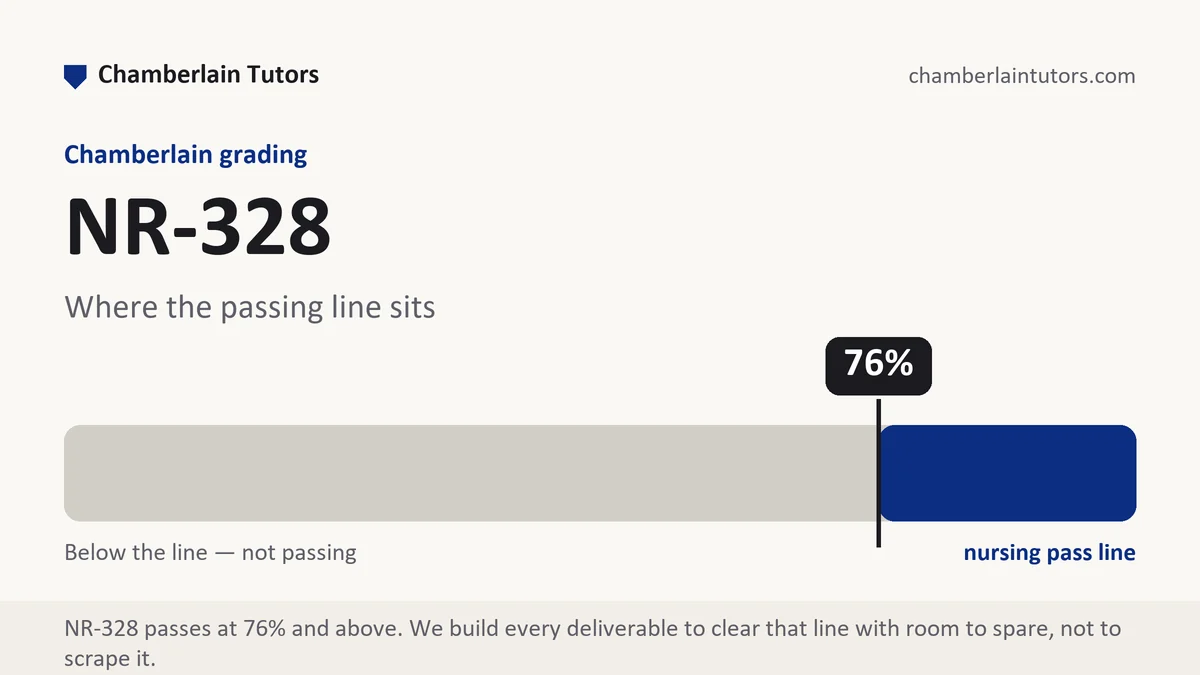
The 76 percent floor for core nursing courses applies here as elsewhere. What makes this course deceptively risky is familiarity: adult content transfers well enough that students write adult papers with pediatric nouns, and those papers land in the seventies with comments about developmental considerations that never become clearer on the second attempt.
How we help in this course
We write pediatric case analyses, family teaching plans, growth and development papers, safety and anticipatory guidance work, medication and pathophysiology write-ups adjusted for the age band, board responses and reflections. The pattern our drafts install is simple to describe and hard to sustain alone: every recommendation states the age it is for and changes if the age changes.
The 48 clinical hours belong to you. We do not attend a site, contact anyone connected to your placement, sign or fill any document, or record hours. The written work is the part we carry.
In NR-328 right now?
Send the week and the rubric from Canvas. First premium sample free, floor-checked, back in 24 to 48 hours.
Read the rubric before the prompt
Pediatric assignments hide their weights in plain sight. Copy the criterion rows into a blank file, cut each to its verb, assess, adapt, teach, coordinate, evaluate, and look specifically for a row that mentions development or family. Those two rows are where pediatric papers are won, and they are frequently heavier than the clinical content row students spend their week on.
Convert to words before you draft. A 1,250 word teaching plan with rows at 35, 30, 20 and 15 percent gives roughly 440, 375, 250 and 190 words. Suppose the 35 percent row is developmental adaptation. That means more than a third of the paper should be about how this plan is shaped by the child's stage, not one bracketed sentence noting the age. Most drafts we see spend under a hundred words there and then wonder where the points went. Reference list and any appendix sit outside the count unless your guide says otherwise.
Keep the targets in brackets beside your headings. If the developmental section will not fill, the reason is usually that you named a stage without using it, which is the same error the grader is about to circle.
One step before drafting saves a rewrite. Write the child's exact age in months or years at the top of the page, then write three things that age can do and two things it cannot, and keep the list beside you while you draft. Every teaching method, every safety point and every assessment approach in the paper should be checkable against that short list. Papers that skip this step tend to describe a generic child, then have the developmental content added afterwards as a paragraph, which is exactly the shape graders identify as adult work with pediatric labels.
The shape of a family teaching plan
The dominant deliverable here is a teaching plan or a case analysis that ends in one. These parts recur, and each has a job.
| Part | What it has to prove | The weak version |
|---|---|---|
| Child and stage | Age in months or years plus the developmental characteristics that will shape everything below. | An age stated once and never used again. |
| Caregiver profile | Who provides care, what they already know, what they can realistically do at home. | Parents present, with no capability or barrier named. |
| Learning need | The specific gap this family has, drawn from the assessment rather than from the diagnosis. | A topic that would apply to every family with this condition. |
| Method matched to age | How you would teach the child, chosen for their stage, alongside how you teach the caregiver. | A single explanation delivered to the room at large. |
| Safety and anticipatory guidance | The hazards of this stage, not of childhood generally, tied to the home described. | Generic advice that ignores whether the child crawls, climbs or drives. |
| Team involvement | Which disciplines are involved, what each contributes, and what you would communicate to them. | A mention of the healthcare team as one undifferentiated body. |
| Evaluation | How you would know the teaching worked, with the caregiver demonstrating or restating. | Understanding verbalized, recorded with nothing behind it. |
Evidence and citation craft at this level
Pediatric evidence is banded by age, which makes careless citation more visible here than in adult courses. Four habits carry the difference.
Currency, and a stated reason for older work. Guidance on sleep, feeding, screen exposure and injury prevention is revised often enough that a source past five years needs justification in the sentence. Developmental theory that defined a stage is fair to cite at any age, provided you say that is why you reached for it.
Design, sample and age band before the finding. Announce all three: "in a cohort of 4,200 children aged 2 to 5 years". A finding drawn from adolescents cannot be quoted in a paragraph about toddlers, and the age band is the part students drop when trimming a sentence for length.
Association verbs unless the study was controlled. Screen time, feeding practice and behavior research is overwhelmingly observational, so write "was associated with" and "occurred more often among". Causal phrasing in a pediatric paper reads as advice to a parent, and graders mark it accordingly because that is how a family would hear it.
Denominator, window and age group before any rate. Write "roughly 3 of every 100 of the 1,900 infants followed to 12 months had the outcome" rather than "3 percent were affected". Pediatric rates shift sharply between age bands, so a figure without its band is not usable in a plan and a grader marking the support row will say so.
What separates a passing plan from a strong one
A passing NR-328 plan is clinically fine and developmentally silent. It states the child's age, describes the condition accurately, and offers teaching that any competent nurse would recognize. It sits in the high seventies or low eighties because it treats the child as a small adult with a caregiver attached.
Strong plans do three things. They let the stage change the method, so the paper explains how you would explain a procedure to a preschooler through play and to an adolescent through autonomy and privacy, and the difference is visible on the page. They teach the caregiver as a distinct learner with their own barrier and their own evaluation. And they name a second discipline concretely, saying what you would ask the dietitian, the child life specialist or the school nurse and what you would want back, which is what team participation looks like in writing. Method that bends with age, a caregiver taught separately, a named colleague with a specific request.
Mistakes that cost points here
- An adult plan with pediatric nouns. If the plan would work unchanged for a 40 year old, the developmental row scores at the bottom regardless of clinical accuracy.
- Age stated but not applied. Naming a stage is not using one. Every teaching method and safety point should visibly follow from the stage you named.
- Talking past the caregiver. The person who administers care at home needs their own learning need, method and evaluation, not a share of the child's.
- Generic safety guidance. Anticipatory guidance is stage-specific by definition. Outlet covers and driving contracts are not interchangeable advice.
- The team as a vague noun. Name the discipline, the contribution and the communication. That row is unusually easy to score and unusually often left empty.
- Identifiers in a pediatric write-up. No initials, dates, room numbers, school names or distinctive family details. Describe by age band and situation.
Questions NR-328 students ask
How do I show developmental adaptation without writing a textbook summary of stages?
The assignment mentions the multidisciplinary team but my case only involved nursing. What do I write?
How specific should teaching evaluation be for a family?
Where NR-328 sits in Chamberlain's programs
Open the exact program map for sequence, credit, and option context. The current student schedule and syllabus remain authoritative after transfer evaluation, electives, state rules, and approved plan changes.
The weeks, one by one
Week 1
NR-328 opens where every pediatric course has to open: with the recognition that the patient is a child and a family at the same time, and that assessment findings only mean something against a developmental baseline. Read the full Week 1 manual.
Week 2
The second stage of a pediatric arc usually belongs to the well child: health promotion, immunization schedules, safety and anticipatory guidance across the age bands. Read the full Week 2 manual.
Week 3
By the third stage a pediatric arc usually moves indoors: the hospitalized child, the stress admission places on a family, pain assessed with age-matched tools, and medication safety recalculated for bodies measured in kilograms. Read the full Week 3 manual.
Week 4
The middle of a pediatric arc usually turns to the alterations that fill children's hospitals: respiratory conditions first, because small airways make children deteriorate fast, with common infectious illnesses close behind. Read the full Week 4 manual.
Week 5
Deeper in the alteration weeks, pediatric arcs usually take up the conditions that reshape a family's whole life: congenital heart differences, the anemias and clotting disorders, and childhood cancer. Read the full Week 5 manual.
Week 6
Late-middle stages of a pediatric arc commonly cover the neurologic and musculoskeletal alterations, seizures, head injury, the mobility conditions, and widen into the child with chronic or special healthcare needs, where nursing shifts from fixing to sustaining. Read the full Week 6 manual.
Week 7
Toward the end of a pediatric arc the coverage often turns to the patients who complicate the frameworks: adolescents, whose care runs on autonomy, confidentiality and risk behavior, and the children whose presentations raise protection concerns, where documentation standards become the strictest in nursing. Read the full Week 7 manual.
Week 8
Closing stages of a pediatric clinical course usually converge on three strands: a final examination or standardized-style assessment across the whole arc, a reflective piece connecting the 48 clinical hours to the course outcomes, and the wrap-up of any remaining written work. Read the full Week 8 manual.