NR-327 Maternal-Child Nursing runs three theory credits and one clinical credit across 48 clinical hours, covering family-centered maternal and newborn care across the childbearing cycle, including high-risk factors, complications and additional women's health issues. The written work is unusual in one respect that decides most grades: almost every assignment is anchored to a stage. Antepartum, intrapartum, postpartum and newborn are not chapter headings here, they are the frame the grader reads through, and a paper that floats between them loses points it never sees coming.
What NR-327 actually grades
Whether you can say what is expected at a given point in the cycle, then say what would count as a deviation from it, then say what a nurse does about the deviation. That three-step sequence is the spine of nearly every case write-up in the course. It is also why memorized normals are not enough: the same finding can be expected in one stage and a warning in another, and the grader is reading to see whether you know which frame you are standing in.
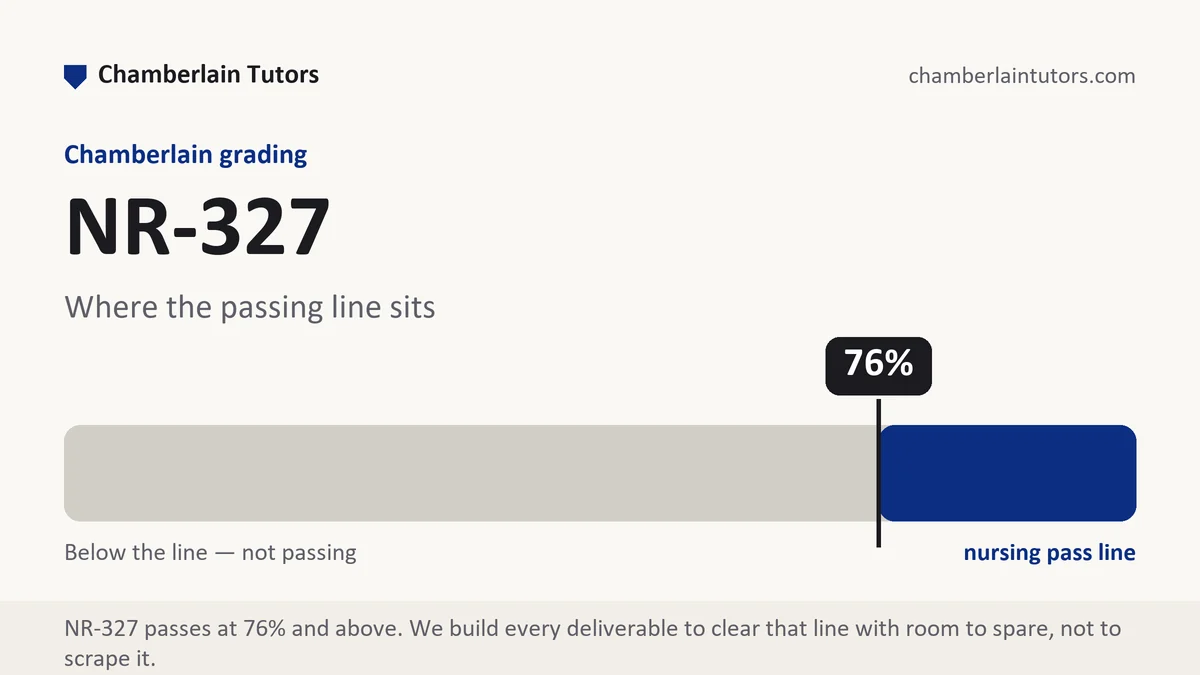
Family-centered is the second axis, and it is graded more literally than students expect. The catalog language puts the family at the center of care, so a paper that treats a partner or support person as background scenery misses a criterion row rather than a stylistic preference. Core nursing courses carry a 76 percent floor, and with a four-credit load and weekly writing running alongside clinical days, the margin is built out of ordinary submissions rather than the memorable ones.
How we help in this course
We write case analyses, stage-anchored care plans, risk factor papers, newborn assessment write-ups, teaching plans for discharge home with an infant, board responses and reflections. What the model drafts install is stage discipline: every claim in the paper carries a visible answer to the question at what point in the cycle.
Your 48 clinical hours are yours entirely. We do not attend, contact a site, complete placement documents or record hours. Everything we send is written work built to your assignment's scoring guide.
In NR-327 right now?
Send the week and the rubric from Canvas. First premium sample free, floor-checked, back in 24 to 48 hours.
Read the rubric before the prompt
Maternal-child assignments frequently carry five criterion rows rather than four, because the newborn is scored separately from the mother. Open the guide first, list the rows, reduce each to a verb, describe, differentiate, prioritize, teach, evaluate, and check whether one row belongs to the infant. That single observation reorganizes the paper.
Then convert weights to a budget. A 1,400 word case with rows at 30, 25, 20, 15 and 10 percent gives roughly 420, 350, 280, 210 and 140 words. If the 15 percent row is newborn transition and you wrote two sentences about the baby, you gave away 210 words of guaranteed points while spending 600 on maternal history the guide never asked you to expand. That is the most common misallocation in this course, and it comes from writing about the patient you talked to rather than the patients the rubric lists.
Keep budgets in brackets and hold them. A stage section that will not fill is usually a section where you have described the physiology but not said what a nurse assesses at that hour.
Before drafting, write the stage and the hour at the top of the page and leave it there while you work. Antepartum at 32 weeks, second stage of labor, four hours postpartum, day two of life: each of those frames makes different findings expected and different findings alarming. Papers that lose the stage do so gradually, usually in the risk factor section where the literature speaks in general terms, and by the nursing priorities section the writer is describing pregnancy rather than this pregnancy. A visible header at the top of the draft prevents the drift entirely.
The shape of a childbearing cycle case write-up
Most graded writing in NR-327 assembles from these parts. Each answers a question the grader will look for by name.
| Part | What it has to establish | The version that loses points |
|---|---|---|
| Stage named first | Exactly where in the cycle this case sits, stated before any finding. | A case that discusses pregnancy in general with no timeline. |
| Expected picture for that stage | What normal looks like at this point, so a deviation has something to deviate from. | Straight to the abnormality with no baseline established. |
| Maternal data | History, current findings and relevant values, tied to the stage. | An intake form transcribed without selection. |
| Fetal or newborn data | The second patient assessed in their own right, with their own findings. | The infant mentioned once at the end as an outcome. |
| Risk factors, stratified | Which factors are modifiable, which are historical, and which change this stage's plan. | An undifferentiated list copied from a chapter. |
| Nursing priorities for the stage | What is assessed, how often, and what finding would escalate care. | Generic monitoring with no interval and no threshold. |
| Family teaching | What the parents need to do at home, taught to the people who will actually do it. | Education topics listed with no learner named. |
Evidence and citation craft at this level
Obstetric and newborn literature is unusually easy to quote badly, because its numbers are stage-specific and its risk language is observational. Four habits keep a paper defensible.
Current guidance, with age argued when it lapses. Screening intervals, feeding guidance and safe sleep recommendations are revised regularly, so a source past five years needs a reason stated in the sentence. Anatomy and the physiology of labor are stable and can be cited from older texts with no apology.
Design and sample before the number. Say what produced the finding: "in a cohort of 14,800 singleton pregnancies" or "in a randomized trial of 320 laboring patients". Sample composition matters more here than almost anywhere, because a finding from one obstetric population may not transfer to another.
Association verbs for risk factors, always. Risk factor research in this field is observational. It supports "was associated with a higher rate of", "occurred more often among", "predicted". It does not support "causes", and writing that a factor causes an outcome is both a support error and a claim you would never make to a patient sitting in front of you.
Denominator and window before any rate. Obstetric rates are defined by their window, so carry it: "roughly 6 of every 100 of the 3,400 pregnancies studied developed the complication before 37 weeks" beats "6 percent developed the complication". Per pregnancy, per delivery and per live birth are different denominators, and using one while citing another is the error most often marked in these papers.
What separates a passing case from a strong one
A passing NR-327 case is correct and stageless. The facts are right, the risk factors are real, the plan is reasonable, and the whole thing could be moved two weeks earlier or later in the pregnancy without a single sentence changing. It scores in the low eighties, and the grader's comment is usually some version of tie this to the stage.
Strong cases do three things. They name the stage in the first paragraph and refer back to it whenever a finding is interpreted, so the reasoning is anchored rather than floating. They treat the newborn or fetus as a patient with an assessment of their own instead of as an outcome of the mother's. And they set thresholds, saying not only what is monitored but at what value or interval a nurse escalates, which converts a monitoring plan into a decision. Anchored stage, two patients, explicit thresholds.
Mistakes that cost points here
- Writing about pregnancy instead of a moment in it. Every interpretive sentence should be answerable with at what point, and a paper that cannot answer loses the heaviest rows.
- Forgetting the second patient. The infant usually carries a criterion row. Two sentences at the end will not satisfy it.
- Risk factors as a list. Sorting factors into modifiable, historical and immediate is the analysis; reproducing the textbook list is not.
- Causal language about risk. Observational evidence supports association only, and this course grades the distinction closely because of what the claims imply for patients.
- Family named but not used. Family-centered means the plan changes because of who is in the room. If the partner or support person never affects an action, the row scores as a mention.
- Identifiers in the write-up. No initials, delivery dates, room numbers or facility names, and particular care with details that would identify a family in a small community.
Questions NR-327 students ask
How much detail does the newborn section actually need?
My risk factor sections keep coming back marked as descriptive. What is the fix?
Can I use a patient I cared for during my clinical hours?
Where NR-327 sits in Chamberlain's programs
Open the exact program map for sequence, credit, and option context. The current student schedule and syllabus remain authoritative after transfer evaluation, electives, state rules, and approved plan changes.
The weeks, one by one
Week 1
NR-327 begins with its organizing philosophy and its first clinical territory at once: family-centered care as the lens, and the antepartum period as the ground. Read the full Week 1 manual.
Week 2
The second stage of NR-327 typically settles into the long middle of pregnancy: normal physiological changes by trimester, the rhythm of prenatal visits, nutrition, discomforts and their remedies, and the warning signs every pregnant patient must be able to recite. Read the full Week 2 manual.
Week 3
Week 3 of NR-327 typically enters the labor room: the mechanics and stages of birth, the factors that determine how labor goes, pain management across its spectrum, and the nurse's role as the person who watches two patients through one process. Read the full Week 3 manual.
Week 4
The fourth stage of NR-327 usually crosses from the expected pregnancy into the threatened one: hypertensive disorders, glucose intolerance of pregnancy, bleeding conditions by trimester, and the infections and chronic illnesses that reshape antepartum care. Read the full Week 4 manual.
Week 5
Week 5 of NR-327 usually takes the labor room into rougher weather: fetal monitoring interpretation, labor that stalls or accelerates dangerously, cord and placental emergencies, and the operative and assisted births that follow some of them. Read the full Week 5 manual.
Week 6
The sixth stage of NR-327 usually follows the family home, or at least toward the door: the physiological reorganization of the postpartum weeks, the systematic assessment nurses run head to toe on a recovering body, hemorrhage as the emergency that defines postpartum vigilance, infection and clot. Read the full Week 6 manual.
Week 7
Week 7 of NR-327 belongs to the smallest patient: the newborn's extraordinary first days, when circulation reroutes, lungs take over, and a body that has never regulated its own temperature must learn fast. Read the full Week 7 manual.
Week 8
NR-327 usually closes by widening its lens: the additional women's health issues the catalog promises, screening, common gynecologic concerns, health maintenance across the reproductive years, folded together with a synthesis of the whole childbearing cycle the course just traversed, and in most. Read the full Week 8 manual.