NR-326 Mental Health Nursing carries three theory credits and one clinical credit across 48 clinical hours, covering anxiety, self concept, thought disorders, mood alterations, addictive behaviors, organic brain dysfunction, abuse and violence, along with therapeutic communication and stress management. The written work is unlike anything earlier in the program. Instead of documenting a body, you document a conversation, and the grade turns on whether you can analyze your own half of it honestly.
What NR-326 actually grades
Chiefly, technique awareness. A mental health write-up asks you to reproduce an interaction, name the communication technique behind each of your responses, and evaluate whether it worked. Students arrive expecting content questions about disorders and instead meet a page that asks why they said what they said. The second grading axis is language: person-first phrasing, description instead of judgment, and terminology that has not been retired. A paper can be clinically sound and still lose a band for calling a patient by a diagnosis.
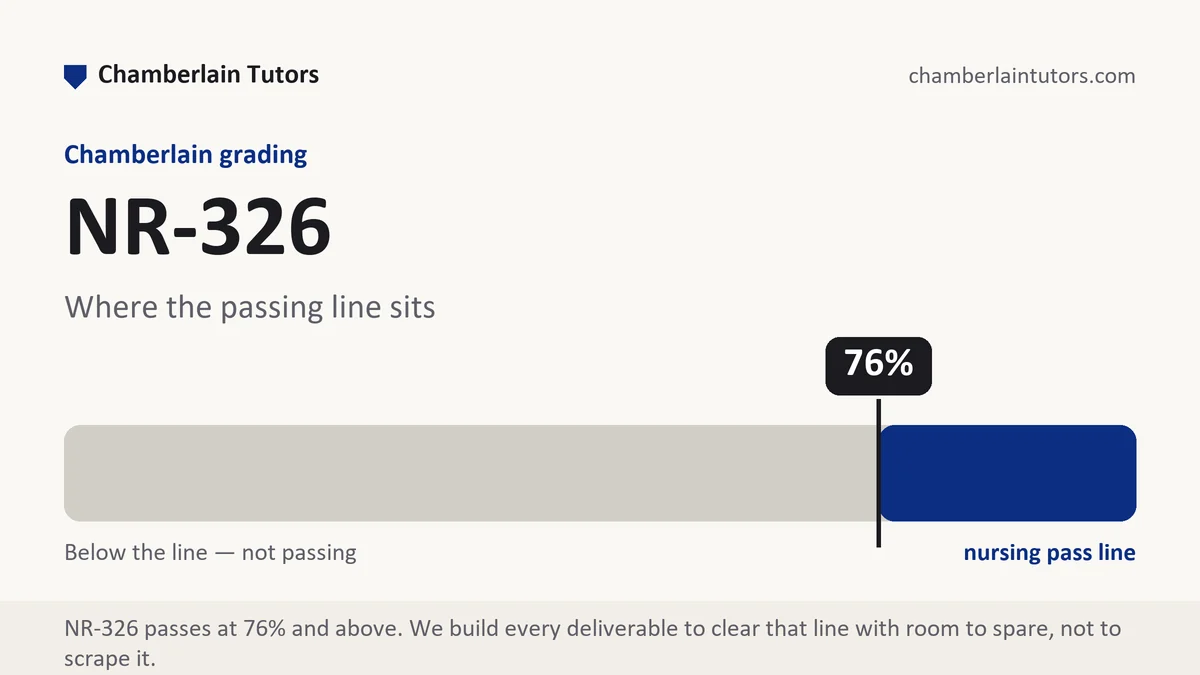
The 76 percent floor for core nursing courses applies here too. What makes this course statistically risky is not difficulty but discomfort: the assignments that students postpone longest are the reflective ones, and postponed reflective work is written fast and scores accordingly.
How we help in this course
We write process recordings, therapeutic communication analyses, case papers, medication and safety write-ups, group observation reflections, board responses and course reflections. Our drafts model the part students find hardest: analyzing a response that did not land, in plain language, without either defensiveness or self-flagellation.
The 48 clinical hours, the site placement and everything attached to them stay with you. We do not attend, contact anyone, sign anything or log time. What we can do is give you a written pattern for the analysis so the reflection stops feeling like an exposure and starts feeling like a form.
In NR-326 right now?
Send the week and the rubric from Canvas. First premium sample free, floor-checked, back in 24 to 48 hours.
Read the rubric before the prompt
Process recording assignments look like transcription work, so students skip the guide and lose the analysis rows entirely. Pull the criterion rows into a blank file first and reduce each to its verb: record, identify, analyze, evaluate, reflect. The recording verb is usually the lightest weighted row in the whole guide, which is the opposite of how most students spend their evening.
Convert weights to words before drafting. On a 1,100 word assignment with rows at 40, 30, 20 and 10 percent, you get roughly 440 words for the first row, 330 for the second, 220 for the third and 110 for the last. If the 40 percent row is analysis of technique and the 10 percent row is the transcript, then a submission with three pages of dialogue and one paragraph of analysis has inverted the guide by a factor of four. That inversion is the standard shape of a failed process recording, and it is entirely avoidable by reading the weights first.
Keep the numbers in brackets beside the headings. A thin analysis section usually means you selected an interaction where nothing difficult happened; choose a harder exchange rather than padding an easy one.
One habit protects the whole assignment. Immediately after the interaction, before you leave the building, write down the first line the patient said, the line you regret, and the line that followed it. Three fragments is enough to rebuild an accurate recording that evening, and accuracy is what the analysis rows are scored on. Recordings reconstructed days later drift toward what you wish had happened, and the drift is visible: the dialogue becomes smoother, the responses become more therapeutic, and the analysis has nothing awkward left to examine.
The shape of a process recording
The dominant deliverable here is the process recording, usually laid out in columns or in labeled blocks. These are the elements a grader reads for, whatever the layout.
| Element | What it must contain | What loses the band |
|---|---|---|
| Setting and purpose | Where the interaction happened, who was present, what you intended to accomplish. | An interaction floating with no context or goal. |
| Patient statement | What was said, quoted as closely as you can recall, including the pauses. | A summary of what the patient generally talked about. |
| Your response | Your exact words, including the ones you wish you had not used. | An improved version of what you said, written afterwards. |
| Technique named | The therapeutic technique or the barrier your response actually represents. | A label attached to a response that does not match it. |
| Analysis of effect | What the response produced in the next line, and why you think it did. | A general statement that the interaction went well. |
| Alternative response | What you would say instead, and the reasoning behind the substitution. | A rewrite with no explanation of what it would fix. |
| Self-reflection | Your own reaction during the exchange and how it shaped your choices. | An apology, or a paragraph of praise for the patient's courage. |
Evidence and citation craft at this level
Mental health writing is where careless citation does real harm, because the numbers involved attach to people who are already misdescribed in public. Four habits matter.
Current sources, and terminology that dates with them. Treat anything past five years as needing a stated reason, and read older sources for language as well as data. Diagnostic terms and the words used for substance use have changed, and repeating a retired term from a 2009 article will cost you in a course that grades stigma-free language directly.
Design and sample before the finding. Announce the study first: "in a community survey of 5,200 adults" or "in a randomized trial of 180 outpatients". Mental health literature mixes small clinical trials with very large surveys, and the two support completely different sentences.
Association verbs, held strictly. This is the course where causal overstatement does the most damage. Adverse childhood experience research is observational; it supports "was associated with a higher likelihood of", never "causes". Similarly, a medication trial supports "reduced symptom scores in this sample", not "cures". A grader marking your support row is also marking your clinical judgment when you slip.
Denominator and window before any prevalence figure. Write "an estimated one in five of the 9,000 adults surveyed reported symptoms in the previous 12 months" rather than "20 percent have anxiety". Lifetime, past-year and current prevalence differ enormously, and using a lifetime figure to argue about present need is the error most often circled in these papers.
What separates a passing recording from a strong one
A passing process recording is accurate and safe. The dialogue is plausible, the techniques are labeled, the reflection says the student learned a lot. It scores in the high seventies because nothing in it went wrong, and nothing going wrong is usually a sign that the student selected an easy interaction or cleaned up a hard one.
Strong recordings do three things that feel risky and score well. They include a response that failed, labeled honestly as a barrier rather than relabeled as a technique, because the analysis of a misstep is the most gradeable paragraph in the assignment. They quote the patient's next line as evidence, so the claim that a response opened or closed the conversation rests on what actually followed. And they name the student's own reaction, the boredom, the fear, the urge to reassure, and connect it to a specific word choice. A named failure, evidence from the next line, and an honest account of what you felt.
Mistakes that cost points here
- Cleaning up the transcript. A recording in which every response was therapeutic is a recording a grader does not believe, and it strands the analysis rows with nothing to analyze.
- Reassurance labeled as support. Telling a patient not to worry is a communication barrier with a friendly face. Name it correctly and the analysis row opens up.
- Diagnosis as identity. Write a patient experiencing psychosis, not a psychotic. This course grades language, and the substitution costs nothing.
- Analysis that praises rather than examines. Saying the interaction was meaningful is not analysis. Say what your words did to the next line the patient spoke.
- Any identifier at all. Mental health write-ups carry higher stakes for privacy. No initials, unit names, dates, or unusual details that could identify a person.
- Leaving the reflection to the last hour. Reflective rows are heavily weighted here and read as hurried when they are. Draft the analysis the same day as the interaction, while the exact words are still available to you.
Questions NR-326 students ask
What if I cannot remember the exact words of the interaction?
Do I lose points for admitting a response was not therapeutic?
How do I write about abuse, violence or addiction without sounding judgmental?
Where NR-326 sits in Chamberlain's programs
Open the exact program map for sequence, credit, and option context. The current student schedule and syllabus remain authoritative after transfer evaluation, electives, state rules, and approved plan changes.
The weeks, one by one
Week 1
NR-326 opens where psychiatric nursing itself opens: with the conversation, because in mental health the interview is the assessment and the sentence is the intervention. Read the full Week 1 manual.
Week 2
Week 2 of NR-326 typically moves into the most common territory in all of mental health: anxiety, from everyday worry through panic, and the stress responses that sit underneath it. Read the full Week 2 manual.
Week 3
By the third stage of NR-326 the course usually turns to mood: depression across the lifespan, the elevated states that sit opposite it, and the self-concept disturbances that thread through both. Read the full Week 3 manual.
Week 4
The middle of NR-326 usually belongs to thought disorders: psychosis, the schizophrenia spectrum, and the nursing work of communicating with a person whose reality has split from the room's. Read the full Week 4 manual.
Week 5
Week 5 of NR-326 usually takes up addictive behaviors: substance use across the lifespan, intoxication and withdrawal as distinct clinical states, and the family system that addiction reorganizes around itself. Read the full Week 5 manual.
Week 6
The sixth stage of NR-326 usually covers organic brain dysfunction: the cognitive disorders in which the trouble is the brain's machinery rather than mood or thought content. Read the full Week 6 manual.
Week 7
Late in NR-326 the course turns to its heaviest territory: abuse and violence across the lifespan, and the crisis intervention framework nurses use when a person's usual coping has collapsed. Read the full Week 7 manual.
Week 8
The final stage of NR-326 is where the course folds back on itself: seven weeks of disorders, communication and safety logic get integrated, and most sections pair a closing written piece, a reflection, a synthesis post or a multi-problem case analysis, with concentrated preparation for. Read the full Week 8 manual.