NR-325 Adult Health II runs three theory credits and two clinical credits over 96 clinical hours, and it moves the frame outward: alterations in life processes and their effect on the patient's family, clinical decision making for health restoration and maintenance, and discharge planning. The written work follows that outward move. Where the first adult health course graded a plan for a patient in a bed, this one grades a plan for a household that has to keep working after the bed is empty.
What NR-325 actually grades
Three things sit at the center of most scoring guides students bring us here. Whether the alteration is described as something that happens to a life rather than to an organ. Whether the decision making shows restoration and maintenance thinking, meaning what gets the patient back and what keeps them there. And whether the discharge plan would survive contact with a real home, with a real caregiver who works, a real pharmacy that closes, and a real staircase.
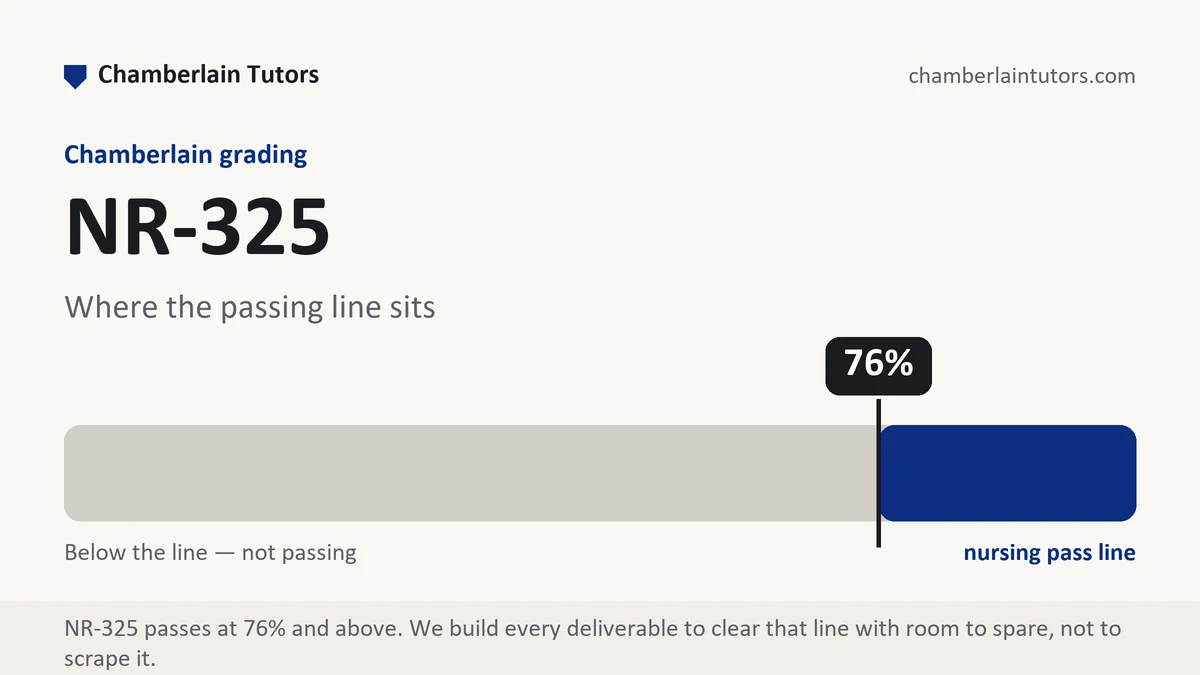
The 76 percent floor applies as it does across core nursing courses, and this course tends to punish a specific habit: writing a discharge plan for an ideal patient. Ideal patients have transport, literacy, a supportive family member with daytime availability and no competing illness. Real ones have some of that on a good week, and the guide's heaviest row usually asks you to account for the gap.
How we help in this course
We write discharge and transition plans, case analyses, family impact papers, teaching plans, pathophysiology and medication write-ups, board responses and reflections. The pattern we install is that every element of the plan names a person who executes it, a barrier it has to survive, and a way of checking that it happened.
Your 96 clinical hours stay entirely yours. We do not perform them, communicate with your site, complete placement paperwork or log a single hour. Our work sits beside the clinical component, not inside it.
In NR-325 right now?
Send the week and the rubric from Canvas. First premium sample free, floor-checked, back in 24 to 48 hours.
Read the rubric before the prompt
Discharge planning assignments carry more rows than students expect, and the rows are rarely equal. Open the scoring guide before you read the case, list the criterion rows in a blank file, and reduce each to a verb: identify, analyze, plan, coordinate, evaluate. Order your headings by the guide so the grader travels in a straight line.
Then price the rows. A 1,600 word paper with four rows weighted 30, 25, 25 and 20 percent works out to roughly 480, 400, 400 and 320 words. Notice how flat that distribution is, and how differently most drafts are built. Students write 700 words on the condition and its pathophysiology, which is background, and 200 on the coordination row that carries a quarter of the grade. Background is comfortable because it can be researched without thinking about a particular household. The coordination row cannot, which is precisely why it pays.
Bracket your targets and hold them. When the family impact section will not reach its number, the reason is nearly always that the family has not been asked a question in the draft, only described.
Before drafting, spend five minutes writing the household as a schedule rather than as a description: who is home Monday morning, who drives on a weekday, when the pharmacy is reachable, who sleeps when. A discharge plan is a plan about time, and most weak ones fail because they were written as if the week had no shape. Once the schedule exists on paper, the barriers section writes itself and the coordination section becomes concrete, because you can see exactly which hour of which day each element of your plan is asking someone to spend.
The shape of a discharge and transition plan
The dominant written deliverable in this course assembles from these parts. Each one answers a question a grader is holding while reading.
| Part | The question it settles | What a thin version does |
|---|---|---|
| Baseline and change | What this person could do before, and what the alteration changed. | Describes the disease and never mentions the life it interrupted. |
| Family and household map | Who lives there, who provides care, who works, and what that costs them. | Names a supportive family with no detail behind the adjective. |
| Barriers, named | Transport, cost, literacy, language, stairs, work schedule, competing illness. | Assumes an ideal home and plans for it. |
| Restoration priorities | What has to recover first and what a realistic pace looks like. | A goal list with no sequence and no timeline. |
| Coordination and referrals | Which services, who initiates each one, and what happens if one is unavailable. | Refer to home health, with nobody named and no fallback. |
| Teaching and verification | What the patient and caregiver must be able to do, and how you confirmed they can. | Education provided, with no method of checking. |
| Follow-up and failure signals | What appointment exists, and which specific changes should trigger a call. | Follow up with the provider, with no timeframe and no warning signs. |
Evidence and citation craft at this level
Discharge writing leans on outcome literature more than any earlier course, and outcome literature is easy to misuse. Four habits keep it honest.
Currency, argued when it lapses. Transition-of-care practice has moved considerably, so a source past five years needs a stated reason to be in your paper. If you cite an older work because it originated a model you are applying, say so and the citation strengthens rather than dates the argument.
Design and sample announced first. Put the study before the number: "in a stepped-wedge trial across 14 hospitals" or "in a retrospective review of 3,600 discharges". Readmission literature spans wildly different designs, and a grader marking the support row is checking whether you noticed which one you cited.
Association verbs unless the design is controlled. Follow-up calls are associated with lower readmission in observational work. Saying calls reduce readmission asserts a controlled finding, and this is the single most common overstatement in NR-325 papers because the sentence is trying to sell the intervention you chose.
Denominator and window before any rate. Readmission is defined by its window, so a rate without one is not a rate. Write "roughly one in six of the 2,400 patients discharged returned within 30 days" rather than "17 percent were readmitted". A 30 day figure and a 90 day figure will not support the same plan, and quoting one while planning for the other is a support error a careful grader will catch.
What separates a passing plan from a strong one
A passing NR-325 paper is organized and reasonable. It has a plan, the plan has parts, the parts are the right kind of thing. It scores in the low eighties because it is written for a patient who does not exist, and every element of it would need to be renegotiated the moment a real caregiver said they work nights.
Strong papers do three things. They put a named role beside every action, so the plan tells a reader who does it rather than that it will be done. They plan against one specific constraint openly, showing the alternative you would use if the first option fails, which is what coordination actually means. And they define failure signals concretely enough that a family could act on them, naming the change in weight, breathing, wound or behavior that triggers a call, rather than advising the patient to contact the provider if anything worsens. Named actors, a fallback, and warning signs a nonclinical person can recognize.
Mistakes that cost points here
- Planning for an ideal household. A plan that assumes transport, daytime help and easy literacy is a plan that will be marked as unrealistic in the row that carries the most weight.
- Describing the family instead of assessing it. Supportive is an adjective. Who lifts, who drives, who pays and who is losing shifts are findings.
- Teaching with no verification. Education provided is not a completed step. Say what you asked the caregiver to demonstrate or repeat, and what a failed attempt would have looked like.
- Pathophysiology crowding out coordination. Background is the cheapest section in the paper and the easiest to overwrite. Cap it and spend the space on the rows that carry weight.
- Vague follow-up. An appointment with no timeframe and warning signs with no specifics give a grader nothing to score and a family nothing to use.
- One-shot posts written live. Board posts cannot be edited after submission at Chamberlain, so compose in a document and paste once, especially in a course where clinical days run long.
Questions NR-325 students ask
How do I write about the family without inventing details?
What makes a restoration and maintenance section different from a goal list?
My discharge papers score well on content but poorly on application. Why?
Where NR-325 sits in Chamberlain's programs
Open the exact program map for sequence, credit, and option context. The current student schedule and syllabus remain authoritative after transfer evaluation, electives, state rules, and approved plan changes.
The weeks, one by one
Week 1
NR-325 is the second adult health course, and its catalog territory is alterations in life processes, their effect on the patient's family, clinical decision making, and discharge planning, all backed by 96 clinical hours. Read the full Week 1 manual.
Week 2
Expect a case that deteriorates across hours, a write-up tracing cues to escalation, or a discussion on failure to rescue and the nurse's part in preventing it. Read the full Week 2 manual.
Week 3
Chamberlain publishes no syllabi outside Canvas. Read the full Week 3 manual.
Week 4
The delegation layer is what distinguishes this week from the prioritization work of the first adult health course. Read the full Week 4 manual.
Week 5
The genre is a readiness argument, function, cognition, support and environment weighed against the demands of each candidate destination. Read the full Week 5 manual.
Week 6
Chamberlain publishes no syllabi outside Canvas. Read the full Week 6 manual.
Week 7
Expect a trajectory-based care plan, a goals-of-care write-up, or a discussion on chronic illness at the end of an admission. Read the full Week 7 manual.
Week 8
Final weeks in the second adult health course tend to converge everything the session built: a capstone-style written product that follows one patient across the whole arc, admission through deterioration risk, family, decisions and discharge, alongside completion of your own clinical requirements. Read the full Week 8 manual.