NR-324 Adult Health I carries three theory credits and two clinical credits across 96 clinical hours, and covers adult patients and families in health promotion and in the management of acute and chronic conditions using the nursing process across varied settings. The hours happen at a site. The grade happens in writing, mostly in care plans, concept maps and case analyses where the nursing process has to be visible as reasoning rather than recited as a list of five words.
What NR-324 actually grades
The written work asks one question in several costumes: can you get from data to a defensible nursing action without skipping a step. Assessment data has to produce a problem statement, the problem statement has to produce a measurable outcome, the outcome has to produce interventions, and each intervention has to carry a rationale that explains the physiology or the evidence behind it. Miss any link and the paper reads as a task list, which is what most middle-band submissions are.
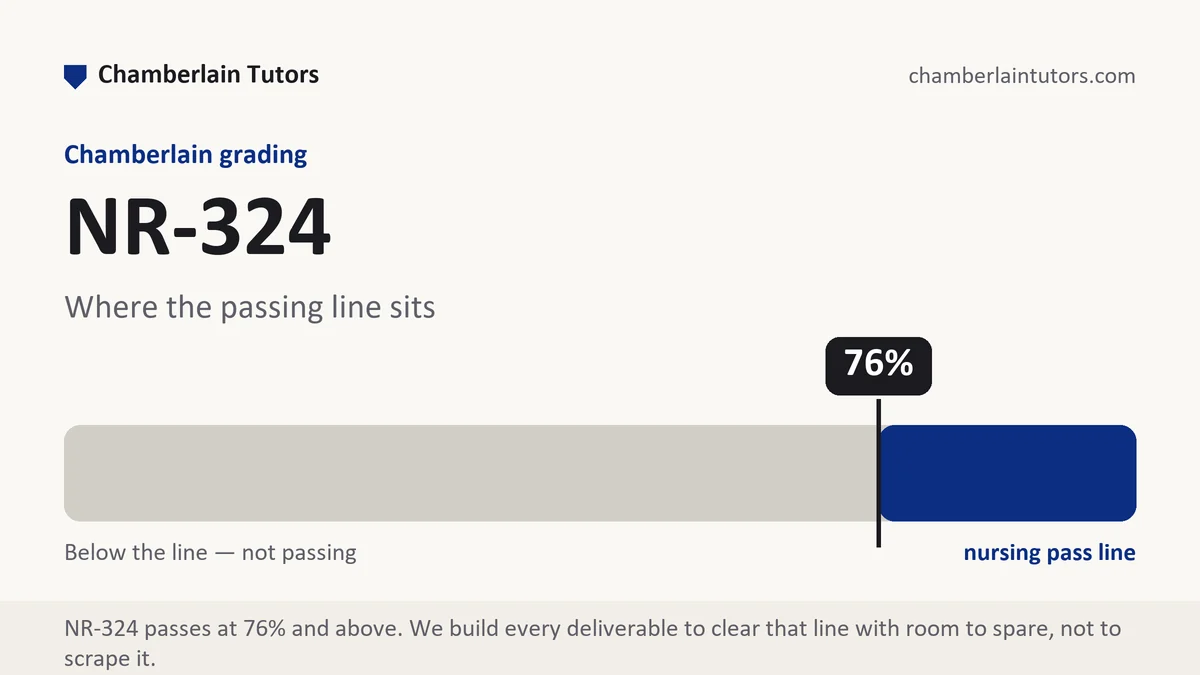
The 76 percent floor for core nursing courses applies, and this is where students first feel it, because a five-credit course sits heavily in a term average and the written work runs weekly alongside clinical days that eat the time you planned to write in. The pieces that sink grades are rarely the hard ones. They are the routine care plans submitted at speed.
How we help in this course
We build the paper side: care plans, concept maps, case analyses, medication and pathophysiology write-ups, discussion posts and reflective assignments. What our drafts add is the chain, so the outcome you propose is traceable to a specific assessment finding, and every intervention arrives with its rationale attached rather than assumed.
What we never touch is the clinical side. We do not complete clinical hours, contact a site or preceptor, sign or fill anything about your placement, or record time you did not work. The 96 hours are yours; the writing that surrounds them is where a model draft earns its place.
In NR-324 right now?
Send the week and the rubric from Canvas. First premium sample free, floor-checked, back in 24 to 48 hours.
Read the rubric before the prompt
Care plan assignments look self-explanatory, which is exactly why students skip the guide and lose points in rows they never read. Copy the criterion rows into a blank file first, strip each to its verb, assess, diagnose, plan, implement, evaluate, and then check whether the guide weights them evenly. It usually does not, and the imbalance is the whole strategy.
Convert the weights into words before drafting. A 1,500 word case with rows weighted 35, 25, 25 and 15 percent gives roughly 525 words to the first row, 375 to each of the middle two and 225 to the last. Now compare that to how students actually write: the assessment section swells because the data is already collected and typing it feels like progress, while the evaluation row, worth 225 words of real thinking about how you would know the plan worked, gets two sentences at midnight. That single imbalance accounts for more lost points in this course than any content error.
Put the target word count in brackets after each heading and remove it when the section arrives. If the rationale section will not reach its budget, you have interventions you cannot justify, and the fix is to cut them rather than to pad around them.
One preparation step changes the quality of a care plan more than any writing technique. Before drafting, write the outcome sentence first and force a number and a date into it, then work backwards to the interventions that could produce it. Plans built in that direction stay coherent because every intervention has a target to serve. Plans built forward from a diagnosis tend to accumulate reasonable-sounding actions with no shared destination, which is why their evaluation sections read as improvised. The order you write in is doing more work than the words you choose.
The shape of a nursing process care plan
Whatever your assignment calls it, the graded object in this course usually assembles from these six pieces, and a grader can find or fail to find each one.
| Piece | What has to be provable in it | The version that loses points |
|---|---|---|
| Assessment data, selected | The findings that matter to this problem, subjective and objective, with values attached. | The entire chart transcribed with no selection visible. |
| Problem statement | The patient problem, its cause or related factor, and the evidence that establishes it. | A label with no related factor, so nothing explains why this patient has it. |
| Outcome, measurable | What will be different, by how much, by when, and how it will be observed. | The patient will improve, with no number, no deadline and no observer. |
| Interventions, ranked | Nursing actions in priority order, at your scope, specific enough to hand over. | Monitor and educate, repeated four times with different nouns. |
| Rationale per intervention | The physiology or evidence that makes this action work for this problem. | Because it is standard practice, cited to nothing. |
| Evaluation | The result measured against the outcome, and what you would change if it was not met. | Goal met, with no data and no alternative plan. |
Evidence and citation craft at this level
Rationales are citations in disguise, which makes this the first course where sloppy sourcing shows up structurally rather than cosmetically. Four habits fix it.
Current guidance, and a stated reason for anything older. Management of acute and chronic adult conditions changes with each guideline cycle, so treat a source past five years as needing a justification in the sentence. Physiology described in a classic text is fair; a target range or a first-line recommendation from a decade ago is not.
Design and sample before the finding. Say what produced the number before you give it. "In a multicenter trial of 1,240 adults admitted with the condition" lets a reader weigh the claim, and it is the difference between a rationale and an opinion with a reference after it.
Verbs that match what was studied. Nursing interventions are frequently studied observationally, so write "was associated with fewer falls" unless a controlled comparison supports "reduced falls". Rationale sections are where causal verbs get attached to correlational evidence most often, because the sentence is trying to sound decisive.
Denominator and window before any rate. "About one in nine of the 890 patients developed the complication within 30 days of surgery" can be used in a plan; "11 percent developed the complication" cannot, because neither the base nor the period is visible. If your source measured over six months, your sentence has to say six months.
What separates a passing care plan from a strong one
A passing care plan in NR-324 is complete and inert. Every box has content, the diagnosis is plausible, the interventions are things nurses do. It scores in the high seventies or low eighties because it would fit any patient with that condition, and the grader can tell because nothing in it refers to a person.
Three moves lift it. The outcome carries a number and a deadline, so success or failure is decidable rather than arguable. The interventions are ranked with the ranking defended, because saying which comes first and why is the clearest evidence of clinical judgment a student paper can carry. And the evaluation section admits a possibility of failure, naming what you would change if the outcome was not met, which is the part that reads as a nurse thinking rather than a student completing. Decidable outcome, defended ranking, an evaluation with a plan B.
Mistakes that cost points here
- Outcomes with no measure. If nobody could tell on Thursday whether the outcome was met, the row scores in the bottom band no matter how appropriate the goal was.
- Interventions above your scope. Prescribing, ordering and diagnosing are not nursing interventions in this course. Write what a nurse does, including what a nurse reports and to whom.
- Rationales that cite nothing. A rationale is where the citation belongs. Standard practice is not a source and reads as a gap in the heaviest row of the guide.
- Transcribing the whole chart. Selection is the skill. Data with no bearing on the problem dilutes the section the guide is scoring.
- Patient identifiers in the write-up. No initials, room numbers, admission dates or facility names. Describe by age band and clinical picture.
- Writing the plan after the clinical day ends. Clinical days end late and the board post still cannot be edited after posting at Chamberlain, so build the draft before the shift rather than after it.
Questions NR-324 students ask
My care plans are always marked as too general. What actually fixes that?
How many interventions should a care plan carry?
Can you help with the clinical hours or the paperwork attached to them?
Where NR-324 sits in Chamberlain's programs
Open the exact program map for sequence, credit, and option context. The current student schedule and syllabus remain authoritative after transfer evaluation, electives, state rules, and approved plan changes.
The weeks, one by one
Week 1
NR-324 opens the adult health sequence, and the first written work in a clinical course like this one is almost always a care plan or care-plan-shaped exercise: assessment data organized into clusters, a nursing diagnosis chosen and defended, outcomes written so they can be measured, and. Read the full Week 1 manual.
Week 2
The craft being graded is instructional design in miniature, with learner assessment, objectives, content, method and evaluation each earning their own rubric row. Read the full Week 2 manual.
Week 3
By the middle third of an adult health session the writing usually moves into the body systems that fill medical units: oxygenation and perfusion, the chronic cardiopulmonary conditions and their acute exacerbations. Read the full Week 3 manual.
Week 4
Somewhere near the middle of the adult health arc, the writing turns to the body's plumbing and chemistry: fluid balance, electrolytes and glucose regulation. Read the full Week 4 manual.
Week 5
Surgical care is a staple of the first adult health course, and in our reading of the catalog arc this is the NR-324 stage where the writing follows a patient through an operation: the risks assessed before, the complications watched for after, and the mobility and safety work that determines where. Read the full Week 5 manual.
Week 6
The later-middle weeks of an adult health session usually reach the digestive and elimination systems, and this is also where many sections introduce the concept map: a one-page diagram of a patient's problems, their connections and their plans, graded on the links as much as the boxes. Read the full Week 6 manual.
Week 7
Late in an adult health session the writing widens from one patient to several, because prioritization across an assignment is the skill that separates a student who can plan care from one who can run a shift. Read the full Week 7 manual.
Week 8
Closing weeks in clinical courses tend to carry two kinds of work at once: a summative written piece, often a reflection on clinical growth or a final synthesis exercise, and the concentrated preparation for whatever final assessment your section runs. Read the full Week 8 manual.