NR-305 Health Assessment for the Practicing RN is the RN to BSN version of assessment: four theory credits, no lab, built on the assumption that you already assess patients for a living. That assumption is the trap. The course does not grade whether you can assess; it grades whether you can write assessment as an academic argument across four domains, physical, psychosocial, cultural and spiritual, and turn the result into an individualized patient teaching plan a stranger could follow.
What NR-305 actually grades
Experienced nurses lose points here for a predictable reason: they write from practice instead of from evidence. On a unit, "I would check her feet" is a complete thought. In a graded paper it is an unsupported assertion, and the scoring guide has a row for exactly that. The course wants the physical domain handled with the same rigor as the psychosocial, cultural and spiritual domains, which is where most drafts thin out, because those three are the ones nobody documents at speed on a real shift.
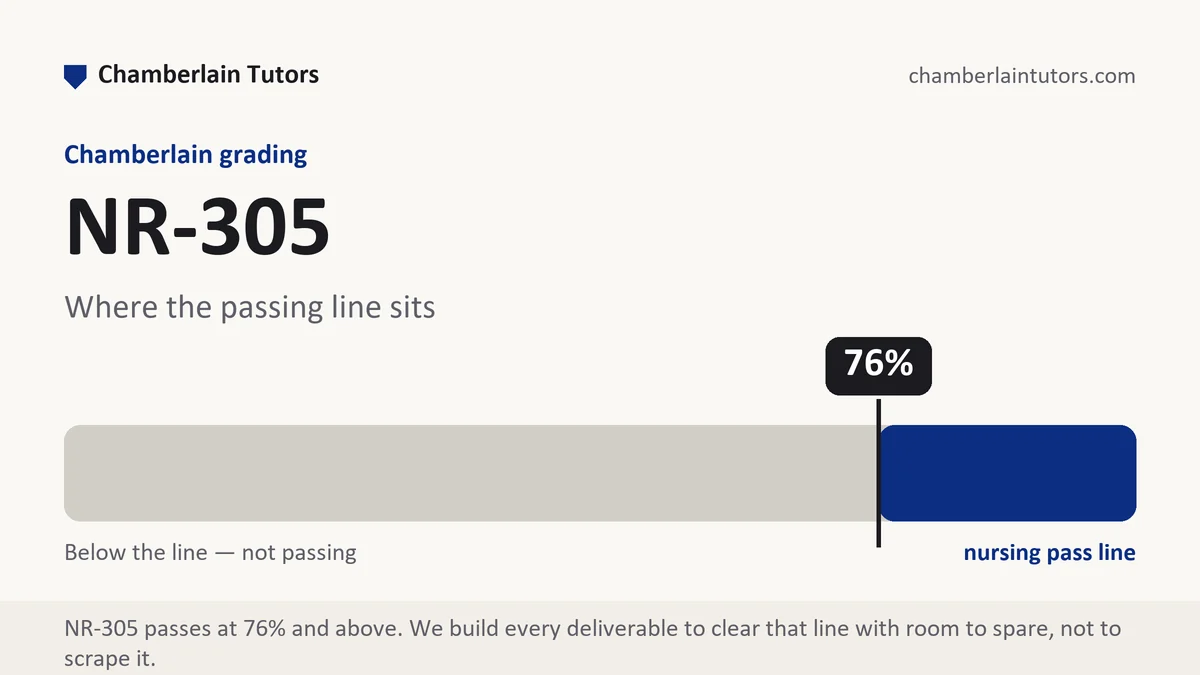
The other half of the grade is the teaching plan. Not a topic, a plan: a named learner, a stated need, a method chosen for that learner, and a way of finding out whether it worked. Core nursing courses carry a 76 percent floor, and in a four-credit course with weekly written work the average is built out of many pieces, so the cost of a mediocre teaching plan compounds rather than disappears.
How we help in this course
We write the papers, the four-domain assessment write-ups, the teaching plans, the board responses and the reflective pieces, in the register a graduate-level nursing paper wants rather than the register of a shift report. The typical fix we install is turning your clinical instinct into a sourced argument: the same judgment you already have, now with the design of the evidence behind it visible in the sentence.
Nothing we do touches licensure, employment or patient records. We are writing about assessment, not performing it, and everything we send is a model to work from.
In NR-305 right now?
Send the week and the rubric from Canvas. First premium sample free, floor-checked, back in 24 to 48 hours.
Read the rubric before the prompt
Working nurses read the prompt on a phone between shifts and start writing that night. It is the most expensive habit in this course. Open the scoring guide first, copy its criterion rows into a blank document, and reduce each to a single instruction verb: assess, analyze, individualize, support, evaluate. Order your headings by the guide, not by the order the domains occur to you.
Then convert the weights into a word budget. Take a paper capped at 1,750 words with four rows weighted 35, 25, 25 and 15 percent. Multiplying through gives roughly 610 words to the first row, 440 to each of the middle two and 260 to the last. Now look at your last submission. If the physical domain ran 900 words while the cultural and spiritual domains shared 300, you did not write a four-domain paper; you wrote a physical assessment with three appendices, and the guide charged you for it. Reference list and title page sit outside the count unless the guide says otherwise.
Keep the numbers visible while drafting. A domain that will not reach its budget is telling you it needs a source or an example, not that it deserves less space.
There is one preparatory step worth building into every week. Before you draft, write the four domain names down the side of a page and give each one two lines from your encounter, something the patient said or something you observed. If a domain has nothing beside it, you have found the section that will collapse later, and you have found it while there is still time to ask a question rather than at midnight with the paper due. Working nurses often discover the spiritual and cultural rows are empty not because the patient had nothing to say but because nobody asked.
The shape of a four-domain assessment paper
Most graded writing in NR-305 assembles from these parts, whether the assignment is called an assessment paper, a case analysis or a teaching project.
| Part | What it has to establish | The weak version |
|---|---|---|
| Patient frame | Age band, living situation, functional baseline and why this person was chosen, with identifiers removed. | A demographic sentence that could describe half the country. |
| Physical domain | Findings in clinical language with values, locations and qualities, and relevant negatives. | System headings with the word normal underneath. |
| Psychosocial domain | Support network, stressors, coping strategies and mood, gathered with named questions rather than inferred. | An impression of how the patient seemed to be doing. |
| Cultural domain | What the patient believes about the illness, who decides in the family, food and practice patterns that affect the plan. | A paragraph about the patient's ethnicity that never returns. |
| Spiritual domain | Sources of meaning, practices that matter during illness, and any request that would change nursing care. | A note of religious affiliation with no bearing on anything. |
| Individualized teaching plan | One learning need drawn from the four domains, a method matched to the learner, and a stated evaluation. | A handout topic with a sentence about providing education. |
Evidence and citation craft at this level
The gap between a floor nurse's knowledge and a BSN paper's evidence is not knowledge. It is sourcing discipline, and four habits close it.
Recent sources unless the age is argued. Anything past five years needs a reason stated in the sentence. Assessment frameworks that have not changed are fair to cite at any age if you say why you reached for the original; prevalence and screening guidance are not.
Design and sample before the number. Put the study's shape ahead of its result. "In a cohort of 2,100 community-dwelling adults followed three years" does more for your credibility than any adjective you could attach to the finding afterwards.
Association verbs for observational work. This matters most in the cultural and psychosocial sections, where students slide from "patients in this group reported lower adherence" to "this culture causes lower adherence" in the space of a paragraph. Observational evidence supports association, prediction and co-occurrence. It does not support causation, and a grader reading for cultural humility will notice the slide before they notice the citation.
Denominator and window before any rate. Write "about one in eight of the 640 adults surveyed had missed a dose in the previous week", not "13 percent were non-adherent". The base and the window are what convert a number into evidence, and in teaching plan sections they are what let a grader judge whether your plan matches the size of the problem.
What separates a passing paper from a strong one
Passing papers in NR-305 read like competent practice written down. They are accurate, they cover the domains, they end with a reasonable teaching topic. They score in the low eighties because everything in them is asserted by a nurse rather than argued by a writer. The reader is asked to trust the author's experience, and academic grading does not pay for trust.
Strong papers do three things differently. They quote the patient, so the psychosocial, cultural and spiritual domains rest on what was said rather than on what was sensed. They let a domain change the plan, which is the whole point of assessing four of them, so the teaching method visibly bends around a cultural or spiritual fact rather than mentioning it and moving on. And they end with an evaluation that could return a bad result, which is the difference between a plan and a wish. Quoted evidence, a plan that bends, an evaluation that can fail.
Mistakes that cost points here
- Writing from the shift instead of from the source. Your experience explains why you knew where to look. It does not support the claim, and unsupported claims sit in the heaviest rows.
- Treating culture as demographics. A named background with no consequence for the plan scores as a mention. Ask what the patient believes about the illness and who decides in the household, and the section starts earning.
- Skipping the spiritual domain because it feels intrusive. One respectful question about what sustains the patient produces a real finding. Silence in that section produces a zero-length section.
- Bringing shift shorthand into an academic paper. Abbreviations, slang and telegraphic sentences read as informal here even when they are correct on a unit.
- Leaving identifiers in the write-up. No initials, room numbers, employer names or dates of service. Describe the patient by age band and situation instead.
- Posting to the board from the box. Discussion posts do not reopen after submission at Chamberlain, so draft elsewhere and paste once.
Questions NR-305 students ask
I have assessed patients for years. Why are my papers scoring in the seventies?
Can I write about a patient from my own unit?
How individual does an individualized teaching plan have to be?
Where NR-305 sits in Chamberlain's programs
Open the exact program map for sequence, credit, and option context. The current student schedule and syllabus remain authoritative after transfer evaluation, electives, state rules, and approved plan changes.
The weeks, one by one
Week 1
NR-305 opens with a premise that changes how you should write from the first sentence: you already assess patients every shift, and this course is not pretending otherwise. Read the full Week 1 manual.
Week 2
The second territory of NR-305 typically turns to the physical examination, and for a practicing RN the challenge is not performing it but writing it: taking findings your hands and eyes gather automatically and rendering them in exact, standardized, cited academic prose. Read the full Week 2 manual.
Week 3
The catalog for NR-305 promises assessment beyond the physical, and this is the stage where that promise starts collecting: psychosocial assessment, meaning stress, coping, mood, support systems, roles and the mental status picture, gathered and written with the same rigor the physical exam gets. Read the full Week 3 manual.
Week 4
Cultural assessment is the stage of NR-305 where the writing itself is the ethical instrument. Read the full Week 4 manual.
Week 5
Spiritual assessment completes the trio the NR-305 catalog names alongside psychosocial and cultural, and it is the one working nurses have usually practiced least on paper. Read the full Week 5 manual.
Week 6
Late in the NR-305 arc, the course's widened lens usually turns to the population where it matters most: older adults, assessed for function, safety and risk rather than for diagnosis alone. Read the full Week 6 manual.
Week 7
The individualized patient teaching plan is named in the NR-305 catalog as a destination, and this is the stage where the course usually collects it: a plan built from everything the preceding weeks assessed, physical, psychosocial, cultural, spiritual and functional, and individualized in the. Read the full Week 7 manual.
Week 8
The final territory of NR-305 gathers what the catalog promised into a single written performance: a whole-person assessment, physical, psychosocial, cultural and spiritual, integrated on one constructed adult, with the individualized teaching thread the course has been building toward woven through it. Read the full Week 8 manual.