NR-304 Health Assessment II is the second half of the sequence, 1.5 theory credits plus a half credit of lab across 16 lab hours. The first course asked you to gather data. This one asks what the data means: using findings in clinical decision making, identifying teaching and learning needs, and documenting a comprehensive assessment. The written work therefore stops rewarding completeness and starts rewarding judgment, which is why students who cruised through part one sometimes stumble here.
What NR-304 actually grades
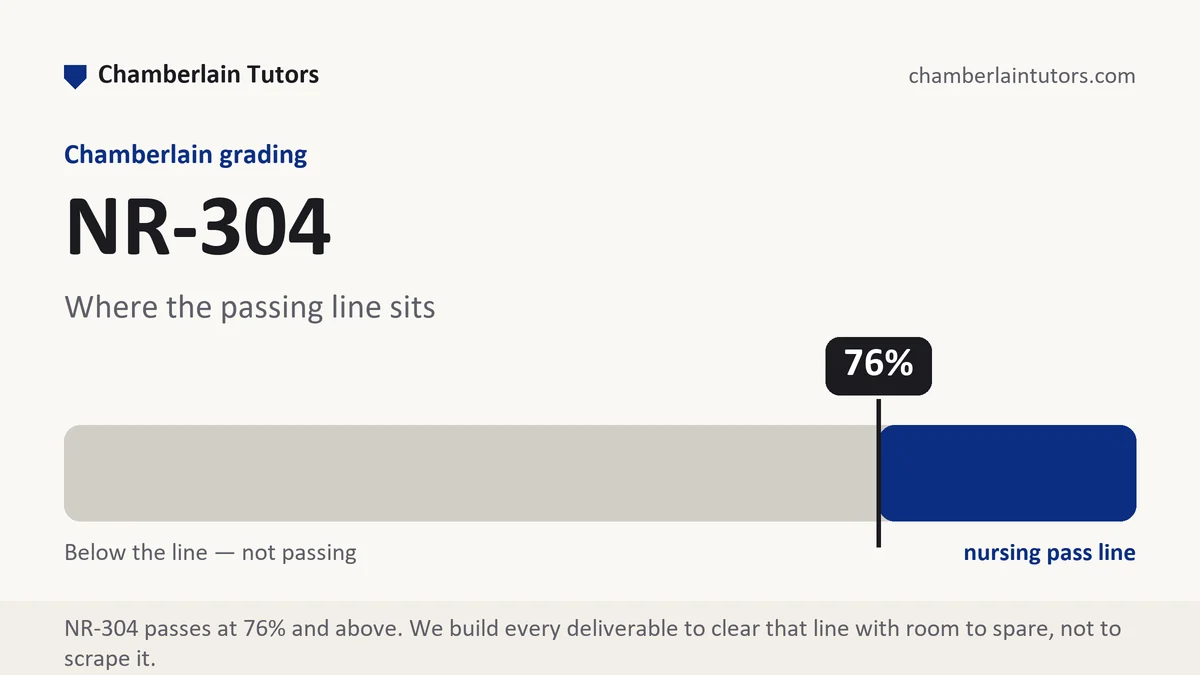
Three things, in roughly this order of weight. Whether you can cluster findings instead of listing them, whether you can say what a cluster obliges a nurse to do next, and whether the teaching need you identify actually follows from the assessment rather than from a topic you already wanted to write about. The 76 percent floor for core nursing courses sits underneath all of it, and in a two-credit course the graded pieces are few enough that one weak submission moves the average visibly.
The distinguishing move is clustering. A comprehensive assessment produces dozens of data points, and the student who reports all of them in the order the body is arranged has documented rather than assessed. Grouping three findings that share a cause, then naming what that grouping suggests, is the single behavior this course exists to build, and it shows up in the highest weighted rows of nearly every scoring guide students bring us.
How we help in this course
We build the written side: comprehensive assessment documentation, clinical decision write-ups, teaching plans, board responses and any reflective piece attached to the lab component. Drafts come back with findings already clustered, with each decision traced to the data that forced it, and with the teaching plan tied to a learning need the assessment actually produced.
The lab portion stays with you. We do not perform, record or attest to any hands-on demonstration, and nothing we send is meant to stand in for one. What travels well is the writing pattern, and once the pattern is in your hands it carries into every clinical course that follows this one.
In NR-304 right now?
Send the week and the rubric from Canvas. First premium sample free, floor-checked, back in 24 to 48 hours.
Read the rubric before the prompt
The prompt is a story. The scoring guide is the contract. Open the guide first and paste its criterion rows into an empty document, one row per line, then reduce each row to the verb it is really asking for: document, cluster, prioritize, teach, evaluate. Those verbs become your headings, in the guide's order, so a grader travelling down the rows meets your sections in the same sequence rather than hunting for them.
Now price the rows in words, because a percentage is a depth instruction. Suppose the write-up is capped at 1,400 words and the guide lists five rows weighted 30, 25, 20, 15 and 10 percent. The arithmetic gives you roughly 420 words for the first row, 350 for the second, 280 for the third, 210 for the fourth and 140 for the last. Students routinely invert this by spending 600 words reproducing the data set, which is usually a 20 percent row, and 120 words on the decision-making row that carries 30. Reproducing data feels productive because it is easy; it is also the cheapest paragraph in the paper.
Write each target in brackets beside its heading and remove the bracket only when the section hits its number. If a section lands far under budget, the guide has just told you that your reasoning there is thin, and it told you before the grader had to.
One habit shortens every assignment in this course. Before writing, list your findings on paper and physically group them, drawing rings around the ones that share a mechanism or a cause. The rings become your clusters and the clusters become your headings, which means the analysis section is planned before the first sentence exists. Students who draft straight into the document tend to reproduce the order of the assessment form instead, and once that order is on the page it is very hard to see past it. Five minutes with a pen restructures the whole submission.
The shape of a comprehensive assessment write-up
Whatever the assignment is called, the written product in this course tends to move through the same six moves. Each one answers a question the grader is holding.
| Move | The question it answers | What a weak version does |
|---|---|---|
| The data set, edited | What did you find, reported in clinical language with values and locations? | Reprints every system at equal length, including the ones with nothing to say. |
| Clusters named | Which findings belong together, and on what basis? | Leaves the reader to assemble the pattern themselves. |
| Interpretation | What does each cluster suggest about this patient right now? | Restates the finding in different words and calls it analysis. |
| Priority and rationale | Which concern comes first and why that one before the others? | Lists three priorities with no ranking argument. |
| Learning need identified | What does this patient not yet know that the assessment revealed? | Chooses a teaching topic that could have been picked before meeting the patient. |
| Teaching approach and evaluation | How will you teach it to this learner, and how will you know it worked? | Hands over a pamphlet and calls the plan complete. |
Evidence and citation craft at this level
Second-course assessment writing cites more than the first course did, because interpretation and teaching both need backing. Four habits carry most of the difference.
Current sources, verified rather than assumed. Guidance on screening intervals and education practice is revised often, so treat a source older than five years as needing a stated justification. If you cite an older work because it defined a concept, say that in the sentence and the age becomes a strength.
Design and sample stated before the finding. Put the study's shape in front of its result. "In a randomized trial of 260 adults discharged with heart failure" tells your grader how much weight the next clause can bear, and it costs one clause to say.
Verbs matched to the design. Teaching studies are especially easy to overstate. Observational work supports "was associated with better adherence"; only a controlled comparison supports "improved adherence". Watch the sentence where you justify your teaching method, because that is where students reach for a causal verb the evidence does not carry.
Denominator and window before any rate. Never publish a bare percentage. "Roughly one in five of the 480 patients enrolled was readmitted within 30 days" is checkable; "20 percent were readmitted" is not, because the reader cannot see how many people or how long. Rates in patient education work are especially sensitive to the window, since a 30 day figure and a six month figure describe different worlds.
What separates a passing write-up from a strong one
A passing NR-304 paper is thorough. Every system is documented, the teaching plan exists, the citations are real. It scores in the low eighties and its author feels cheated, because nothing in it is wrong. What is missing is consequence. The passing paper reports; the strong paper argues that these findings, taken together, oblige this response.
Three things mark the stronger version. It ranks, openly, saying which concern leads and defending the order rather than presenting a flat list. It ties the teaching need to a specific line in the assessment, so the plan could not have been written for anyone else. And it closes the loop with an evaluation method that would actually detect failure, such as a return demonstration or a teach-back question with a wrong answer that would be visible. Ranking, traceability, an evaluation that can fail. Those three are what the top performance column is describing when it asks for more than completeness.
Mistakes that cost points here
- Documenting instead of deciding. A flawless data dump with no interpretation section fails the row that carries the most weight, and it is the most common shape we see in drafts sent for review.
- Choosing a teaching topic in advance. If your plan would have been identical before the assessment, the grader will see it. Let one specific finding pick the topic.
- Teaching a plan with no evaluation. A teaching section that ends with the teaching is half a section. Say how you would check understanding and what a failed check looks like.
- Priorities with no ranking argument. Three concerns presented side by side is not prioritization. Name the leader and give the reason it outranks the others.
- One-shot posts drafted in the box. Discussion posts cannot be edited once submitted at Chamberlain. Compose in a document, check the guide against it, then paste.
- Patient identifiers in an academic paper. Initials, room numbers, dates of service and facility names have no place in a graded write-up, and their presence can cost more than points.
Questions NR-304 students ask
How do I show clinical decision making without diagnosing?
My teaching plans keep coming back marked as generic. How do I fix that?
The assignment says comprehensive, but the word cap is small. What do I cut?
Where NR-304 sits in Chamberlain's programs
Open the exact program map for sequence, credit, and option context. The current student schedule and syllabus remain authoritative after transfer evaluation, electives, state rules, and approved plan changes.
The weeks, one by one
Week 1
NR-304 Week 1 is the hinge between two questions: Health Assessment I asked whether you could perform a technique, and this course asks what the result of that technique means for the patient in front of you. Read the full Week 1 manual.
Week 2
Somewhere in the early body of NR-304, most sections spend a stage on the abdomen, and the written work that comes with it turns on one discipline: order. Read the full Week 2 manual.
Week 3
The musculoskeletal stage of NR-304 grades a translation skill: turning what you see a body do into scored, comparable data. Read the full Week 3 manual.
Week 4
Neurological assessment is where imprecise writing does the most damage, because neuro findings are trended: the whole point of a neuro check is comparison with the last one, and a vaguely written baseline poisons every check that follows. Read the full Week 4 manual.
Week 5
By the middle of NR-304 the course stops asking about one system at a time. Read the full Week 5 manual.
Week 6
The catalog language of NR-304 names a skill most students do not expect a physical assessment course to grade: identifying teaching and learning needs from assessment data. Read the full Week 6 manual.
Week 7
Documentation is the deliverable of this stage, not the afterthought. Read the full Week 7 manual.
Week 8
The closing stage of NR-304 is a convergence: everything the session trained separately, precise findings, regional exams, clustering, teaching needs, documentation, gets performed once as a whole. Read the full Week 8 manual.