NR-222 Health and Wellness carries three credit hours of lecture, with no lab and no clinical component, and its subject is the well person rather than the sick one. The catalog scopes it as health promotion and preventive care across the life span, read through biological, psychological, spiritual, environmental and sexual domains, with national Healthy People objectives supplying the targets. That produces a specific kind of graded writing: pick a population, look at it through the domains, anchor it to a published objective, and defend an intervention with evidence. This page is the manual for that deliverable, including how to convert the scoring rows into a word budget and how to handle population statistics without losing points on the numbers.
What NR-222 actually grades
The mental switch this course demands is from treatment to prevention. Most students arrive able to describe what a clinician does once a person is unwell, and NR-222 asks the opposite question: what keeps this person well, at this stage of life, and what evidence says the thing you are proposing works before anything goes wrong.
Two structures carry almost all the grading. The first is the life span. A recommendation only means something once the age band is fixed, because the risks, the teachable moment and the family context all move with it. The second is the domain set the catalog names. Biological, psychological, spiritual, environmental and sexual are not decorative headings; they are lenses, and a paper that runs the same population through several of them is doing the analytical work the rows are written to reward. Healthy People objectives sit on top as the national frame, which is why quoting one correctly, with its data year, is usually worth more than adding another paragraph of general advice.
All of it lands on the university's ordinary calendar: a 16 week semester made of two 8 week sessions, as many as six start dates in a year, graded work opening in Canvas each week, and discussion posts that lock the moment they publish.
How we help in this course
We draft the written layer of NR-222 against your posted scoring rows: health promotion papers, life span analyses, teaching plans and the board posts that carry the same demands in fewer words. Population figures arrive with their denominators, their data years and their sources attached, because that is where prevention writing most often bleeds points.
Terms are the site standard: a premium original draft in 24 to 48 hours, targeted at the A band of your course's actual scale, through the eight-person pipeline with two QA passes and the floor check, revised free until it lands.
In NR-222 right now?
Send the week and the rubric from Canvas. First premium sample free, floor-checked, back in 24 to 48 hours.
Scoring rows into a section plan, then into a word budget
Only one of the two documents in front of you assigns a grade, and it is not the prompt. So start with the guide and translate it. Take each criterion row and rewrite it as the question it is really asking, phrased tightly enough that a paragraph could answer it. A row about analyzing determinants turns into: what in this group's environment and psychology is driving the risk. Those questions become your headings, left in the guide's own order so that nothing sends the grader hunting for a row you covered somewhere else.
Now price the rows, because a weight is an instruction about depth. Say your week's paper is capped at 1,200 words with four rows at 30, 30, 25 and 15 percent. The arithmetic gives roughly 360 words to each of the two heaviest rows, 300 to the 25 percent row and 180 to the last one. Note what two equal weights mean: the analysis row and the evidence row are worth the same, so a paper that spends 600 words on describing a population and 150 on defending the intervention has already given away most of one row while feeling thorough.
The row students underfeed here is nearly always evaluation, the one asking how you would know the plan worked. It arrives last in the prompt, it arrives last in the draft, and it gets whatever words are left over. Budget it first instead. Write the measurement sentence before you write the introduction, then build the paper toward it, and the ending becomes a conclusion rather than a summary.
The shape of a health promotion paper
Whatever a given week calls it, the graded piece is usually a health promotion or preventive care analysis. Eight parts do the scoring work, and a grader is actively hunting for each one.
| Section | The question it has to answer | How a thin version reads |
|---|---|---|
| Population and life stage | Who exactly, in which age band, in what setting, and why this group rather than adults in general. | A population so broad that every later recommendation has to be generic. |
| The domain lens | Which of the course domains you are analyzing through, and what that lens shows that another would miss. | Domain names listed once as headings, with the same lifestyle advice under each. |
| Risk picture with numbers | The burden in this group, with a source, a data year and a denominator attached to every figure. | A percentage with no base population and no year, borrowed from a health news article. |
| The national objective | The Healthy People objective this connects to, quoted as written, with what it targets and by when. | A gesture at national goals with no objective actually named or cited. |
| Level of prevention, named | Whether you are proposing primary, secondary or tertiary prevention, and why that level fits this group now. | An intervention that is quietly screening while the paper calls it prevention. |
| Evidence for the intervention | What study or guideline supports the thing you are recommending, in this population rather than in a different one. | A recommendation supported by common sense and a textbook chapter. |
| Teaching plan, made concrete | What you would deliver, to whom, in what format, at what reading level, and how it fits their week. | A pamphlet mentioned in one sentence and never described. |
| Evaluation measure | The one number or observation that would tell you this worked, plus the window you would measure it over. | A closing paragraph promising to evaluate effectiveness. |
Population numbers, handled carefully
Prevention writing runs on statistics, and statistics are where otherwise good NR-222 papers lose their evidence row. Four habits fix most of it.
Two dates, not one. Public health sources carry a publication year and a data year, and they are often years apart. Cite both when they differ, and treat a figure whose data year is a decade old as needing a reason to be on your page. Unless your guide says otherwise, hold sources to the last five years and justify any exception in the sentence itself.
Introduce the study before its result. Open with the kind of study and who was in it: in a national survey of 9,400 adults, or in a randomized trial of 780 adolescents. That clause also shows a grader whether the studied group resembles the one you chose, which is half of what the evidence row is checking.
Keep the verb honest. Survey and cohort designs let you say a factor tracked with an outcome, appeared more often in a group, or predicted it. Only a controlled trial lets you write prevents, reduces or causes. Lifestyle topics pull causal verbs out of writers faster than anything else in this course, and the accurate verb costs nothing while protecting the row.
No rate without its base and its span. Twenty-two percent of the 1,600 residents screened had elevated readings at a single community event is a finding. Twenty-two percent had high blood pressure is decoration. If a figure is age adjusted, say so, because holding a young population against a national average without that note produces a conclusion your own numbers do not support.
The gap between a correct paper and a strong one
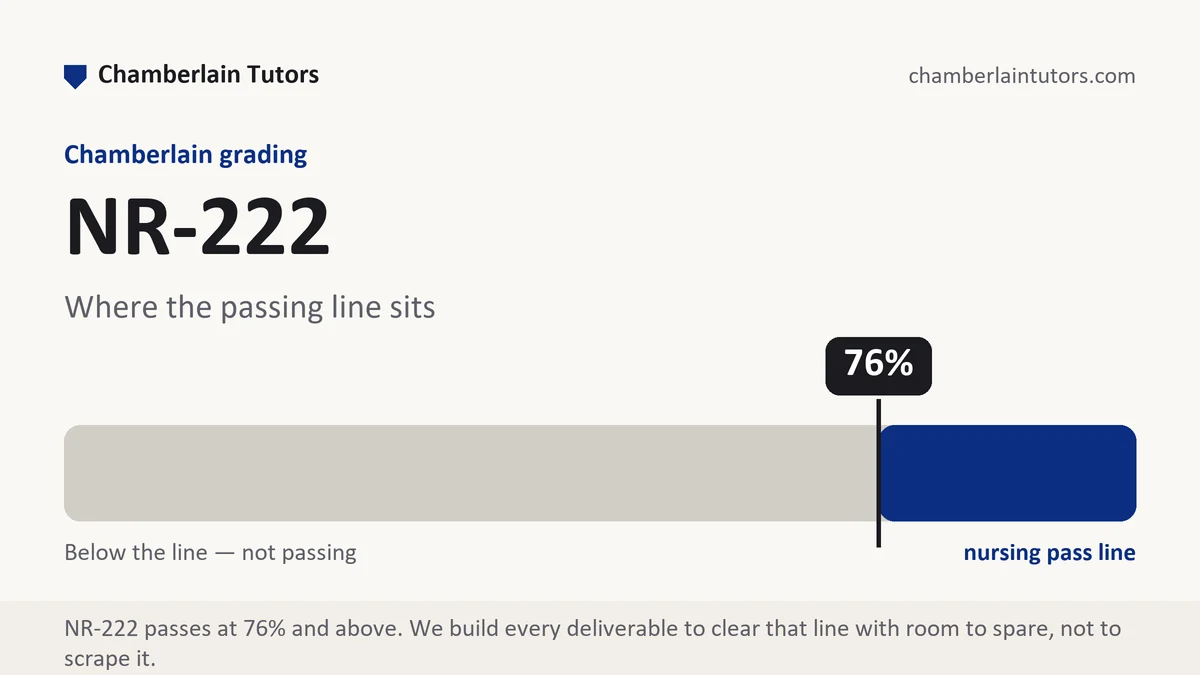
A passing NR-222 paper is accurate and generic. It picks a broad population, recommends diet, exercise, sleep and stress management, gestures at national objectives without quoting one, and closes by saying prevention matters. Nothing in it is false. It scores in the seventies, and with the 76 percent floor applying to core nursing courses, a term of correct but generic submissions leaves no margin, since extra effort later cannot raise a weak weighted average.
Three differences show up within a page. A strong paper narrows the population until its recommendations could only fit that group, which is what makes the domain analysis possible at all. It commits to one level of prevention and defends the choice, rather than blending screening, education and management into a single undifferentiated plan. And it closes on a measurable outcome with a time frame attached, so the ending is checkable instead of hopeful. Narrow, committed, measurable. None of it costs extra reading, only earlier decisions.
Five mistakes that cost real points here
- Choosing a population that is really everybody. Adults, or women, or teenagers is not a population. Once the group is broad, every recommendation has to be broad, and the analysis row has nothing specific to score.
- Writing treatment while calling it prevention. Managing an existing condition is tertiary prevention and should be labeled that way. Papers that drift into disease management without naming the level lose the row that asks for preventive reasoning.
- Using domains as headings only. If the paragraph under the environmental heading would read identically under the psychological one, the lens was never applied.
- Quoting a national objective from memory. Objectives have exact wording, a target and a data year. Paraphrasing one loosely turns your strongest citation into your weakest sentence.
- Ending on intent instead of measurement. Promising to evaluate effectiveness scores nothing. One number, one window, one source of that number scores the row completely.
Questions NR-222 students ask
The prompt lets me choose the population. Which choice makes the paper easier to write well?
Can I use my own family, patients or workplace as the example?
How do I use a Healthy People objective without simply copying it?
Where NR-222 sits in Chamberlain's programs
Open the exact program map for sequence, credit, and option context. The current student schedule and syllabus remain authoritative after transfer evaluation, electives, state rules, and approved plan changes.
The weeks, one by one
Week 1
NR-222 Week 1 opens with a deceptively simple task: define health, and defend the definition. Read the full Week 1 manual.
Week 2
NR-222 Week 2 moves the camera off the individual and onto everything around the individual: income, housing, education, transportation, food access, social connection, and the environments that shape health before any clinician is involved. Read the full Week 2 manual.
Week 3
NR-222 Week 3 hands you the three-level architecture of prevention: primary actions that stop disease before it starts, secondary actions that catch it early while it is silent, and tertiary actions that limit damage once it is established. Read the full Week 3 manual.
Week 4
NR-222 Week 4 asks why people keep doing what harms them, and what a nurse can do about it besides repeating advice louder. Read the full Week 4 manual.
Week 5
NR-222 Week 5 starts the lifespan walk at its beginning: health promotion for infants, children, and adolescents, where the patient grows, the real audience is often a parent, and the risks change costume every few years. Read the full Week 5 manual.
Week 6
NR-222 Week 6 carries health promotion into adulthood and old age, where the work shifts from building habits to defending function: screening in the busy middle years, then preserving mobility, cognition, independence, and connection as aging changes the terms. Read the full Week 6 manual.
Week 7
NR-222 Week 7 turns the nurse into a teacher and grades the lesson plan. Read the full Week 7 manual.
Week 8
NR-222 Week 8 gathers the whole session into one deliverable: a written wellness plan that assesses a person across dimensions, sorts their circumstances, locates their readiness, sets prevention-leveled priorities, and teaches to them, all in one document. Read the full Week 8 manual.