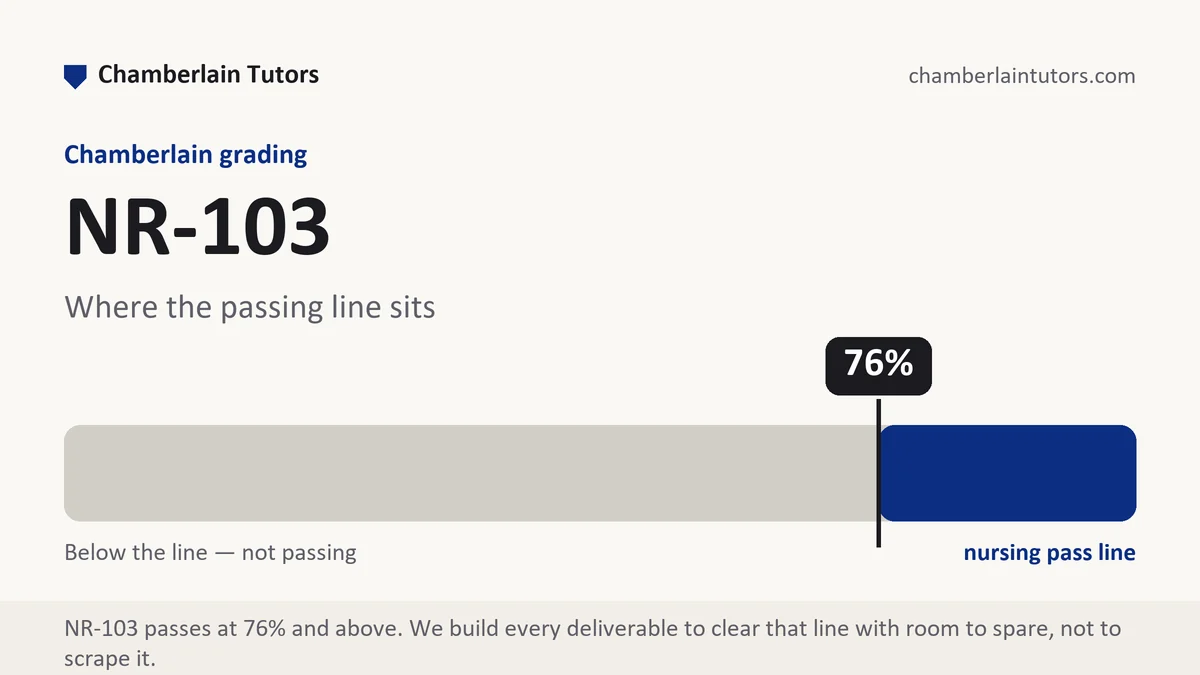
NR-103 Transition to the Nursing Profession is a two credit hour seminar with no lab and no clinical hours, and it is the first place Chamberlain grades how you write rather than only what you know. The catalog puts four things inside it: how this university works, how adults actually learn, emotional intelligence and self-management, and scholarly writing down to punctuation and grammar. That last item is the one students underestimate. Sentence-level correctness is scored here, not merely corrected, and the course sits under the 76 percent floor Chamberlain applies to core nursing work. This page is the manual: scoring rows into a plan, what a reflection has to prove, and where the points quietly leak.
What NR-103 actually grades
Two credit hours buys a short course, and short courses concentrate the grade into very few pieces. Nothing here is a knowledge dump about anatomy or pharmacology. The graded writing asks you to take an experience, hold it against a named idea from the course, and show what changed in how you work. Adult-learning principles, emotional intelligence domains and self-management methods are the ideas; you are the case study.
Underneath that sits the writing skill layer the catalog names outright. Scholarly format, punctuation and grammar are course content here, which makes them gradeable content. In later nursing courses a comma splice costs you a comment. Here it can cost you a row, and it is the only row in your degree you can max out with a proofreading pass rather than with new knowledge.
Both halves land inside Chamberlain's weekly rhythm. A semester runs 16 weeks, split into two 8 week sessions, with as many as six starts offered across the year, and every week opens graded work in Canvas. Discussion posts do not reopen once they publish, so in a course that grades punctuation, a board reply is a permanent writing sample.
How we help in this course
We draft the written layer of NR-103 to your posted scoring rows: reflections, self-assessments, board posts written to final quality before they publish, and the short scholarly pieces the seminar uses to test format. Everything comes back with the mechanics already clean, because in this course clean mechanics is points rather than polish.
The service terms match the rest of the site: a premium original draft in 24 to 48 hours, targeted at the A band of your course's actual scale, through the eight-person pipeline with two QA passes and the floor check, revised free until it lands where you need it.
In NR-103 right now?
Send the week and the rubric from Canvas. First premium sample free, floor-checked, back in 24 to 48 hours.
Read the scoring rows before you read the prompt
A two credit seminar has very few graded pieces, so each carries more weight per page than anything in a longer course. Before drafting, build a two column answer sheet. On the left, paste each criterion row exactly as Canvas states it. On the right, write the one sentence that would satisfy it. Any row where the sentence will not come is the row you do not yet understand, and that is worth a message to your instructor early in the week rather than a guess at the end of it. The rows then become your sections, in the order the guide prints them.
Next, turn the percentages into a word count, because weight is an instruction about depth. Suppose your week's reflection is capped at 900 words with rows at 35, 25, 25 and 15 percent. Run the arithmetic: roughly 315 words belong to the first row, 225 to each of the middle two, and 135 to the last. Put those four figures at the top of the page and check each section against its own figure as you finish it. A section landing far under its share is a warning rather than a saving.
Two things go wrong at this step. The first is the mechanics row. If format and grammar carry 15 percent, that is not 135 words about grammar, it is 135 words of budget you spend on a proofreading pass instead. Treat any row scoring presentation rather than content as time rather than text, and give it the last 20 minutes before you submit. The second is the reflection row, almost always the heaviest and almost always the shortest thing students write, because personal writing feels finished sooner than researched writing does. If that row is worth a third of the grade and your reflection is two paragraphs, the arithmetic has already decided your score.
One line worth hunting for before you trim anything: whether the title page and reference list count toward the limit. If they do not, cutting analysis to make room for citations gives away words nobody was charging you.
The shape of a reflective self-assessment
Reflections and self-assessments are the seminar's staple deliverable, whatever a given week calls them. Six moves carry the grade, and a grader can usually tell within a paragraph whether each one is there.
| Move | What the grader is checking | What the weak version looks like |
|---|---|---|
| One situation, named in specifics | That you picked a single moment with a time, a place and a decision in it, small enough to analyze in a page. | A general account of a whole semester, or of nursing as a career. |
| The course idea, named | The adult-learning principle, emotional intelligence domain or self-management method you are applying, named in the course's own words. | Everyday language for the idea, with the course term missing entirely. |
| The idea defined from a source | A cited definition or model, so the term you used means what the discipline says it means. | A definition invented on the spot, or one lifted from an unnamed website. |
| Honest self-rating | Where you actually sit against that idea, described using the same language the model uses. | Either flawless self-praise or blanket self-criticism, both of which are unusable. |
| The change, written as behavior | What you will do differently, stated so specifically that someone could watch you do it. | An intention with no shape, such as managing time better or communicating more. |
| The check | How you will know the change worked, in the form of something you could look back at in four weeks. | A closing paragraph that restates the introduction and stops. |
Sources and citations in a first nursing course
Reflective writing still carries evidence, and this is the course where the habits get built. Four of them do most of the work.
Library first, and check the year. Use the university library rather than an open web search. Aim for work published within the last five years unless your guide sets a different window, and when you keep something older, say in the sentence why it earns its place. A founding description of an emotional intelligence model earns it. A ten year old figure does not.
Set the scene before the statistic. Tell the reader what kind of study it was and how many people were in it before the finding arrives. A clause like in a survey of 412 first-year nursing students costs seven words and changes an assertion into something a reader can weigh.
Let the verb follow the design. If a study only watched people, your verb can reach as far as linked to, or reported more often by, and no further. Words like caused and improved belong to controlled designs. Hanging a causal verb on a correlation is the sentence-level mistake most likely to be circled in a course that grades sentences.
Give every percentage a base and a period. Roughly one in five of the 300 students surveyed reported the same difficulty during their first term tells a reader something. Twenty percent struggled does not. The base group and the time frame are what let anyone check you.
Then run the mechanics pass this course exists to teach. Read the draft aloud once, because your ear catches run-on sentences your eye forgives, and check that every in-text citation appears in the reference list and every reference appears in the text.
What lifts an NR-103 reflection above passing
A passing reflection here is sincere, on topic and roughly the right length. It describes something that happened, agrees the course idea is useful, and ends politely. Nothing in it is wrong, which is exactly why it lands in the seventies. Sincerity is not a scored row, and with the 76 floor governing core nursing courses, a run of merely sincere submissions leaves no margin in a course that has few grades to average.
Three moves change that. The first is narrowing: one moment examined closely, rather than four moments mentioned. The second is using the course idea instead of naming it, so the analysis reads as the model applied throughout rather than cited in the opening paragraph and abandoned. The third is ending on a change specific enough to be checked, which is the whole difference between a reflection and a diary entry. Narrow, applied, checkable. None of the three asks you to read more.
Six mistakes that cost real points here
- Writing a diary instead of an analysis. Story is the raw material, not the deliverable. If no course idea is named and applied, the grader has nothing to score against the rows.
- Treating the mechanics row as decoration. Punctuation and grammar are course content here. A row you can max out with a careful reread is the cheapest margin in your degree.
- Posting to the board before proofreading. Chamberlain discussions do not reopen once a post publishes. Draft in a document, read it aloud, then paste, because that post is a permanent writing sample in a writing course.
- Leaving the concept unnamed. Describing self-awareness without ever using the term the model uses reads as everyday language, and the row asking you to apply the idea stays empty.
- Ending on an intention with no shape. Vowing to improve time management scores nothing. A change stated with a what, a when and a how often scores the same row completely.
- Assuming a two credit course cannot hurt you. Fewer graded pieces means each carries more weight, on the same transcript as everything else.
Questions NR-103 students ask
It is only a two credit seminar. Does this grade really matter?
How personal is a reflection supposed to get?
My ideas are fine, my grammar is not. What actually fixes that quickly?
Where NR-103 sits in Chamberlain's programs
Open the exact program map for sequence, credit, and option context. The current student schedule and syllabus remain authoritative after transfer evaluation, electives, state rules, and approved plan changes.
The weeks, one by one
Week 1
NR-103 Week 1 is the first piece of writing most students produce as nursing students, and it almost always circles one question: why nursing, and what makes nursing a profession rather than a job. Read the full Week 1 manual.
Week 2
NR-103 Week 2 is where the curriculum hands you its own vocabulary: the conceptual framework your program uses to organize what a nurse is and does, built around ideas like caring, professional identity, and the person as a whole rather than a diagnosis. Read the full Week 2 manual.
Week 3
NR-103 Week 3 turns the lens on you as a learner, and the written work at this stage usually takes the form of a study plan or learning self-assessment: how you take in material, where your current habits leak time, and what system will carry you through an eight-week session where content arrives. Read the full Week 3 manual.
Week 4
NR-103 Week 4 treats communication as a clinical skill practiced on paper first: how a nurse writes an email a professor takes seriously, structures information so nothing critical is buried, and speaks to patients and colleagues in registers that fit the moment. Read the full Week 4 manual.
Week 5
NR-103 Week 5 is the stage where borrowed ideas start needing name tags. Read the full Week 5 manual.
Week 6
NR-103 Week 6 widens the frame from the nurse to the team around the nurse: who does what in a modern care setting, where scopes of practice begin and end, and why the registered nurse so often functions as the hub the other spokes pass through. Read the full Week 6 manual.
Week 7
NR-103 Week 7 is about the behaviors that make a license worth trusting: accountability, boundaries, confidentiality, and the ethical code that governs nurses long before a student touches a patient. Read the full Week 7 manual.
Week 8
NR-103 Week 8 closes the transition by asking you to write a forward plan: the professional identity you have started building, the habits and goals that will carry it through the program, and the supports that will keep you in school when the pace bites. Read the full Week 8 manual.