NR-606 Week 7 is the prescribing week for a population that is still growing. Late in an eight-week session, with the assessment work behind you, the writing turns to the decision itself: whether medication is indicated for a child or adolescent, what the starting dose is and why that number, what is measured before and after, and what tells you the trial worked or should stop. Your section may print this as NR 606 or NR606; it is the same course. Chamberlain publishes no syllabi outside Canvas. The placement here is our teaching judgment from the course's catalog arc; your section's rubric decides what your week actually asks.
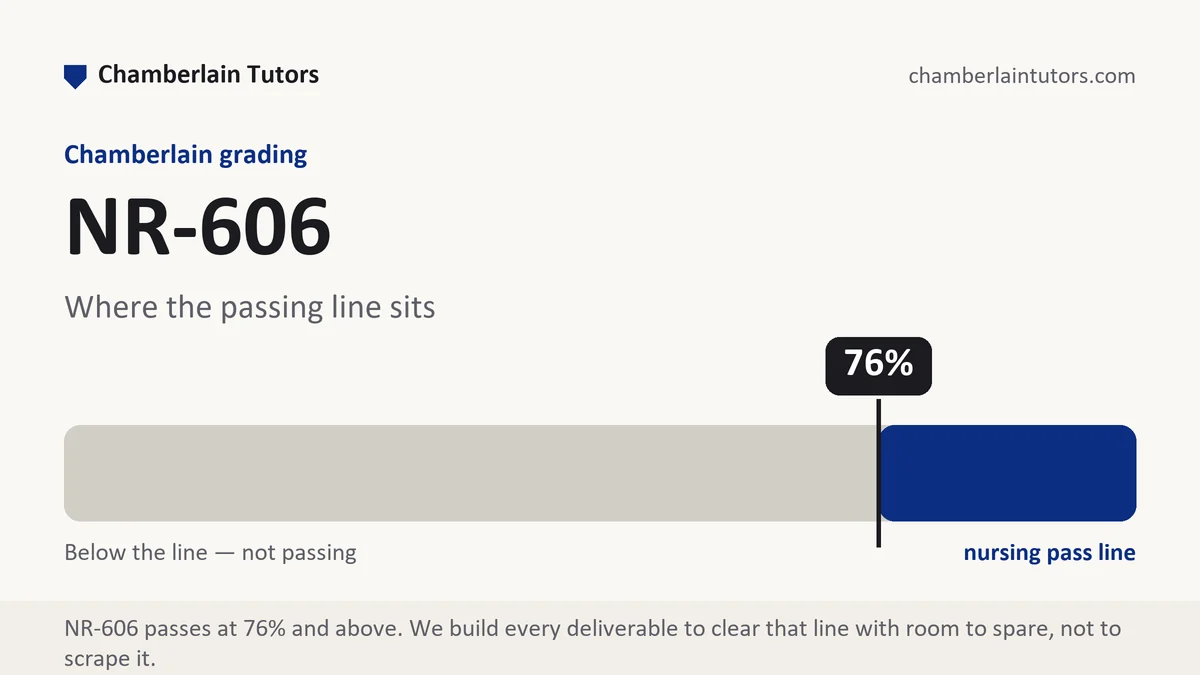
What NR-606 Week 7 asks for
The territory is dosing and surveillance in a body that changes. Weight moves, metabolism differs from adult patterns, growth is a monitored outcome rather than a background fact, and the person taking the medication is often not the person who decides whether it is taken. Every one of those realities produces a specific requirement in the write-up: a documented weight and its date, a rationale for the starting dose that mentions the age and the weight, a titration schedule with intervals, and a monitoring plan that names parameters, thresholds and who collects them.
The second demand is the indication argument. Medication in this population is one arm of a plan, and a strong paper says what the behavioral, family or educational arm is doing at the same time, what was tried first where that was appropriate, and what makes medication the right addition now. A prescription written as the entire plan reads as an incomplete answer in a course built on comprehensive care.
The third demand is consent and assent, documented as two things. A caregiver consents; the young person assents, and their questions and objections belong in the record. At this point in an eight-week session the deliverable is usually a management case or a treatment plan of three to five pages. Two boundaries hold to the end: prescribing happens under your preceptor's supervision inside your setting's rules, and your clinical hours, log, preceptor forms and any signed documentation remain yours alone.
The NR-606 Week 7 method, step by step
Six moves that make a pediatric medication decision auditable on the page.
-
Write the target symptom and its current measure
Name the specific problem the medication is aimed at and how it is currently quantified: a rated scale score, a behavior count from home or school, or a functional marker. Without a starting number there is no way to judge the trial later.
-
Record weight, height and the date they were taken
Both numbers with a date, plus any recent trend in them. In this population these are dosing inputs and monitored outcomes at the same time, and a plan that omits them cannot justify its own numbers.
-
Justify the starting dose out loud
Say where the number came from: the age band, the weight, the usual starting range for this indication in this age group, and any factor that argues for starting lower. A dose that appears without a sentence behind it is the single most common gap in student pediatric plans.
-
Write the titration schedule with intervals and stopping points
How much, how often, up to what, and what you check before each increase. Then the point at which no further increase is appropriate and what happens instead. Titration described as adjust as needed gives the management row nothing.
-
Build the monitoring table before the first dose
Baseline items, what recurs at each visit, the intervals, the thresholds that would prompt action, and who collects each item. Include the parameters specific to the agent and the growth and vital sign items specific to the age.
-
Document consent, assent and the family's questions
What the caregiver was told and agreed to, what the young person was told at their level and how they responded, what worried them, and what you said back. Include what everyone was told to do if something alarming happens and how to reach the service.
A layout and word budget for a pediatric medication plan
Below is the drafting frame our tutors use for a pediatric prescribing case, sized for roughly 1,400 to 1,600 words. It is our own outline rather than anything the university issues, and your week's rubric outranks it wherever the two disagree. Scale each target proportionally if your assigned length differs.
| Section | What belongs in it | Word target |
|---|---|---|
| Indication and current measure | The target symptom, its impairment, and the baseline number the trial will be judged against. | 180 to 210 |
| What is already in place | Behavioral, family and educational interventions running alongside, and what has been tried already. | 200 to 240 |
| Agent selection | Why this class and this agent at this age, with the alternative answered rather than ignored. | 260 to 300 |
| Dose, weight and titration | Weight and date, starting dose with its rationale, increments, intervals and the ceiling. | 280 to 330 |
| Monitoring plan | Baseline items, recurring items, intervals, thresholds for action, and who collects each. | 280 to 330 |
| Consent, assent and instructions | The conversation with caregiver and young person, their questions, and what to do if something goes wrong. | 200 to 240 |
Evidence craft for pediatric prescribing claims
An adult trial cannot underwrite a pediatric dose. If your source studied adults, say so in the sentence and say what you did about the gap. This is the error a specialty faculty reader looks for first in this territory, and naming the gap yourself converts a weakness into a demonstration of judgment.
Report the age band of every study you use. A trial in children aged six to twelve does not automatically speak for a five-year-old or a sixteen-year-old. Put the band in the sentence with the finding so the reader can judge the transfer themselves.
Give effects a denominator and a window. A percentage responding is unusable without how many were treated and by what point. Sixty of two hundred and ten children responded by week eight is a claim that can be argued with, which is what makes it evidence.
Handle labeling and warnings precisely. Where an agent carries a boxed warning or an age restriction relevant to your case, state it accurately, name the source and the year, and say how it changes your monitoring. Where use would be outside labeling, say that plainly rather than leaving it implied.
Five mistakes that cost points in this week's territory
- A dose with no weight behind it. Missing weight and date makes the starting number unjustifiable and the monitoring incomplete.
- Medication written as the whole plan. With no behavioral or educational arm described, the comprehensiveness rows have nothing to award.
- Monitoring listed without intervals or thresholds. Naming parameters is half the work; the schedule and the action points are the other half.
- Assent omitted. Caregiver consent alone leaves the patient out of a decision about their own body, and most guides in this territory score the omission.
- Adult evidence used silently. Borrowing a finding across age without acknowledging it costs more than the gap itself ever would.
Before you submit
- A baseline measure for the target symptom appears before the plan
- Weight and height are recorded with the date they were taken
- The starting dose has a stated rationale tied to age and weight
- Titration gives increments, intervals and a ceiling
- Monitoring names parameters, thresholds, intervals and responsible parties
- Every reference appears in the text and every in-text citation appears in the list
Writing a pediatric medication plan for NR-606?
Send the case and the rubric from Canvas. A premium original draft comes back in 24 to 48 hours with the dose justified from age and weight and the monitoring built as a schedule, and revisions run until the grade lands.