NR-603 Week 1 usually opens the advanced diagnosis course with the machinery itself: how an undifferentiated complaint becomes a prioritized differential and then a defended working diagnosis. The graded product is not the answer but the visible path to it, tiered candidates, hypothesis-driven data gathering, pertinent negatives doing stated work. Your section may print this as NR 603 or NR603; it is the same course. Chamberlain publishes no syllabi outside Canvas. The placement here is our teaching judgment from the course's catalog arc; your section's rubric decides what your week actually asks.
The catalog frames NR-603 as advanced clinical diagnosis and practice across the lifespan, complex acute and chronic conditions including behavioral health, with 125 practicum hours running through the same eight weeks as the writing. Our lane, marked at the course's first page: drafts, coaching and revision of written work. The hours, the preceptor, the site's paperwork and the logs are your side of the line and stay there.
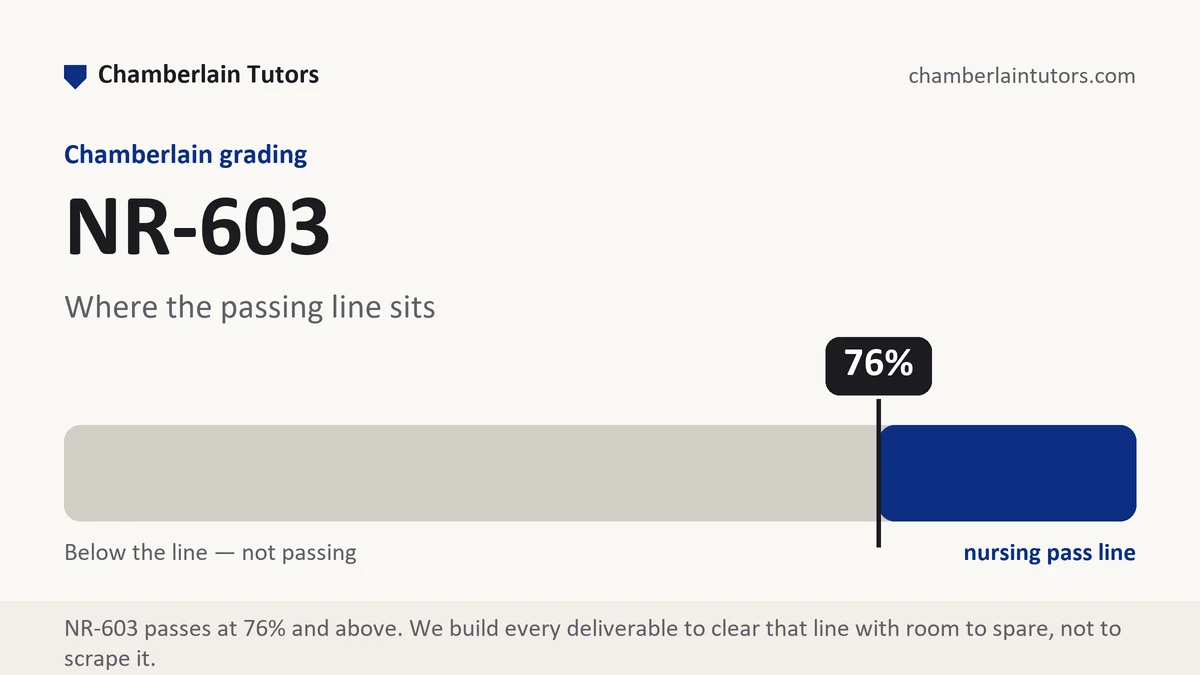
What NR-603 Week 1 asks for
Expect the territory to cover the problem representation, one sentence that abstracts the patient into clinical language, differential construction in deliberate tiers, the discipline of letting hypotheses choose the questions and exam moves rather than the reverse, pertinent positives and negatives as working evidence, and the cognitive biases that bend diagnosis, anchoring, premature closure, availability, with the habits that check them.
The deliverable shapes are usually a reasoning-focused case write-up where the differential is the graded core, a paper deconstructing a diagnostic error, or an exercise producing tiered differentials for a set of presentations. If your section runs a discussion this week, it commonly gives one vague complaint, fatigue, dizziness, weight loss, and asks for your first three hypotheses and the data that would separate them.
The habit graders test first is direction of flow. A write-up that collects all data and then announces a diagnosis has hidden its reasoning; the week exists to make you show data being sought because a hypothesis demanded it.
The NR-603 Week 1 method, step by step
Six moves that put the thinking on the page.
-
Compress the case into a problem representation
One sentence: who, with what course, and which qualifiers. Acute against chronic, exertional against positional, first episode against recurrent. That sentence is the differential's search key, and writing it well is half the week's skill.
-
Build the differential in three tiers
Most likely given the epidemiology, cannot-miss whatever the odds, and worth-holding possibilities behind them. Each candidate earns one sentence of why it belongs. Tiering is what separates a differential from an alphabetized list, and rubrics score the separation.
-
Let the hypotheses order the data gathering
For each question asked and maneuver performed, the paper should make clear which candidate it tests. Write it as pursuit: this was asked because it separates these two, this was examined because a cannot-miss requires it.
-
Give pertinent negatives their jobs
An absent finding matters only when tied to the hypothesis it weakens. List the negatives that did real work and name the candidate each one demoted. Unattached negatives are inventory; attached ones are reasoning.
-
Audit yourself for one named bias
Pick the bias this case most invited, anchoring on the first plausible story, closure before the cannot-miss tier cleared, and write the check you ran against it. One honest, specific audit outperforms a paragraph naming every bias in the textbook.
-
Commit, with the closing finding named
State the working diagnosis, the finding that finally separated it from its nearest rival, and what would reopen the question. Then format to current APA with headings in your week's rubric wording.
A reasoning case, section by section
Targets assume 1,350 words. Rescale to your prompt; in reasoning-weighted rubrics the differential and pursuit sections carry the paper.
| Section | What belongs there | Word target |
|---|---|---|
| Problem representation | The one-sentence abstraction with its qualifiers, and a line on why each qualifier matters | 140 to 180 |
| Tiered differential | Most likely, cannot-miss and holding candidates, each with its one-sentence claim to a place | 260 to 310 |
| Hypothesis-driven pursuit | History and exam moves each tied to the candidate it tests, written as pursuit rather than inventory | 260 to 310 |
| Pertinent positives and negatives | The findings that moved candidates, each attached to what it moved and which direction | 200 to 240 |
| Bias audit | The one bias this case invited, and the concrete check run against it | 130 to 170 |
| Commitment | The working diagnosis, its closing finding, and the result that would reopen the question | 170 to 210 |
The commitment section is short and decisive on purpose. Reasoning papers die of hedging at the end; the skill being graded includes the nerve to conclude and the humility to name the reopening condition.
Citing the reasoning literature and the epidemiology
This week's citations split into two kinds. The first is the clinical epidemiology that justifies your most-likely tier: prevalence and incidence figures, each carried with its population, setting and time window, because likely in an urgent care differs from likely in a specialty clinic, and a differential ranked on the wrong setting's numbers is quietly wrong.
The second kind is the diagnostic reasoning literature itself, which is largely observational and simulation-based. Findings about error rates or bias effects support was associated with and was observed in, not proof that a habit causes misdiagnosis; matching that register shows you can appraise the science of your own thinking, which is very much this week's point.
Wherever a claim about a disease's typical presentation does argumentative work, cite a current source rather than memory, and put the year in the sentence when the source is a versioned guideline. Presentation patterns get revised as populations age and change; the phrase classic presentation has an edition date more often than students expect.
Five mistakes that cost points in the reasoning week
- The flat list. Ten diagnoses without tiers or claims tells a grader the epidemiology never engaged.
- Data before hypotheses. A complete review of systems performed before any candidate existed reverses the method being graded.
- Orphan negatives. Denies fever, denies weight loss, with no candidate attached to either, is inventory pretending to be reasoning.
- The missing cannot-miss tier. A differential of only plausible, benign candidates fails the week's safety logic regardless of the final answer.
- A conclusion without its closing finding. Announcing the diagnosis without naming what separated it from the runner-up hides the one step the paper exists to show.
Before you submit
- The problem representation is one sentence with working qualifiers
- The differential shows three tiers and every candidate has its one-line claim
- Each history question and exam move is tied to the hypothesis it tests
- Pertinent negatives are attached to the candidates they demote
- One named bias is audited with a concrete check
- The commitment names the closing finding and the reopening condition
First 603 case due while the rotation eats the week?
Send the presentation and rubric from Canvas. A tiered, pursuit-structured draft returns in 24 to 48 hours with the reasoning where a grader can see it.