NR-508 Week 1 lays the foundation the rest of the session stands on: what the body does to a drug, and what the drug does to the body. Absorption, distribution, metabolism and elimination decide how much of a dose reaches its target and for how long, while receptor binding and dose response decide what happens once it arrives. Written work at this stage is graded on whether you can use those ideas to explain a specific patient rather than define them. Your section may print this as NR 508 or NR508; it is the same course. Chamberlain publishes no syllabi outside Canvas. The placement here is our teaching judgment from the course's catalog arc; your section's rubric decides what your week actually asks.
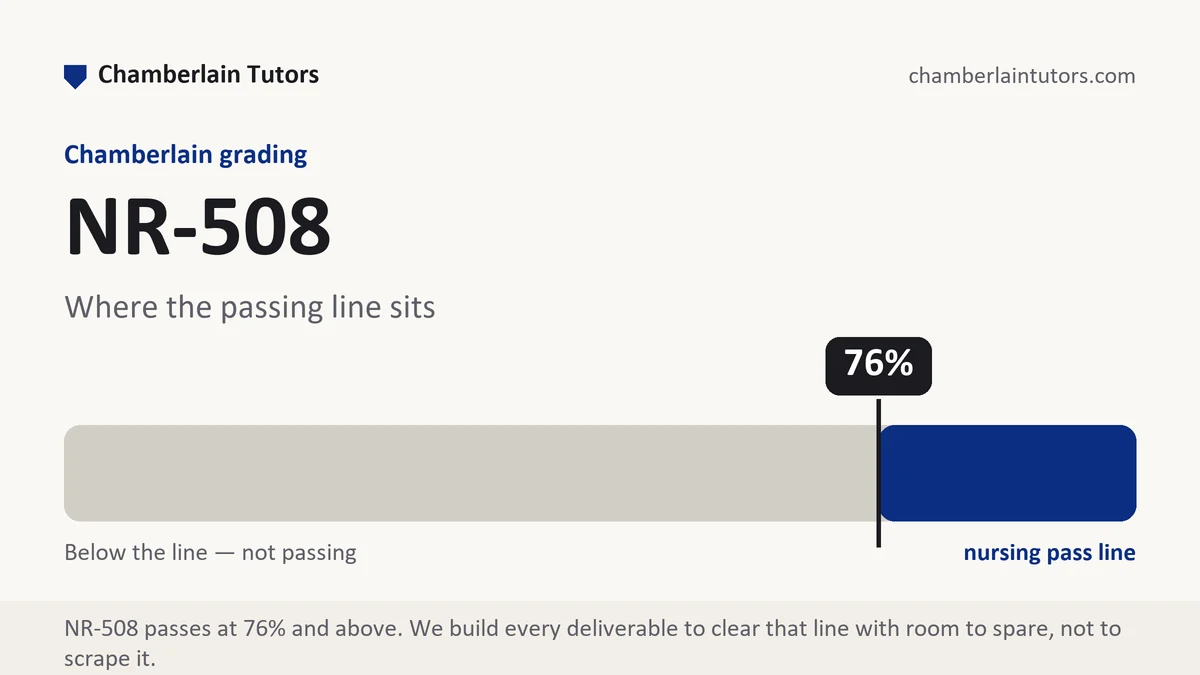
What NR-508 Week 1 asks for
The territory is the vocabulary of drug behavior: bioavailability and first pass effect, protein binding and volume of distribution, the enzyme systems that metabolize most of what a practitioner prescribes, half life and the relationship between it and steady state, renal and hepatic elimination, and on the dynamic side agonism, antagonism, potency, efficacy and the therapeutic window. Graduate work does not stop at the definitions. It asks what changes when the patient has reduced kidney function, when another medication induces or inhibits the same enzyme, when age changes body composition, or when the route of administration changes.
Opening deliverables in this course tend to be short and conceptual, sometimes a written response and sometimes a posted answer to a scenario. The trap is that a short conceptual piece invites recitation, and recitation is the cheapest thing a grader at this level can be shown. Write every principle with a consequence attached: a longer half life means a longer wait to steady state and a longer wait to see whether a change worked, which is a scheduling fact a practitioner acts on.
One habit set now pays for the remaining weeks. Whenever you name a pharmacokinetic property, finish the sentence with the practical decision it changes, which is usually dose interval, starting dose, monitoring interval or the choice between two agents. If your section runs a discussion this week, remember that posts do not reopen once submitted in Canvas, so a drug claim posted in haste stays visible for the whole term.
The NR-508 Week 1 method, step by step
Six moves that turn foundational pharmacology into writing that reasons rather than recites.
-
Reduce your week's rubric to its verbs
Explain, compare, apply and predict ask for different work, and the row weights say which one holds the points. Turn the rows into headings in the order they appear and write against them rather than against your own outline.
-
Pick the patient variable before the principle
Start from the thing that is different about this patient: kidney function, liver function, age, body composition, another medication, an oral route that a first pass effect will blunt. The principle then has something to explain.
-
Follow the drug in order and stop where it matters
Absorption, distribution, metabolism, elimination, in sequence, but spend words only on the steps your patient variable actually disturbs. A full tour of all four for a drug that is entirely renally cleared wastes most of a short deliverable.
-
Convert half life into a timetable
Say what the half life means for reaching steady state, for how long a change takes to show and for what happens if a dose is missed. Time is the most usable output of this whole topic and the one students most often leave implicit.
-
Say what the dose response curve implies
Distinguish potency from efficacy plainly, and say whether the agent has a wide or narrow therapeutic window, because that single property decides how closely anyone has to watch.
-
Land it on a decision
Close with the choice the reasoning produced: a lower starting dose, a longer interval, a different route, an earlier check. A principles paper that ends on a definition has not shown a practitioner thinking.
A layout and word budget for a principles write-up
This is the drafting frame our tutors keep beside an opening pharmacology piece, sized for a response of roughly 900 to 1,100 words. It is our own outline rather than anything the university issues, and your week's rubric outranks it wherever the two disagree. Scale each target proportionally if your assigned length differs.
| Section | What belongs in it | Word target |
|---|---|---|
| Opening frame | The patient variable and the question it raises, in two sentences, with no runway ahead of it. | 60 to 80 |
| Route and absorption | How the drug gets in, what fraction reaches circulation, and what the route changes about onset. | 140 to 170 |
| Distribution | Where it goes, what protein binding and body composition do to that, and why it matters here. | 140 to 170 |
| Metabolism and elimination | The clearance route, the enzyme or organ involved, and what happens when that route is impaired. | 200 to 240 |
| Timing from half life | Steady state, the interval between doses, and how long before anyone can judge the effect. | 150 to 180 |
| Dose response and window | Potency against efficacy, and whether the margin between useful and harmful is wide or narrow. | 140 to 170 |
| The decision | What you would do differently for this patient because of everything above. | 90 to 110 |
Evidence craft for pharmacologic principles
Match the source to the kind of claim. Approved indications, dosing ranges, listed warnings and pharmacokinetic parameters belong to drug references and manufacturer labelling, and citing them for that material is correct rather than lazy. Anything phrased as one agent performing better than another needs a study that compared them.
Parameters are population averages. A stated half life or bioavailability figure describes a study population, often healthy adults, and your patient may sit well outside it. Say where the number came from and note the patient features that would shift it, since that sentence is the difference between quoting a value and understanding it.
Keep mechanism and outcome as separate claims. A plausible mechanism is a reason to expect an effect; it is not evidence that the effect occurs. Papers in this course routinely reason from receptor activity to clinical benefit in one sentence, and that jump is exactly what the analysis rows are watching for.
Date the reference you used. Labelling is revised, and drug references publish updates continuously. Name the edition or the access year in your citation so a reader knows which version supports your claim, and check that a value you learned earlier in your program has not since changed.
Five mistakes that cost points in this week's territory
- Definitions in place of application. A correct account of first pass metabolism with no patient attached is textbook recall and scores as recall.
- All four kinetic steps given equal space. Short deliverables cannot afford a tour, and the step that your case actually disturbs ends up underwritten.
- Half life mentioned without a timetable. The number is only useful once it has been turned into a wait, an interval or a review date.
- Potency and efficacy used as synonyms. They answer different questions, and a grader reads the swap as a gap in the reading.
- Interaction asserted with no route named. Saying two drugs interact means little; saying which shared clearance route produces the problem is the analysis.
Before you submit
- One patient variable drives the whole response and appears in the opening lines
- Words are concentrated on the kinetic step that variable actually disturbs
- Half life has been converted into a timetable a clinician could use
- Potency, efficacy and therapeutic window are used with their distinct meanings
- Each source type matches the kind of claim it is being asked to support
- Every reference appears in the text and every in-text citation appears in the list
Opening NR-508 this week?
Send the instructions and the rubric out of Canvas. A premium original draft comes back in 24 to 48 hours with the kinetics written as reasoning about one patient, and revisions run until the grade lands.