Chamberlain runs two kinds of graduate certificate. The post-graduate APRN certificates, FNP, PMHNP, AGACNP and AGPCNP, add a nurse practitioner specialty for a nurse who already holds a graduate nursing degree, and they carry clinical hours, a preceptor and a site. The graduate certificates in Healthcare Policy, Nursing Education, Nursing Informatics, Nursing Leadership and Population Health add a focus without adding scope of practice, and the Leadership Foundations post-baccalaureate certificate sits one step earlier than all of them. Every one of them runs on the same eight-week sessions, the same weekly deliverables in Canvas, and the same grading scales as the degrees. We draft the written work for any of them in 24 to 48 hours, checked against whichever scale your course grades on.
Two families under one word
The word certificate covers two different experiences here. An APRN certificate is a specialty build: didactic courses plus a practicum, which means a preceptor who has to say yes, a site that has to be approved, and paperwork moving on someone else's calendar. A non-clinical certificate is a writing program, its weeks made of papers, discussion threads and project deliverables, with no placement to chase and no hours to log. Both share the same clock and the same rubrics as the degree courses around them, which is what people underestimate when they hear certificate and picture something lighter.
Who a certificate is for, and who should take the degree
A certificate is the right instrument when you already hold the graduate degree and what you need is the specialty or the focus sitting on top of it. It is also right when the realistic alternative is doing nothing, because a full degree looks like too much calendar to start. It is the wrong instrument in two situations. If you do not yet hold a graduate nursing degree, the post-graduate APRN certificates are not a side door into that qualification, and the master's tracks are the route instead, beginning with the shared NP core. And if the review of your transcript leaves almost the entire specialty sequence still in front of you, you have signed up for a degree's worth of coursework without a degree at the end of it.
The scale you land on, whichever one you pick
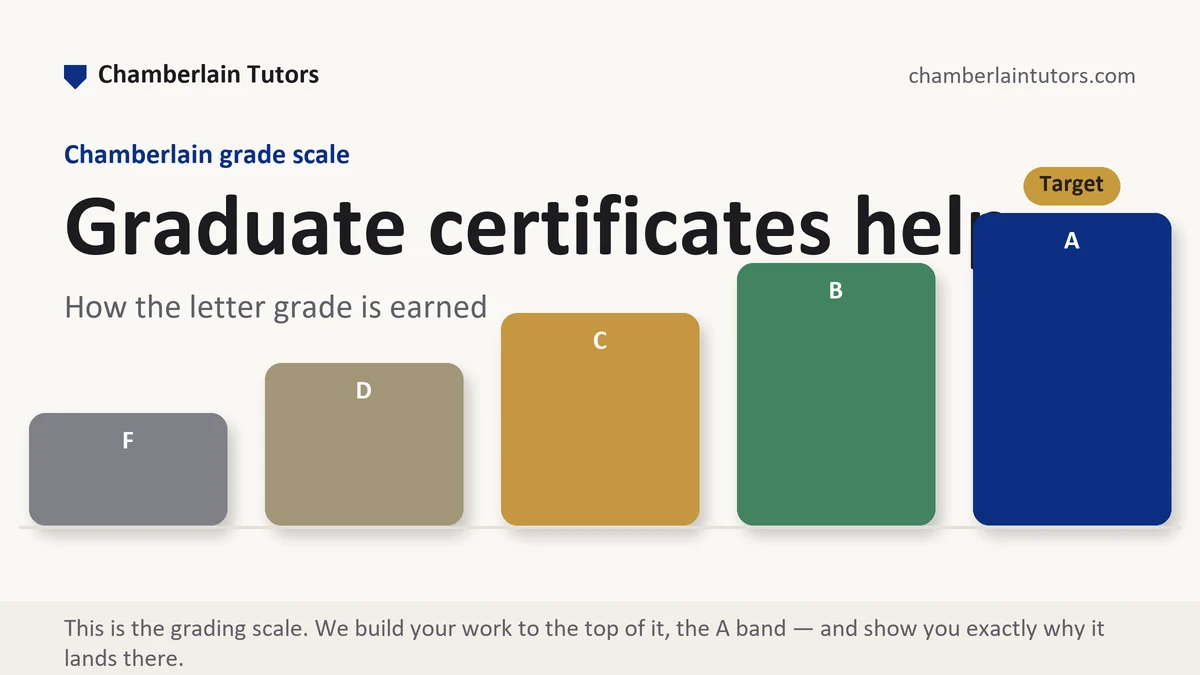
Two grading standards operate at Chamberlain and a certificate exempts you from neither. Core nursing coursework passes at 76 percent. The specialty scale used in NP courses skips the C band entirely, which puts its failing line at 84. On a short plan of study that eight-point gap bites harder than it does inside a degree, because there is less coursework left behind you to average a bad result against. Find out in week one which scale each course on your plan grades against, and treat the answer as the number you are actually writing toward. Our drafts are checked against that number before they reach you, not after a grade posts.
Certificate courses, week by week
Send the course, the week, and the rubric out of Canvas. First premium sample free, checked against your course's scale.
The ten certificates, and where each one is covered
Chamberlain does not publish its syllabi publicly, so no page anywhere, this one included, can tell you which courses your plan of study will list. What a page can do is name the set, say what each one is built for, and point at the track coverage that already exists here.
| Certificate | Built for | What the weeks are made of | Covered here |
|---|---|---|---|
| Post-graduate FNP | Adding family primary care across the lifespan | Didactic weeks plus practicum hours, a preceptor and site paperwork | The FNP track |
| Post-graduate PMHNP | Adding psychiatric mental health practice | The same shape, with psychiatric case writing carrying the didactic load | The PMHNP track |
| Post-graduate AGACNP | Adding adult-gerontology acute care | Didactic weeks plus practicum, with acute decision-making argued in writing | The shared NP core |
| Post-graduate AGPCNP | Adding adult-gerontology primary care | Didactic weeks plus practicum, with chronic-management writing dominant | The shared NP core |
| Healthcare Policy | Nurses moving toward advocacy, regulation and policy analysis | Analysis and position writing; check your plan for any applied component | Assignment desk |
| Nursing Education | Nurses heading into faculty or staff development roles | Curriculum, teaching and evaluation writing; ask whether a teaching experience sits on your plan | The session, explained |
| Nursing Informatics | Nurses working between clinicians and the systems they use | Systems analysis, workflow mapping and data-governance deliverables | Assignment desk |
| Nursing Leadership | Charge nurses, managers and nurses moving into administration | Finance, quality and organizational writing built on your own setting | The doctorate above it |
| Population Health | Nurses working on outcomes at community scale | Population data carried honestly in prose, plus project deliverables | The MPH register |
| Leadership Foundations, post-baccalaureate | A BSN nurse testing graduate work before committing to a master's | Graduate-register writing on the same eight-week clock | Where BSN work ends |
Two rows need reading twice. The AGACNP and AGPCNP certificates point at the core page rather than a track page of their own, so start there and send the specialty course when you reach it. And Leadership Foundations sits before the graduate degrees rather than after one, the only entry here not adding to a master's you already hold.
The calendar arithmetic, done once
A certificate's length is a count of courses, and that count is unknowable until your plan of study exists. Converting the count into calendar time is knowable right now, and doing it early changes decisions.
Chamberlain runs eight-week sessions with six start dates a year. Six sessions of eight weeks is 48 weeks, so a year holds all six with roughly four weeks of changeover shared between them, a handful of days each time rather than a summer. Every course on your plan is therefore eight weeks of graded work, and taken one at a time, eight weeks of calendar.
| Courses left on your plan | Sessions at one per slot | Weeks of instruction | First start to last final |
|---|---|---|---|
| 4 | 4 | 32 | About 8 months |
| 6 | 6 | 48 | About 12 months |
| 8 | 8 | 64 | About 16 months |
Then price a repeat, because a short plan behaves differently from a degree. Imagine a twelve-course degree: one repeated course is about eight percent of the program. Put the same repeat inside a plan of five courses and it is twenty percent of it, plus a whole extra eight-week session on a program that only had five. It can add two. Ask which sessions each course on your plan opens in before you schedule around it: if the course you would repeat does not run every session, one failure costs sixteen weeks instead of eight, and anything sequenced behind it waits just as long.
The decision, named in both directions
Certificate now, or the whole master's again
The certificate keeps the calendar short and builds on coursework you already passed, which is the whole logic of a post-graduate route. It keeps you working while you do it, and it reaches a specialty without repeating research, theory and policy courses you sat through once. What it costs is certainty. Until the review of your transcript is finished, the length of the program is genuinely unknown.
The full master's costs more sessions and more tuition, and some of those sessions re-cover ground you have covered already. What you buy is a published course list you can plan against from day one, no dependence on how a reviewer reads a syllabus from a decade ago, and a second credential on the transcript. Neither answer is wrong. The mistake is choosing before the plan of study exists, since that document is the only thing that makes the comparison real.
A clinical certificate, or a non-clinical one
An APRN certificate expands what you are licensed and certified to do, and nothing else on the list matches that. It also brings a practicum: hours to complete, a preceptor to secure, a site to get approved, and documentation habits the specialty assumes you have. The MSN NP tracks carry 625 clinical hours, so ask what figure your own plan carries and get it in writing, because that number decides whether the certificate fits around a working schedule at all.
A non-clinical certificate has none of that friction. Nobody has to say yes to you, nothing waits on a site agreement, and the program sits inside your control. The cost is that writing becomes the entire grade. No lab, no check-off and no clinical day breaks the rhythm, so a bad month has nowhere to hide, and the credential adds focus rather than scope of practice. Choose for what you want to be doing in two years, not for the friendlier calendar.
What we draft, and what stays yours
The service is writing: the weekly deliverables, the discussion posts written final-quality because a board cannot be edited once you submit, the project work and the reference lists, mapped to the rubric rows in your Canvas shell and checked against your course's scale before delivery.
Some things are declined, and the answer does not move when a deadline gets loud. We do not complete clinical hours or fill in an hour log, because the hours are your experience and recording them is part of having had it. We do not contact a preceptor, a site, a faculty member or an advisor, and we do not sign placement paperwork. We do not submit your plan of study, your transcripts or any form to the school. Where a form or a message has to be written, we coach the wording and you send it under your own name.
Before handing work to anyone, us included, get the boring answers: what happens when a draft comes back needing revision, how long revision support stays available, whether the same writer follows you into the next course when one session ends and the next opens days later, and who holds your files afterward. A provider who answers those in one message is telling you more than any promise about a grade could.
Where certificate students actually lose points
- Hearing certificate and picturing something lighter. The rubrics, the eight-week clock and the grading scales are the ones degree students are living under. The only thing shorter is the list of courses.
- Enrolling before the plan of study exists in writing. A verbal estimate of what carries over is not a plan. Ask for the course list, the sessions each course opens in, and the sequence, then schedule against that document and nothing else.
- Assuming eligibility follows automatically. Certifying bodies and your state board decide what a completed certificate qualifies you to sit for and to practice. Confirm with them before the first session, not after the last one.
- Bringing a decade-old writing habit. Rubric rows score sourced reasoning and a defensible conclusion. The tidy summary that earned a B during your first master's reads thin against them, and citation editions have moved since.
- Posting as though a thread can be fixed later. Discussion posts cannot be edited once submitted. Draft in a document, leave it overnight, read it cold, then paste it.
- Starting practicum paperwork when the practicum course starts. Sites, preceptors and approvals run on other people's calendars, and an eight-week session has no slack to absorb a two-week wait for one signature.