UNIV-202 University Seminar - Foundational Nursing Concepts 2 is a one credit seminar covering glucose regulation, medication administration, gas exchange and clinical judgment. The first three are content. The fourth is a way of thinking, and it is what the writing is really scored on. Deliverables here ask you to walk through a situation in order: what you noticed, what you made of it, what you would do, how you would know it worked. Rubrics reward the visible order of that thinking far more than they reward the conclusion.
What UNIV-202 actually grades
The house deliverable is the judgment walkthrough. Something is described, you respond in writing, and the grader looks for a chain: observation, interpretation, priority, action, evaluation. Miss a link and the answer reads as a guess that happened to be correct, which scores as a guess.
The most commonly dropped link is interpretation. Students write what they saw and then what they would do, with nothing in between, so the reasoning that connects the two lives only in their head. The row that pays asks you to say what the observation means before you act on it, in one sentence, every time.
Priority is the second dropped link. When two things need attention, an answer that lists both without ranking them has avoided the actual question. Say which comes first and give the reason in the same sentence. That single move separates the top band from the middle in almost every judgment rubric.
Keep the course size in view: one credit, short weekly Canvas deliverables running beside your other work, some of them discussion posts. Nobody expects a full care plan. They expect an ordered paragraph that shows how you got from a cue to a decision, and the ordering is the skill the seminar exists to install.
How we help in UNIV-202
Our writers keep the chain visible in every paragraph, so the interpretation sentence and the priority sentence are never the ones that go missing. Drafts come back at seminar level and with the reasoning labelled, which makes them useful as revision material rather than as something to copy.
To be plain about the boundary: we write, tutor and edit. We do not sit assessments, complete clinical hours, or produce anything intended for a real patient record. Everything here is coursework support.
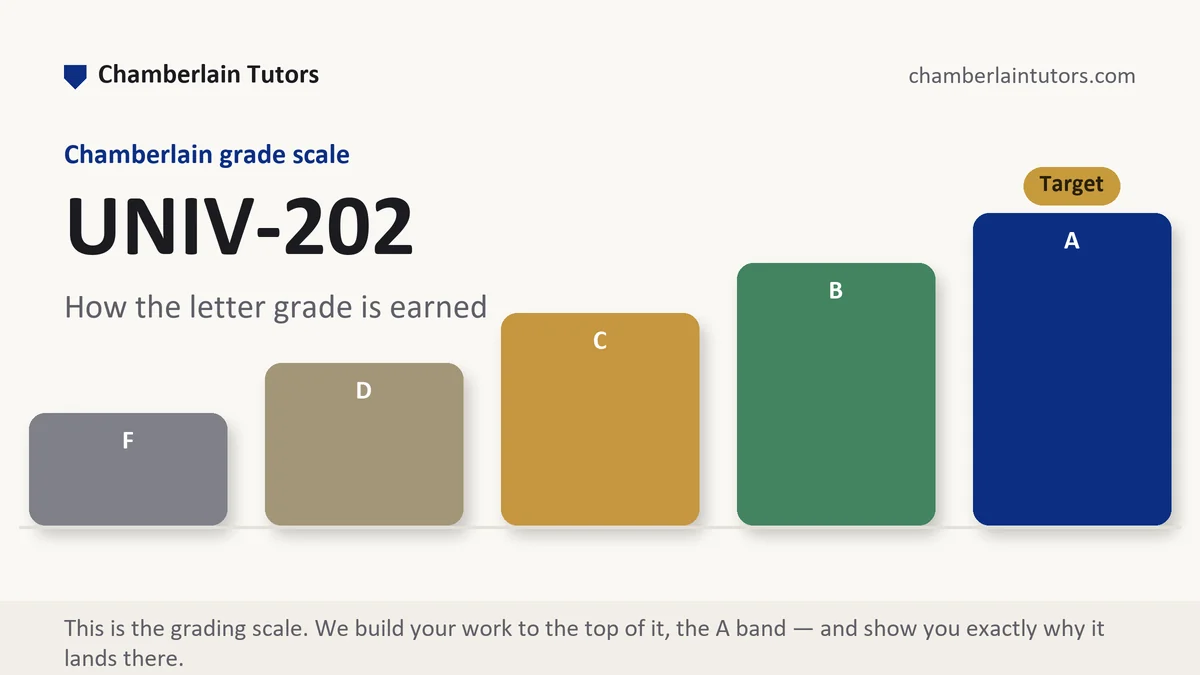
Deliverables run the standard promise: a premium original draft in 24 to 48 hours, targeted at the A band of your course's actual scale, through the eight-person pipeline with both QA passes and the floor check, revised free until it lands.
In UNIV-202 right now?
Send the scenario, the prompt and the rubric from Canvas. First premium sample free, floor-checked, back in 24 to 48 hours.
Read the rubric before the scenario
Scenarios are absorbing, which is the problem. Read one first and you start solving it in your head, then write whatever your solution required rather than whatever the guide asked for. Pull the rows into a blank file and tag each with the stage of thinking it belongs to: noticing, interpreting, prioritizing, acting, evaluating. Those tags are your paragraph order, and using them stops the walkthrough collapsing into a single block of narrative.
Then turn weight into words. Say the week caps you at 850 words with four rows weighted 40, 30, 20 and 10 percent, which gives 340, 255, 170 and 85 words. If the 40 percent row is interpretation, then the sentence type most students skip entirely owns 340 words of the document. Writing that out in advance changes what you draft, because 340 words of interpretation cannot be produced by restating the scenario.
One habit makes the plan stick. Next to each stage, write the first three words of the sentence you intend to use: the finding suggests, the priority is, I would expect. Sentence stems sound mechanical and they are, which is exactly why they keep a walkthrough in order under time pressure.
The shape of a written judgment walkthrough
Whatever the week's scenario contains, the walkthrough moves through the same five stages plus a boundary statement. Each is a short paragraph at this length.
| Stage | What it has to prove | How a thin version looks |
|---|---|---|
| Cues collected | The specific pieces of information you are working from, quoted from the scenario rather than paraphrased into vagueness. | A sentence saying the patient is unwell. |
| Cues separated | Which findings are relevant to the concept in question and which are background, with the sorting made explicit. | Every detail treated as equally important. |
| Interpretation | What the relevant findings mean, said as a claim about the underlying process rather than as a label. | A finding restated in more technical words and called an interpretation. |
| Priority, with a reason | What is addressed first and why that outranks the alternative, in one sentence. | A list of everything that should be done, in no order. |
| Action at student scope | What a student would actually do, including who is told and what is documented. | An intervention outside a student's scope, written as though it were routine. |
| Evaluation | What you would look for afterwards, and what would tell you your interpretation was wrong. | An ending that assumes the action worked. |
Sources and safe language in judgment writing
Four habits keep this writing accurate, and the last two also keep it safe.
Cite a drug reference like a source, not like a memory. When your submission touches medication, name the reference work you consulted and cite it properly. A specific claim about a medication with no source attached is the fastest way to lose the evidence row, and the reference itself takes one line.
Write findings and conclusions in different sentences. Keep the observation in one sentence and your reading of it in the next. Merging them hides the interpretation step that the rubric is looking for, even when your thinking was correct.
Hedge at the level the evidence supports. Consistent with, suggests and would prompt me to check are honest verbs for a student working from limited information. Confirms and proves are not available. Overclaiming in a judgment answer reads as unsafe, and safety language sits inside professionalism rows.
Stay inside student scope on paper. Written work is where habits form, so describe what a student does: assess, report, document, escalate, ask. Coursework that quietly assumes independent authority you do not have loses marks and builds the wrong reflex.
What separates a passing answer from a strong one here
A passing walkthrough reaches a reasonable action. It notices the right things, does something sensible, and reads as competent. What it usually lacks is the connective tissue, so a grader can see the start and the end of the reasoning but not the middle.
Strong walkthroughs make the middle visible and then go one step further. They say what else the cues could have meant and why they settled on this reading, which is the difference between an answer and a decision. They rank when ranking is possible, with the reason attached rather than assumed. And they name a disconfirming sign: the finding that would tell you to think again. That last sentence costs fifteen words and is the clearest evidence a rubric can get that a student is thinking rather than pattern matching.
Six mistakes that cost points in UNIV-202
- Jumping from cue to action. A missing interpretation sentence empties the row that usually carries the most weight.
- Listing without ranking. An unordered list of correct actions answers a question the prompt did not ask.
- Restating the scenario. The grader wrote it, and in an 850 word document every retold detail costs a sentence of reasoning.
- Writing outside student scope. Describing decisions a student cannot make undermines the answer even when the clinical logic is sound.
- Posting a judgment answer in one pass. Chamberlain discussion posts do not reopen once submitted, so an unchecked claim stays visible to the whole section.
- Omitting the evaluation step. An answer that ends at the action has skipped the stage where the rubric asks how you would know.