UNIV-101 University Seminar is a one credit course that builds three skills at once: reading, quantitative reasoning and scientific knowledge for prelicensure study. Written work in this seminar almost always takes one shape, a short response that reads a passage or a data display and then says what it means. What gets graded is not whether you liked the reading. It is whether you can separate what a text claims from what it actually shows, and whether a number you repeat still means the same thing after you have repeated it.
What UNIV-101 actually grades
Treat the reading response as the house style of this course. Something is put in front of you, a passage, a chart, a short article, a worked scientific example, and your submission has to do three moves in a small space: state the claim in your own words, point at the specific evidence the text gives for it, and say what follows or fails to follow. Every rubric row in a seminar like this is a variation on those moves.
The reading skill being scored is not speed. It is the ability to locate a claim and rank it. Science writing hides its argument in the middle, because the first paragraph is context and the last one is caveats, so students who summarize in the order the text arrives keep restating background. A response that opens by naming the claim and its support has already outscored a longer summary.
The quantitative side is scored the same way. A number in a nursing text is never just a number: it has a unit, a base, a period and a source, and stripping any of those turns evidence back into decoration. Graders here are trained to notice a percentage that arrived with no denominator, because that habit becomes dangerous later in a pharmacology or population health course. This is a one credit seminar, so the deliverables are short and weekly through Canvas, but the habits are the ones the rest of the program will assume you already own.
How we help in UNIV-101
Our writers work these responses the way a science editor would: find the claim, test the support, keep every quantity attached to its unit and its base. What comes back reads at first year level rather than doctoral level, because a seminar response written in graduate register is its own kind of mismatch, and the walkthrough shows you where the claim actually sat in the text.
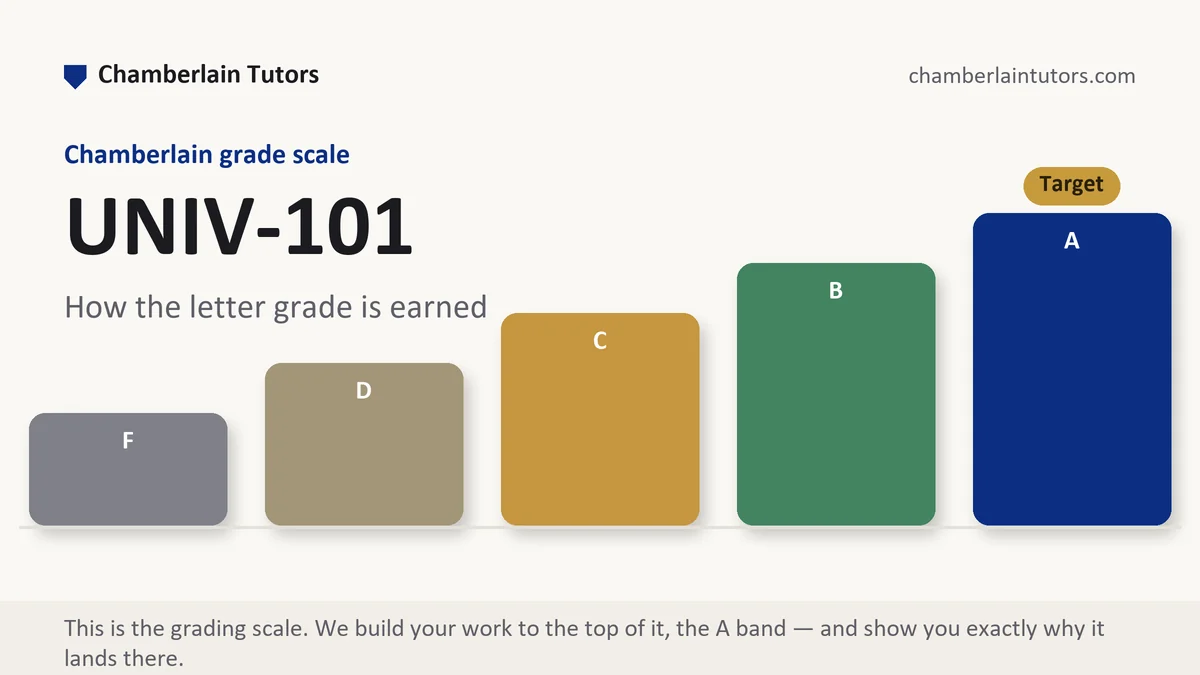
Deliverables run the standard promise: a premium original draft in 24 to 48 hours, targeted at the A band of your course's actual scale, through the eight-person pipeline with both QA passes and the floor check, revised free until it lands.
In UNIV-101 right now?
Send the reading, the prompt and the rubric from Canvas. First premium sample free, floor-checked, back in 24 to 48 hours.
Read the rubric before you read the passage
Most students open the reading first and the scoring guide last, which is backwards. The rubric tells you what to look for while you read, and reading with a target is roughly twice as fast as reading and then hunting. Copy the criterion rows into a blank file, strip each to its verb, and keep them in the guide's order so a grader working down the rows meets your sections in the sequence they expect.
Then price the rows. Say your week caps the response at 600 words across three rows weighted 40, 35 and 25 percent. That gives 240 words to the first row, 210 to the second and 150 to the third. Six hundred words is roughly a page, so those numbers are small on purpose: 240 words is three tight paragraphs and will not survive a scenic introduction. If the heaviest row asks you to interpret rather than to summarize, then the summary you were planning to open with has a budget of zero.
Keep the targets written beside the headings while you draft. A section that comes in at half its share has not answered its row, and a section running well over has usually absorbed material that belonged somewhere else. In short work, proportion is most of the grade, because there is nowhere for a missing row to hide.
The shape of a reading and reasoning response
Whether the week hands you a passage, a graph or a short scientific report, the same skeleton carries the response. Each part answers one question, and a grader can see at a glance whether it was answered.
| Part | What it has to prove | How a thin version looks |
|---|---|---|
| The claim, restated | The main point of the text in your own words, in one sentence, with no hedging borrowed from the author. | The first line of the reading copied out with two words changed. |
| The support, located | The specific evidence offered for that claim: the study, the figure, the mechanism, named and pointed at. | A sentence saying the author provides evidence, with none of it named. |
| The quantity, handled | One number from the text carried correctly, with its unit, its base and its time window intact. | A percentage lifted out of the passage with the denominator left behind. |
| The limit | What the text does not establish, said plainly, so the reader can see you separated claim from proof. | A line saying more research is needed, which is true of everything. |
| The connection | Why this matters for a student heading into nursing science, tied to something concrete rather than to importance in general. | A closing paragraph about how vital science is to nursing. |
Handling evidence and numbers in a science seminar
Four habits separate a response that reads as scientific from one that reads as a book report.
Every number keeps its unit and its base. Write 4 of the 52 participants rather than a small number, and 8 percent of 52 rather than 8 percent. When you convert, show the conversion in the sentence so a reader can follow you back to the source figure. Units are not decoration: milligrams and milliliters are different objects, and this is the seminar where the habit of writing them every time gets built.
Distinguish the textbook from the study. A chapter explains what the field currently accepts. A study reports what one group of researchers found once. Both are citable, and they buy different sentences. Use the chapter for framing and the study for figures, and say which you are using rather than blending them into a single voice.
Cite the display, not just the article. When your evidence is a figure or a table, name it in the sentence, because a grader checking your reading wants to land on the same object you did. Reproducing a chart is not required and mostly costs you words you needed for interpretation.
Match the verb to the evidence. A correlation buys was associated with, occurred more often among and tracked with. Only a controlled comparison buys caused or reduced. Borrowing a causal verb for observational evidence is the single most common accuracy error in first year science writing, and it is easy for a grader to spot because the passage contradicts your sentence.
What separates a passing answer from a strong one here
A passing response is accurate and complete. It summarizes the reading correctly, mentions the evidence, and stays inside the word count. Nothing in it is wrong, which is exactly why it sits in the middle of the band: accuracy is the entry fee, not the achievement.
A strong response does three things a summary cannot. It commits to a single interpretation instead of listing everything the text mentioned, which frees the words for depth. It shows the seam between what the evidence supports and what the author asserts, since noticing that gap is the actual skill the seminar is teaching. And it carries at least one quantity all the way through, from the source figure to a statement of what that figure means for a reader, without the number losing its base along the way. Any one of those moves lifts a response a band; all three together read as coursework from a student who will do well in the science sequence.
Six mistakes that cost points in UNIV-101
- Summarizing in the order the text arrives. That order buries the claim in the middle of your response, where the rubric will not find it.
- Quoting in a 600 word document. A three line quotation spends a twelfth of the budget saying what the source already said. Paraphrase and cite.
- Reporting a percentage with no base. Without the denominator the figure cannot be checked, and the accuracy row is usually where the grader lives.
- Answering the prompt's warm-up question only. Prompts often open with a personal question and then ask for analysis. The analysis is where the weight sits.
- Posting the response straight into the board. Chamberlain discussion posts do not reopen once submitted. Draft in a separate file, check the numbers, then paste once.
- Writing above your level to sound scientific. Borrowed vocabulary used slightly wrong costs more than plain language used exactly right.