UNIV-100 University Seminar - Nursing Student Success is a one credit seminar that runs beside your first prelicensure courses, and the catalog describes it as foundational success concepts delivered through a personalized learning approach. That word personalized is the whole grading story. Your submissions are about you, your habits, your results and your plan, and a grader still scores them against a rubric. The trap is assuming that personal writing is ungradeable writing. It is graded on specificity, on evidence that you actually did the thinking, and on whether a plan you wrote could be followed by someone who is not you.
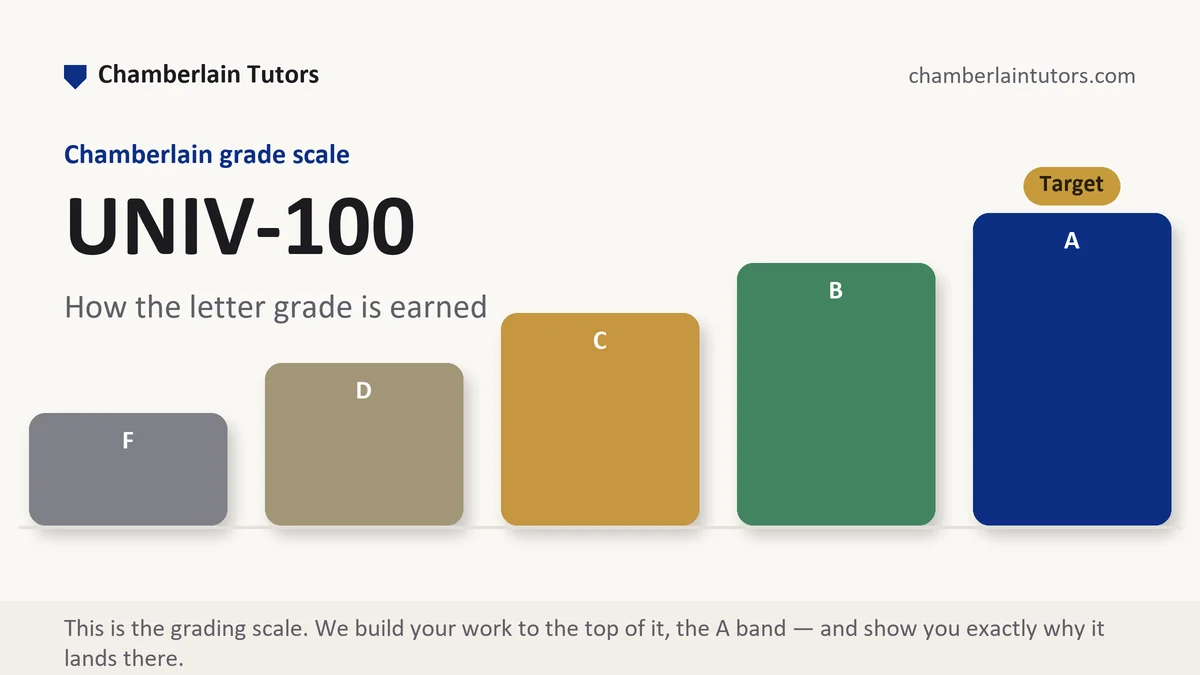
What UNIV-100 actually grades
This is a one credit course, so keep the scale straight in your head. Nobody is asking for a term paper. The deliverables are short, they come weekly through Canvas, and several of them will be discussion posts. What makes them hard is not length but the kind of writing they ask for, which most students have never been taught: structured self description that stays out of both extremes, neither a confession nor a brochure.
Three things get scored again and again in a success seminar. First, accuracy about your own situation, which means named hours, named obstacles and named results rather than adjectives like busy or motivated. Second, connection to the material the seminar puts in front of you, because a reflection that never touches a reading is just a diary entry. Third, a forward move: what changes next week, said concretely enough that you could be held to it. A submission that describes a problem and stops has answered two thirds of most rubrics here.
Understand also why the university front-loads this course. Chamberlain does not curve, does not offer extra credit and does not excuse graded work, and undergraduate failures accumulate toward a dismissal review. A seminar on how to study is the university trying to spend one credit now instead of a repeated course later. Writing it as though it does not count is the one reading of the course that guarantees you waste it.
How we help in UNIV-100
Our writers treat a reflective deliverable the way they treat any other graded document: rubric first, structure second, voice third. What you get back is a draft in your situation and your register, with the plan section built so a grader can see the causal link between what you noticed and what you intend to change.
Deliverables run the standard promise: a premium original draft in 24 to 48 hours, targeted at the A band of your course's actual scale, through the eight-person pipeline with both QA passes and the floor check, revised free until it lands.
In UNIV-100 right now?
Send the prompt and the rubric from Canvas, plus a few honest lines about your week. First premium sample free, floor-checked, back in 24 to 48 hours.
Read the rubric before you read the prompt
Prompts in a success seminar are written warmly, which makes them sound like invitations. Rubrics are written coldly, which makes them useful. Open your week's rubric first, copy the criterion rows into a blank document one per line, and reduce each to its verb: describe, identify, connect, apply, plan, support. Those verbs are your headings, and keeping them in the rubric's order means a grader working down the rows always meets the section they were about to look for.
Then turn the weights into words, because a percentage is a depth instruction in disguise. Suppose your week's deliverable is capped at 700 words and the guide carries three rows weighted 45, 30 and 25 percent. Multiply through: 315 words for the first row, 210 for the second, 175 for the third. On these short reflective pieces the arithmetic is brutal in a useful way. Three hundred words is about four solid paragraphs of specific detail, and it will not stretch to cover an introduction about how important nursing school is. A heading block and a short reference entry are usually outside that limit, but confirm it in your own guide before you spend the words.
Write each target beside its heading and check it off as the section reaches it. When a section lands well under its share, that is not concision, it is a row you have not really answered. When it runs 80 words over, the surplus is usually background nobody asked for. In a 700 word document the difference between the right proportions and the wrong ones is the difference between two grade bands.
The shape of a personal success plan
Most graded writing in this seminar is a success plan wearing one costume or another: a study plan, a time audit, a goal statement, a reflection with a next step. The parts below each do one job, and a grader can tell within a sentence whether the job was done.
| Part | What it has to prove | How a thin version looks |
|---|---|---|
| Current state, counted | Your real starting point in numbers: hours worked, hours studied, nights available, what a bad week looked like. | An adjective standing in for a measurement, such as very busy or overwhelmed. |
| The obstacle, named once | One specific barrier, described so precisely that a solution has something to attach to. | A list of six general pressures, none of them examined. |
| What the seminar material adds | A concept, strategy or tool from the course readings, applied to the obstacle you just named. | A cited idea restated in the abstract and never used again. |
| The change, made testable | What you will do differently, when, for how long, and how you will know it happened. | A promise to try harder or manage time better. |
| The support you will use | Which person, service or routine you will actually contact, and at what trigger point. | A mention that help is available at the university. |
| The review point | The date or condition at which you check the plan and change it if it failed. | An ending that assumes the plan works. |
Evidence and citation craft in reflective writing
Reflective writing still carries citations, and this is the course where you build the APA habits that every later course will assume you already have. Four rules do most of the work.
First person is allowed, vagueness is not. APA has permitted first person for years, and a success seminar is exactly where it belongs. What the rubric punishes is not the word I but the sentence that follows it. I struggled with time management is unusable. I lost roughly six study hours a week to unplanned shifts is a finding you can build a plan on.
Cite the reading even when the topic is you. A reflection that connects to a course source scores in a different band from one that does not. One in-text citation per major claim about learning, matched to a reference entry, is usually enough at this length. Every entry in the list must appear in the text and every citation in the text must appear in the list, because graders check that mechanically and it is free marks either way.
Quote sparingly and paraphrase properly. In a 700 word document a block quote is a spending decision you will regret. Paraphrase, cite, and keep the words yours. A paraphrase that follows the original sentence structure with synonyms swapped in is still the source's writing, and it is the most common integrity problem in first term work.
Do not invent numbers about yourself. If you did not track your hours, say you estimated them and say how. Estimated honestly beats precise and fictional, and it also protects the plan, since a plan built on a made-up baseline cannot be evaluated at the review point you promised.
What separates a passing answer from a strong one here
A passing reflection is sincere, on topic and on time. It admits a difficulty, mentions a strategy, and ends with a resolution to do better. That work is genuinely fine, and it is also what most of the section submits, which is why it sits mid band all session.
Strong work differs in three visible ways. It is specific enough to be wrong: a real number, a real week, a real failure, stated in a way that could be checked. It closes the loop between the material and the plan, so that the strategy named in paragraph three is the same strategy driving the action in paragraph five rather than a decoration. And it is written for a reader rather than for the writer, which means the plan could be handed to a classmate in the same situation and followed without explanation. That last test is the fastest way to raise a grade in this course, and it costs one read-through.
Six habits that quietly cost points
- Writing the warm-up. An opening paragraph about how rewarding nursing is spends a seventh of a short deliverable before the rubric has been touched.
- Confessing instead of analyzing. Detail about a hard week earns nothing on its own. The scoring row wants what you concluded from it and what changes because of it.
- Posting a board reply in one pass. Chamberlain discussion posts do not reopen once submitted. Draft in a separate file, read it aloud once, then paste.
- Skipping the citation because the topic is personal. Reflective does not mean sourceless, and the connection row is usually worth more than students expect.
- Promising a schedule you have already broken. A plan with 20 study hours in it from someone working 40 hours reads as untrue and loses the realism marks the rubric actually cares about.
- Treating one credit as no credit. The grade counts, the average counts, and a first term failure is expensive at a university with no curving and no extra credit.