PA-514 Comprehensive Clinical Module Infectious Disease covers immune function and evidence-based treatment of infection, and its written work has a signature move no other module shares. You are asked to commit to therapy before you know the organism, then to say exactly what would make you change it. Rubrics here reward a syndrome-to-pathogen argument, an empiric choice justified by likely organisms and local resistance rather than by habit, and a stated plan for narrowing once cultures return.
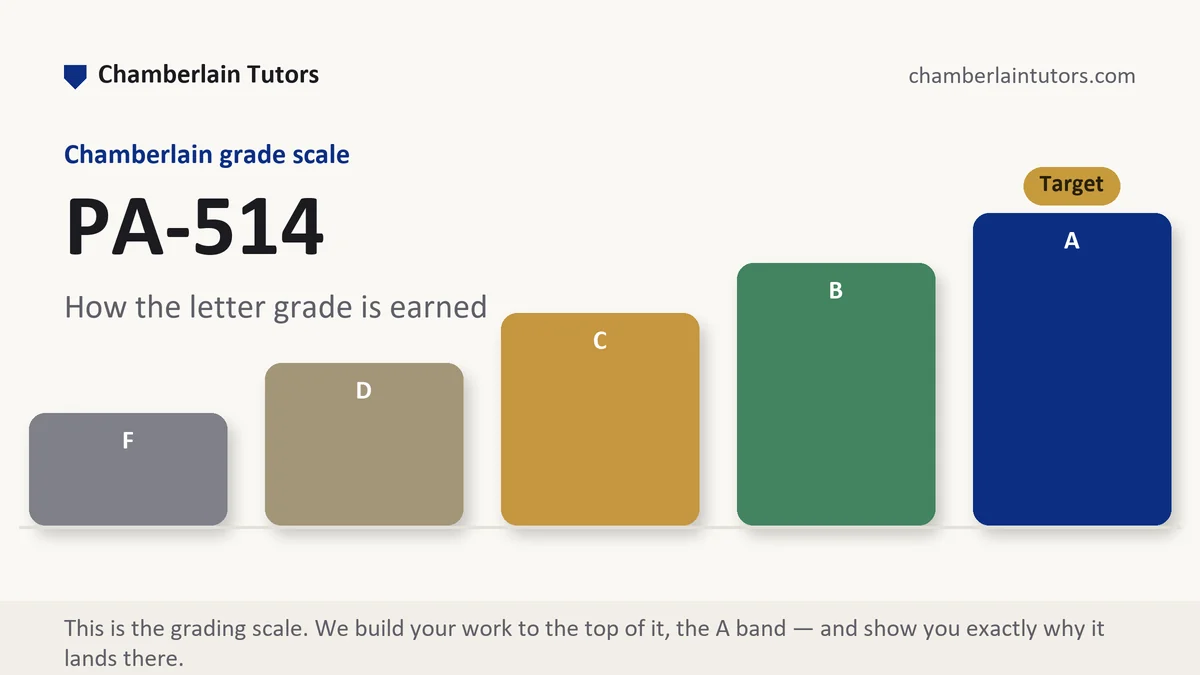
What PA-514 actually grades
The core row is the reasoning bridge between a clinical syndrome and a list of likely organisms. A student who names an antibiotic first has inverted the module. The order that scores runs the other way: this presentation, in this host, acquired in this setting, is most often caused by these three organisms, and therefore empiric coverage needs to include them. Every part of that sentence carries weight, because changing the host or the setting changes the organism list and therefore the therapy.
The second row is host status. Infectious disease reasoning is the place where a patient's immune status stops being background and becomes the main variable. Age, diabetes, neutropenia, transplantation, splenectomy, indwelling devices, injection drug use and recent hospitalization each change both the organism list and the urgency. A write-up that treats every patient as immunocompetent has answered a different question from the one asked.
The third is stewardship, and it appears on rubrics more often than students expect. It is not a moral aside. It shows up as concrete decisions: choosing the narrowest agent that covers the likely pathogens, stating a duration rather than leaving therapy open, planning de-escalation when susceptibilities return, and saying when no antibiotic is the correct answer. Each of those is a scoreable sentence.
The fourth is source control, which is the point students most often miss entirely. Antibiotics do not fix an abscess, an infected device or an obstructed system. Naming the drainage, removal or decompression that has to happen alongside therapy is often the difference between a competent answer and a strong one.
How we help in PA-514
Our drafts build the syndrome-organism-therapy chain explicitly, with the host factors that reshape it named where they act rather than listed at the top. Empiric choices come back with the reason for the spectrum, the duration, the cultures drawn before the first dose, and the de-escalation trigger written in. Where source control matters, it is stated as a step rather than implied.
Send the case and your scoring guide and a premium original draft comes back inside 24 to 48 hours, read against your rows before it ships. Revision is free until the piece lands, and the first sample costs nothing.
Infectious disease case due?
Send the case material and the rubric from Canvas. First premium sample free, back in 24 to 48 hours.
Read the rubric before the case
Infectious disease rubrics usually separate two things students blur: identifying the likely pathogen and justifying the therapy. Those are different rows and they need different paragraphs. Copy the rows into a blank document, reduce each to its verb, and keep the guide's order so the grader keeps meeting the section they expected.
Then price them. Suppose a 1,300 word case response carries rows at 20 percent for the clinical assessment, 30 for likely pathogens and rationale, 30 for empiric therapy and justification, and 20 for monitoring, de-escalation and education. That is 260, 390, 390 and 260 words. The instructive part is that pathogen reasoning and therapy justification are worth the same, which almost no student writes that way. The usual draft gives 500 words to the assessment, 100 to the organisms and a single sentence naming a drug. Rebalancing to 390 and 390 typically moves the piece a full band, because those two rows together carry more than half the score.
One preparation step makes the therapy paragraph write itself. Before drafting, write the three most likely organisms in a column. Beside each, write whether your proposed agent covers it. Any organism with a gap is either one you have decided not to cover, in which case say why, or one your regimen is missing, in which case the regimen is wrong. That single column is the justification row in raw form.
The shape of an infectious disease case response
These parts carry the score, in the order a grader reads for them.
| Part | What it has to prove | How a thin version looks |
|---|---|---|
| Syndrome named | The clinical syndrome and the anatomic site, stated before any organism is mentioned. | Infection used as the diagnosis. |
| Host status | Immune status, comorbidity, devices, recent healthcare exposure, and what each changes. | A past medical history listed without being used. |
| Acquisition setting and exposures | Community, healthcare-associated, travel, animal, occupational or food exposure, and the timeline. | No exposure history taken at all. |
| Likely pathogens, ranked | Two to four organisms with the reason each fits this syndrome in this host. | A list of every organism associated with the body site. |
| Severity and disposition | Whether the patient is septic, and whether this is outpatient, ward or critical care. | A therapy plan with no statement of how sick the patient is. |
| Cultures before therapy | Which specimens are collected, from where, and before which dose. | Cultures mentioned after treatment has already started. |
| Empiric regimen justified | Agent, route, dose interval and duration, with the spectrum matched to the ranked organisms. | A drug named with no reason and no duration. |
| De-escalation trigger | What result would narrow, change or stop therapy, and when you expect it. | Continue antibiotics and reassess. |
| Source control and prevention | Drainage, device removal or decompression where relevant, plus vaccination or prophylaxis for contacts. | Antibiotics offered as the whole treatment. |
Evidence craft in infectious disease
Four habits carry the evidence marks here.
Cite guidelines by body, condition and year. Infectious disease guidance is unusually well organized by syndrome and is revised on a visible schedule. Naming the issuing society, the syndrome and the edition year is a small sentence that tells a grader you consulted the document rather than a summary of it.
Treat resistance data as local and dated. A statement that an organism is usually susceptible to an agent is only true somewhere and only at some time. Say that local susceptibility patterns should be checked, and if the case supplies an antibiogram, quote the percentage and the year. Where your guide sets no recency rule, treat resistance figures older than a couple of years as needing a stated reason.
Match the verb to the design. Randomized non-inferiority data supports was non-inferior to, which is a weaker claim than superior and should not be reported as though it were. Observational data supports was associated with lower mortality among. Laboratory susceptibility supports is active against in vitro, which is not the same as works clinically for that site, particularly where drug penetration is limited.
Give every diagnostic test its operating characteristics in context. Rapid tests, antigen tests and molecular assays behave differently by prevalence and by timing relative to symptom onset. Saying that a negative result at day one does not exclude the diagnosis, and giving the reason, is worth more than naming the test.
What separates a pass from a strong pass
A passing PA-514 response identifies the infection and picks a reasonable antibiotic. Its weakness is that the choice is asserted. The agent appears without a spectrum argument, without a duration and without any statement of what would change it, which means the grader cannot tell whether the writer reasoned or remembered.
A strong response is a decision written under acknowledged uncertainty. It says what it does not yet know and treats anyway, which is the actual clinical situation. It defends the spectrum by naming what it is covering and, just as usefully, what it has decided not to cover and why. It sets a duration rather than leaving therapy open. It states the review point, the culture result that would narrow therapy, and the clinical trajectory that would prompt escalation instead. It names source control where an antibiotic alone cannot work. And it closes with the counselling that reduces the next infection: the vaccination due, the device that should come out, the contact who needs prophylaxis. That last section is frequently worth a fifth of the score and is frequently the shortest part of a student draft.
Six mistakes that cost points in PA-514
- Naming a drug before naming the organisms. The rubric is reading for the bridge, and skipping it forfeits the heaviest pair of rows.
- Treating every host as immunocompetent. Neutropenia, asplenia, transplantation and diabetes each change the organism list, and saying so takes one clause.
- Therapy with no end date. Duration is part of the prescription and part of the row. Open-ended therapy reads as unfinished thinking.
- Cultures drawn after the first dose. Sequence matters clinically and is checked explicitly on many guides.
- Ignoring source control. An abscess, an infected line or an obstructed tract will not respond to antibiotics alone, and missing it is a clinical error rather than a stylistic one.
- Forgetting that no antibiotic is sometimes the answer. Viral syndromes, colonization and contaminated cultures all appear in this module precisely to test that judgment.
Questions PA-514 students ask
How do I justify empiric therapy when the case never tells me the organism?
How much detail does a duration statement need?
Do discussion posts in this module need citations?
Where PA-514 sits in Chamberlain's programs
Open the exact program map for sequence, credit, and option context. The current student schedule and syllabus remain authoritative after transfer evaluation, electives, state rules, and approved plan changes.
The weeks, one by one
The public curriculum verifies PA-514 but does not publish its Week 1 through Week 8 Canvas assignments. Week manuals are added only from verified real deliverables; session length is never used to invent them.