NR-714 Application of Analytic Methods II is a three-credit doctoral course built around a comprehensive systematic review of evidence, including economic appraisal, statistical analysis and outcome measurement. The graded writing is method writing. What earns marks is whether another person could repeat exactly what you did: run your search, apply your criteria, reach your included set, and arrive at the same conclusion. Reproducibility, not eloquence, is the standard this course holds you to.
What NR-714 actually grades
The heaviest rows ask for a search that can be rerun. That means databases named, the actual search string reproduced with its Boolean structure and any controlled vocabulary terms, the date the search was executed, the limits applied, and the number of records returned by each source. Students often write that a comprehensive search was conducted of several databases, which reads as a summary of the work rather than the work itself, and it scores accordingly.
The second cluster of rows is about judgment applied consistently. Eligibility criteria have to be written so that two people would classify the same borderline study the same way. Risk of bias has to be assessed with a named tool, domain by domain, rather than described in adjectives. And the economic material has to state its perspective and time horizon before it reports a cost, because a cost per outcome from a payer perspective over one year answers a different question than a societal perspective over a lifetime.
How we help in NR-714
Our doctoral bench writes review method sections the way a journal expects them: strings reproduced, counts tracked through screening, appraisal by domain, synthesis organized by outcome rather than by article. Every draft comes back with the audit trail visible so you can answer any question about how a study entered or left the set.
Deliverables run the standard promise: a premium original draft in 24 to 48 hours, targeted at the A band of your course's actual scale, through the eight-person pipeline with both QA passes and the floor check, revised free until it lands.
In NR-714 right now?
Send the week and the rubric from Canvas. First premium sample free, floor-checked, back in 24 to 48 hours.
Read the rubric before the prompt
A review rubric is unusually literal, which is good news if you read it early. Pull the criterion rows into a blank file and mark each with the review stage it governs: question, eligibility, search, screening, appraisal, extraction, synthesis, certainty. Those stages are the section headings, in that order, and deviating from the order costs alignment marks for no benefit.
Then convert weights into words. Take a 3,000-word review write-up with four rows at 30, 28, 22 and 20 percent. That leaves 900, 840, 660 and 600 words. In NR-714 the 900-word row is typically synthesis, which surprises students who expect the search description to dominate. The search deserves precision rather than length: a reproducible string and a set of counts occupy little space and satisfy the row completely, leaving the budget where the analysis happens.
Build your flow numbers before you draft. Records identified, duplicates removed, titles and abstracts screened, full texts assessed, studies excluded with reasons grouped, studies included. Those six numbers have to reconcile, and reconciling them at the end of a session is far more painful than tracking them from the first search.
The shape of a systematic review write-up
Whether your week asks for a protocol, a completed review or a section of one, this is the skeleton a reader checks. Each part documents a decision, and an undocumented decision reads as no decision at all.
| Part | What it has to prove | How a thin version looks |
|---|---|---|
| Question in structured form | Population, intervention, comparator and outcome stated so that eligibility follows from them directly. | A topic sentence standing in for a review question. |
| Eligibility criteria | Inclusion and exclusion rules specific enough to settle a borderline study without further discussion. | Relevant studies published in English. |
| Search, reproducible | Databases, full strings, controlled vocabulary, limits, and the execution date. | A statement that several databases were searched. |
| Screening with counts | Numbers at every stage, with exclusion reasons grouped at full-text review. | A final count of included studies and nothing else. |
| Risk of bias by domain | A named tool applied to each study, with a judgment and a reason per domain. | Overall quality described as good or fair. |
| Extraction and effect measures | What was pulled from each study, in what units, with effect sizes and their intervals. | Findings summarized in prose with no numbers. |
| Synthesis by outcome | Studies grouped by what they measured, with agreement and disagreement explained rather than averaged away. | One paragraph per source, sequenced by whichever turned up first. |
| Certainty and limits | How much confidence the body of evidence supports, and what would change it. | A closing note that more research is needed. |
Evidence craft in review and economic work
Four habits carry the difference between a review that reads as method and one that reads as a long literature summary.
Report the search as an artifact, not a description. Put the string in the paper or an appendix exactly as run, including the operators and any subject headings. Give the date of execution, because a search is a snapshot. Where your guide sets a recency limit, apply it in the search itself and say so, rather than filtering by hand afterwards.
Keep design, sample and setting attached to every effect. An effect size without its design is uninterpretable. Write that a randomized trial of 268 adults in two academic centers found the difference, then give the estimate and its confidence interval. Reserve reduced and increased for designs that support them, and use was associated with for observational contributions to the same synthesis.
State the perspective and horizon before any cost. Economic appraisal is worth marks precisely because it is where students improvise. Name the perspective, the time horizon, the dollar year, and whether future costs were discounted. A cost per case avoided that does not say from whose budget is not yet an economic finding.
Every rate carries a denominator and a window, and pooled results carry heterogeneity. Write events over participants, then the rate. Where studies disagree, say how much and explore why by population, setting or dose rather than reporting a single average that hides the spread. If the studies are too different to combine, say that and synthesize narratively; forcing a pooled number you cannot defend is worse than declining to pool.
What separates a pass from a strong pass here
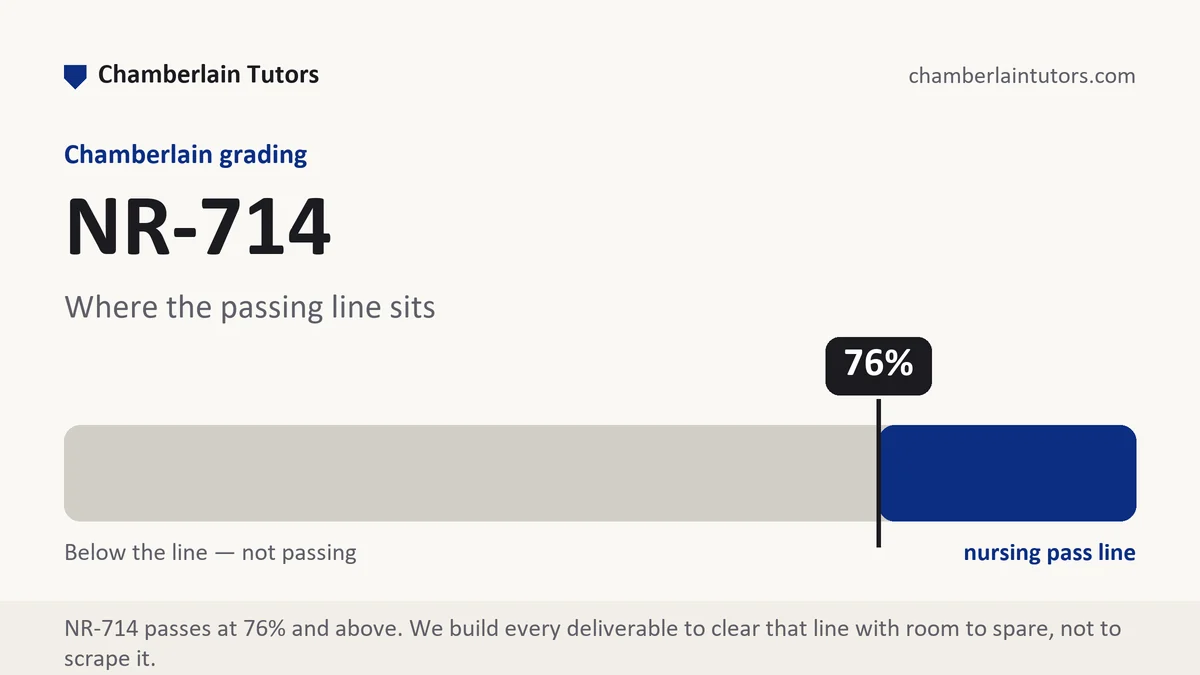
A passing review finds real studies, describes them accurately and reaches a sensible conclusion. It usually loses marks in the same three places: a search nobody could repeat, appraisal written as adjectives, and a synthesis section that is a sequence of study summaries. Core nursing courses at Chamberlain do not pass under 76 percent, and no quantity of later work rescues an average that has drifted low, so those three habitual gaps compound across a session rather than costing one week.
Strong reviews are auditable. Every claim traces to a row in an extraction table, every included study has a documented reason for being there, and every excluded full text has a reason grouped with others like it. They also state what the evidence does not answer, which is often the most useful paragraph in the paper and the one a doctoral reader remembers. And they make the certainty judgment explicit: whether the body of evidence is strong enough to change practice, or strong enough only to justify a local pilot with measurement attached.
Six mistakes that cost points in NR-714
- Describing the search instead of reproducing it. The string is the evidence that the search happened. Without it, the row cannot be scored.
- Losing the flow counts. Numbers that do not reconcile from records identified to studies included suggest the screening was reconstructed after the fact.
- Appraising in adjectives. Good, fair and poor are conclusions. The tool's domains, with a reason for each judgment, are the work.
- Pooling incompatible outcomes. Different instruments measuring loosely similar concepts should not be averaged into one estimate without justification.
- Reporting significance without size. A p value says something happened, not whether it matters. Give the effect and its interval.
- Writing costs with no perspective. A saving to a hospital may be a transferred cost to a patient. Say whose budget you are counting.
Questions NR-714 students ask
My search returns thousands of records. What do I do?
What if I only find five studies and they contradict each other?
Do I really need the economic section if my topic is clinical?
The weeks, one by one
Week 1
A second analytic methods course moves from appraising studies one at a time to conducting a comprehensive systematic review, and a systematic review begins with a written protocol. Read the full Week 1 manual.
Week 2
A comprehensive review is only as defensible as its search, and this stage asks you to build one and then write it down so precisely that a stranger could rerun it and land on your numbers. Read the full Week 2 manual.
Week 3
Screening is the stage where a retrieval becomes a study set, and it is graded on process rather than on outcome. Read the full Week 3 manual.
Week 4
Extraction is where a set of papers becomes a data set. Read the full Week 4 manual.
Week 5
This is the stage where the extracted numbers are combined, or defensibly not combined. Read the full Week 5 manual.
Week 6
Economic appraisal is what distinguishes a comprehensive review from a purely clinical one. Read the full Week 6 manual.
Week 7
Every conclusion a review reaches rests on how its outcomes were measured, and this stage examines that foundation directly. Read the full Week 7 manual.
Week 8
The closing stage assembles the whole review and answers the question it was built to answer. Read the full Week 8 manual.