NR-708 Health Policy is a three-credit doctoral course built around the policy process at micro, meso and macro levels, and the analysis of legislative issues including ethics, economics and access. The writing it grades is a policy analysis, which is a specific genre with rules: a problem defined in policy terms, several real options compared against stated criteria, and a recommendation that admits its own tradeoff. An opinion essay about what the system should do, however well written, is not that genre and does not score like it.
What NR-708 actually grades
The first scoring demand is that the problem be stated as something policy can act on. Not enough patients receive follow-up is a clinical problem. A state statute that limits which clinicians may bill for a follow-up visit is a policy problem, and the difference is whether there is an instrument to change. Most weak submissions in this course never make that translation, and every later section suffers because there is nothing for the options to be options about.
The second demand is level discipline. Micro means the practice or patient level, meso the organization or system, macro the state or federal level. A single issue looks different at each, and rubrics in this course frequently ask you to work across all three. What earns marks is showing how a macro decision lands as a meso constraint and then as a micro experience, with the mechanism named at each step rather than assumed.
How we help in NR-708
Our doctoral writers draft policy analysis in its real form: problem, background, stakeholders, options, criteria, recommendation, monitoring. Statutory and regulatory material is cited from the source text rather than from a summary, so your position holds when someone checks the section number.
Deliverables run the standard promise: a premium original draft in 24 to 48 hours, targeted at the A band of your course's actual scale, through the eight-person pipeline with both QA passes and the floor check, revised free until it lands.
In NR-708 right now?
Send the week and the rubric from Canvas. First premium sample free, floor-checked, back in 24 to 48 hours.
Read the rubric before the prompt
Policy assignments are the easiest place in the doctoral sequence to write two thousand fluent words that score badly, because fluency is not the thing being measured. Copy the criterion rows into a blank document and check whether the guide names a deliverable length or format, because a brief and a paper are graded differently: a brief is judged on compression and decision-readiness, a paper on depth of analysis.
Then turn weights into words. Take a 1,250-word policy brief with four rows at 32, 28, 24 and 16 percent. That is 400, 350, 300 and 200 words. Most students discover at this point that the background section they intended to write, tracing the history of the issue, has a budget of 200 words rather than 600. Compression at that ratio is the skill the brief format exists to teach, and it is why briefs are graded harder than their length suggests.
Keep one column in your outline for the criteria you will judge options against. Naming criteria in advance, such as cost to the payer, access for the affected group, administrative burden and political feasibility, converts the options section from a set of descriptions into a comparison. Rubric rows about analysis are usually satisfied by that single structural choice.
The shape of a policy analysis
Whether your week calls for a brief, an issue analysis or a legislative testimony draft, the underlying structure is the same. Each part performs a function in the argument, and a missing one shows at once.
| Part | What it has to prove | How a thin version looks |
|---|---|---|
| Problem in policy terms | An outcome gap tied to a rule, a payment mechanism or an authority that could be changed. | A clinical complaint with no instrument attached to it. |
| Current policy, cited exactly | The statute, regulation or bill by name and section, with its status and effective date. | A general reference to current law or recent legislation. |
| Stakeholders and their interests | Who gains, who pays, who administers, and what each would say in a hearing. | A list of groups with no position attributed to any. |
| Options, at least three | Genuine alternatives including doing nothing, each described at the level of an actual instrument. | One preferred option and two straw men. |
| Criteria applied consistently | The same named criteria used to judge every option, with evidence under each. | Different arguments used for different options. |
| Recommendation with its cost | One option chosen, with the group that bears the burden named openly. | A recommendation that claims benefits with no losers. |
| Implementation and monitoring | Who implements, on what timeline, and what indicator would show it is working or failing. | A closing call for policymakers to act. |
Evidence and citation craft in policy writing
Policy evidence is a mix of law, data and advocacy, and keeping the three separate is most of the craft.
Cite the instrument, not the coverage of it. A bill has a number, a chamber, a session and a status. A regulation has a citation and an effective date. News articles and association summaries are useful for context and for tracking movement, but the claim about what the policy does belongs to the text. Note the version too, because a bill as introduced and as amended can differ substantially.
Separate analysis from advocacy in your source list. Professional associations, industry groups and think tanks all publish material worth reading, and all of it has a position. Cite it, name the interest in the sentence, and pair it with a neutral source where one exists. Where your guide sets no recency rule, policy sources older than five years need their justification stated, because the underlying rules may have changed since publication.
Match the verb to the design in policy evaluation. Studies comparing states before and after a change, or comparing adopting and non-adopting states, are observational. They buy was followed by and was associated with. Reserve caused for designs that earned it. Policy sections lose evidence marks mostly through confident causal language attached to state comparisons that could not isolate the policy.
Every rate carries a denominator and a window, and cost figures carry a year. Write that 3,100 of 41,500 enrollees lost coverage during the twelve months after the change, then give a percentage. For money, state the dollar year and whether the figure is spending, charges or actual cost, because those three differ by amounts large enough to reverse an argument.
What separates a pass from a strong pass here
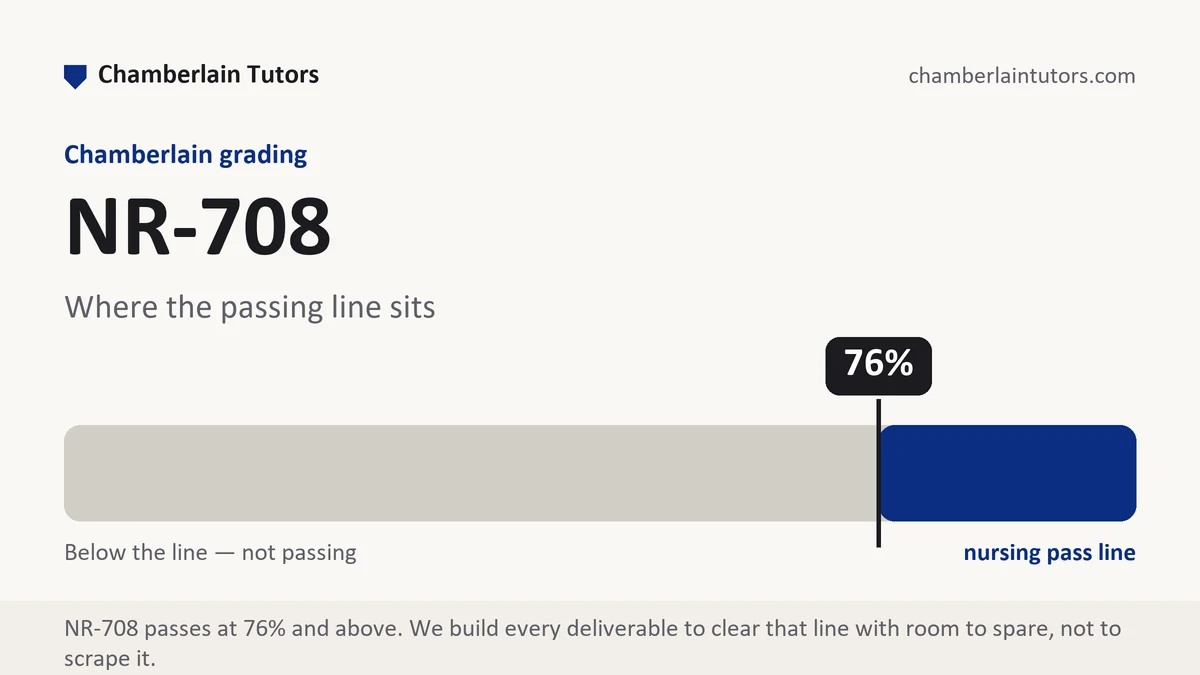
A passing NR-708 submission describes a real issue, expresses a defensible position and cites reputable sources. It reads like a well-informed opinion piece. Core nursing courses at Chamberlain require 76 percent to pass, and later submissions do not raise a weighted average that has weakened, so a session of well-informed opinion pieces tends to sit closer to that floor than students expect.
Strong policy writing differs in three ways. It gives the opposing side its best argument rather than a weak one, because a reader who can predict your rebuttal trusts the analysis more. It quantifies the tradeoff, naming who pays for the recommendation in dollars, staff time or access, since every policy moves a burden rather than removing it. And it ends with an indicator: the number that would move within a defined period if the change worked, and the number that would tell you it was failing. A recommendation with no monitoring plan is an opinion with a citation list.
Six mistakes that cost points in NR-708
- Writing an editorial. Passion is not a scoring row. Options compared against criteria is.
- Never naming a bill, statute or rule. Policy analysis without an instrument has nothing to analyze, and this is the most common structural failure in the course.
- Skipping the do-nothing option. The status quo is always an option and comparing against it is what makes the other options meaningful.
- Treating ethics as adjectives. Name the principle in tension, say which group each side favors, and show the choice being made rather than asserting fairness.
- Framing a state problem federally. Scope of practice, licensure and much of coverage policy sit at state level. Analyzing them nationally produces recommendations nobody can enact.
- Posting a policy position in one pass. Chamberlain discussion posts do not reopen once submitted, and a misstated statute is difficult to walk back in a thread.
Questions NR-708 students ask
How do I find the actual text of a bill or regulation?
Can I write about scope of practice, or is that too obvious a topic?
My criteria feel arbitrary. How do I choose them?
The weeks, one by one
Week 1
NR-708 opens by teaching you to see a clinical frustration as a policy object, and the first written work in a stage like this usually asks you to place one real problem at three altitudes at once: the micro level of the encounter, the meso level of the organization that sets the rules around that. Read the full Week 1 manual.
Week 2
The second stage of a policy course generally moves from what the problem is to how policy actually gets made and unmade, which means writing about process: how an issue reaches an agenda, who drafts, who amends, who votes or promulgates, who implements, and who evaluates afterward. Read the full Week 2 manual.
Week 3
By the middle of the first half of a policy course the writing usually stops being about the problem and starts being about the text: the statute that authorizes, the administrative rule that operationalizes, the sub-regulatory guidance that interprets, and the coverage or contract language that. Read the full Week 3 manual.
Week 4
Around the midpoint of a health policy course the writing has to acquire an economic layer, because no policy argument survives a decision room without one. Read the full Week 4 manual.
Week 5
The ethics stage of a policy course asks for something harder than a statement of values. Read the full Week 5 manual.
Week 6
Somewhere in the back half of a policy course the analysis has to become political, meaning that it has to account for the people and organizations who will decide whether anything happens. Read the full Week 6 manual.
Week 7
Late in a policy course the writing usually changes genre. Read the full Week 7 manual.
Week 8
The closing stage of a policy course usually turns backward and forward at once: backward to evaluate a policy that is already in force, and forward to state what your continuing role in policy will be. Read the full Week 8 manual.