NR-599 is three theory credits on informatics foundations for advanced practice: information literacy, electronic record use and documentation. It is the most immediately practical course in the graduate sequence, because everything in it is something you do on shift. The graded writing tends to ask you to examine your own documentation and your own searching, and then say what a reader of either would conclude.
What NR-599 actually grades
Documentation is graded as communication with a stranger. The question behind most rubric rows is whether a clinician who has never met this patient, reading your note at 2 a.m. with no time to ask you anything, would understand what you thought and why. That standard sounds obvious and it disqualifies most real notes, which are written for billing, for habit or for legal comfort.
Information literacy is graded as reproducibility. Saying that you searched the literature is worth nothing. Saying which databases, which terms, which filters, how many results and how you narrowed them is worth a row, because somebody else could run it again and get your set back. Practitioners who learn this in a foundations course stop rediscovering the same articles for the rest of the program.
The electronic record itself sits between the two strands. Rubric rows often ask what the system makes easy and what it makes hard, which is a fair question with a specific answer: templates decide what gets asked, required fields decide what gets answered, and free text decides what can never be found again. Writing about the record at that level of detail is what separates an analysis from a complaint.
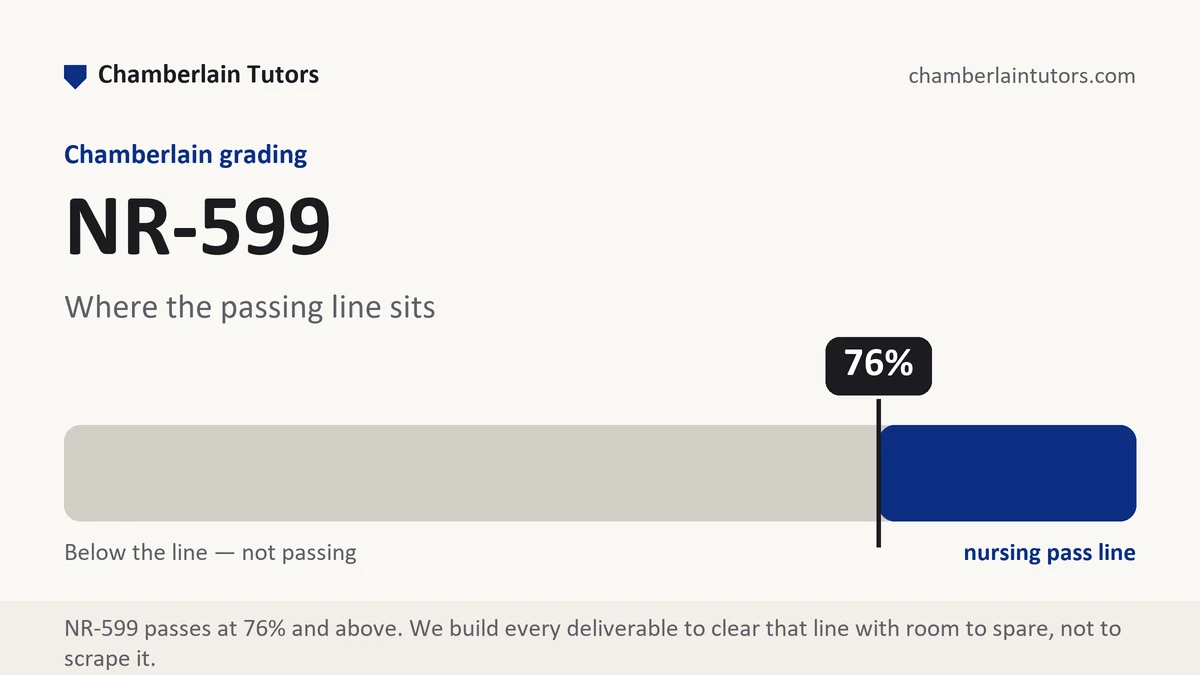
Both strands share one idea: information has to survive being handed to someone else. Chamberlain's floor in core nursing courses is 76, and students taking this inside a nurse practitioner specialty run a scale with no C where 84 is the last passing number, so early precision here is worth more than it feels at the time.
How we help in this course
Send the prompt and the rubric from Canvas with the setting you document in and, if the assignment calls for it, a fully de-identified example of the kind of note you write. We build the analysis against explicit criteria, quantify what we find, and keep the recommendations at the level of the template and the workflow rather than at the level of trying harder.
For the information literacy pieces we build the search as a documented strategy you can reuse, since the same search skeleton serves every later course in the program.
Working on the documentation piece?
Send the rubric and your setting. We will build the audit criteria and scope the draft today.
Read the rubric before the prompt
Rubrics in this course usually mix a doing row with an analyzing row, and students often complete the first and lose the second. Copy the rows into a blank file and mark which ones want an artifact, such as a search log or a revised note, and which ones want a judgment about what the artifact shows. Producing the artifact without interpreting it is the most common way to finish an assignment and still score in the middle.
Then convert the weights. A 1,300-word cap with rows weighted 30, 30, 25 and 15 percent gives 390, 390, 325 and 195 words. Both 390-word sections are roughly three paragraphs each, which is enough for a real analysis and not enough for background. In a course this practical, any paragraph explaining the general importance of documentation is a paragraph stolen from a row that wanted evidence.
Where a table is permitted outside the count, put the audit criteria and results in it. A criterion table with a column for what you found is the fastest way to make an analysis row easy to award.
The parts of a documentation analysis
The dominant deliverable here is an examination of clinical records against stated criteria. Each part carries a job.
| Part | What it must produce | The version that scores low |
|---|---|---|
| Purpose and reader | Who the note is for and what decision it has to support, stated before any criticism begins. | An assumption that documentation exists for compliance. |
| Criteria, stated first | The specific tests you will apply, drawn from professional standards rather than invented. | Impressions offered without any criteria behind them. |
| What was found | Results against each criterion, counted rather than characterized. | A claim that documentation is generally inconsistent. |
| Where reasoning lives | Whether the note shows what was considered and rejected, not only what was concluded. | A record of findings with the thinking invisible. |
| Structured versus narrative | What is captured in coded fields, what is left in free text, and what becomes unfindable as a result. | No distinction, so retrieval problems never surface. |
| Carried-forward content | Text repeated from prior encounters, and whether it is still true. | Silence about copy-forward, which is the most common defect in real records. |
| Consequences | What the gaps would cost in continuity, safety, coding accuracy or a legal review. | A note that quality should be improved. |
| Remediation | Changes to the template, the prompt or the workflow, not to individual effort. | A recommendation that clinicians document more thoroughly. |
Evidence craft, and the search behind it
Half the sourcing skill in this course is finding the material at all, so treat the search as part of the evidence.
Write the search so it can be repeated. Databases used, terms and their combinations, date limits, language and study-type filters, results returned at each step and the criteria that reduced them. That paragraph satisfies most information literacy rows on its own, and it takes about ten minutes to keep as you go.
Know what each resource is for. Point-of-care summaries are for orientation and for confirming current practice. Primary studies are for numbers and for claims that carry weight. Citing a summary resource for a specific statistic is the most frequent sourcing error in this course.
Design before finding, and verbs that match. Documentation research is largely observational, so "was associated with" and "occurred more often in" are the honest verbs. Reserve "reduced" and "improved" for controlled evidence, including when you cite studies of template changes, which are usually before-and-after work.
Rates need a denominator and a window. "Nineteen of the 60 notes reviewed over one month carried an unchanged problem list from a prior visit" is a finding. "Copy-forward is common" is an impression, and in a course about information quality that distinction is precisely what is being assessed.
Passing and strong in an informatics foundations course
A passing paper explains what good documentation should contain and observes that practice often falls short. It is accurate, uncontroversial and entirely unquantified, which leaves the analysis rows with nothing to grade beyond correctness.
There is a reason the counting matters so much in this particular course. Documentation problems are universally acknowledged and almost never measured, so every reader already agrees with the general complaint and nobody can act on it. The moment a paper says how many notes, out of how many, over what period, it has produced something a practice could take to a template committee.
A strong paper counts something. Even a small sample, honestly described, transforms the writing: twenty notes reviewed against six criteria produces findings, patterns and a defensible recommendation. It also aims its remediation at the system, because a note template that asks the wrong question will defeat any amount of individual diligence. And it protects the record throughout, with identifiers stripped before drafting rather than after, which is both a professional obligation and a signal that the writer understands what they are handling.
Six habits that cost marks in NR-599
- Criteria invented after the fact. State the tests before applying them, and draw them from published standards where you can.
- Findings without counts. Frequently and rarely are not measurements. Numbers out of a stated total are.
- Recommending more effort. Template, prompt and workflow changes survive a busy shift. Exhortations do not.
- An undocumented search. A literature section with no strategy behind it forfeits the information literacy row outright.
- Any identifier surviving into the draft. Strip names, dates, record numbers and site details before you write, not before you submit.
- Posting a discussion response unfinished. Posts do not reopen once submitted at Chamberlain, so paste only the final text.
Questions NR-599 students ask
Can I analyze notes I wrote myself?
How many records make a defensible sample for a course assignment?
My site still uses paper or a very limited system. Does that hurt me?
The weeks, one by one
Week 1
NR-599 opens by asking what informatics actually is in your hands rather than in a textbook, and the opening stage of the session almost always turns on that definition plus an honest reading of where your own competence sits. Read the full Week 1 manual.
Week 2
Information literacy is graded as reproducibility, and the second stage of NR-599 is usually where that lands. Read the full Week 2 manual.
Week 3
Documentation in this stage is graded as communication with a stranger: would a clinician who has never met this patient, reading your note at two in the morning with nobody available to ask, understand what you thought and why you thought it. Read the full Week 3 manual.
Week 4
The middle of NR-599 usually turns from what you write in the record to how the record itself shapes what you write. Read the full Week 4 manual.
Week 5
Somewhere in the second half of NR-599 the course turns to who may see what, under which authority, and what happens when the answer is contested. Read the full Week 5 manual.
Week 6
Decision support is where informatics stops describing the record and starts changing care, and the writing this stage rewards is about design and accountability rather than enthusiasm. Read the full Week 6 manual.
Week 7
Late in NR-599 the frame usually widens from the clinician's screen to the patient's, and the analytic question changes with it: not whether a portal or a remote visit is useful, but for whom it works, for whom it quietly does not, and what the practice can configure to close that distance. Read the full Week 7 manual.
Week 8
Closing stages in an informatics course usually ask you to gather the session into one argument: a change worth making, the evidence behind it, the design of the change itself, and how anyone would know it worked. Read the full Week 8 manual.