NR-544 Quality and Safety in Healthcare carries three theory credits and covers advanced quality management and patient safety practice for continuous improvement. The catalog states that NP students are not eligible for it, so the room is leadership, informatics and administration students. The written work is almost entirely proposal writing, and it is scored on precision: an aim with a number in it, measures with denominators, and a change idea somebody could start on Monday.
What NR-544 actually grades
Measurement discipline, before anything else. A quality paper is graded on whether the reader can tell exactly what would be counted. That means an operational definition for each measure: what goes in the numerator, what goes in the denominator, which cases are excluded and over what period the count runs. Students write about improving falls or reducing infections and never define either, which leaves the analysis rows with nothing testable and caps the paper in the low eighties no matter how fluent the prose.
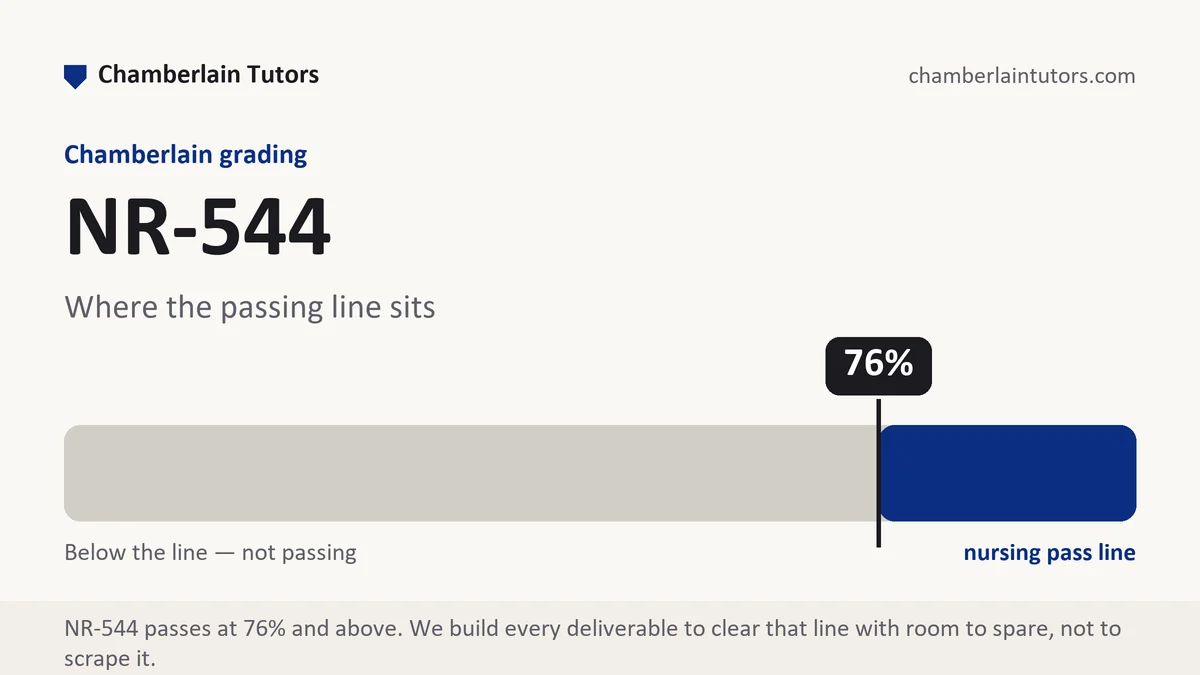
The second axis is systems thinking. Safety writing at this level rewards contributing factors and penalizes blame, and the shift is visible in the verbs. A grader can tell within a paragraph whether an event was analyzed or whether a nurse was quietly convicted. Chamberlain's 76 percent floor for core nursing courses applies, and with weekly deliverables across an eight-week session a couple of imprecise submissions set an average that later work has to climb out of. Supplementary work does not repair a weighted average that has already settled.
How we help in this course
We draft improvement proposals, event and contributing factor analyses, measure specification write-ups, safety culture papers, change model applications, board responses and the session project. Every draft states its measures in numerator and denominator form, because that single habit is what moves these papers up a band.
We work from your scenario, your prompt and published sources. We do not obtain incident reports, request quality data from your employer, sit on a committee for you or contact a safety officer. Where your prompt asks for organizational data, you supply what you are permitted to share and we build the written analysis around it.
In NR-544 right now?
Send the improvement topic and the rubric from Canvas. First premium sample free, floor-checked, back in 24 to 48 hours.
Read the rubric before the prompt
Improvement guides are unusually literal, which works in your favor. Lift the criterion rows into a blank document and reduce each to its verb: identify, define, analyze, propose, measure, sustain. Leave them in the printed order and make them your headings. In this course the define row and the measure row are separate for a reason, and students who merge them lose one of the two.
Now price the rows. Take an 1,800 word proposal with four rows at 30, 25, 25 and 20 percent. That is 540 words for the first, 450 for each of the middle two, and 360 for the last. If the 30 percent row is the problem and the measured gap, then 540 words goes to establishing that a gap exists and how large it is, which is the section students usually cover in a paragraph before rushing to the intervention. Two rows at 450 words each is a signal that analysis and proposal are meant to be equally substantial. Title page, references and appendices sit outside the count unless your guide says otherwise.
Write the four figures beside the headings and check them when the analysis section closes. A proposal section that has outgrown its share usually means the analysis was skipped, and graders can see that from the balance alone.
The shape of a quality improvement proposal
Under any name your section uses, the dominant deliverable is a proposal to change something and to know whether it worked. These are the parts that get scored.
| Part | What it must specify | What a weak version does |
|---|---|---|
| Problem with a measured gap | Current performance, the benchmark or target, and the distance between them. | States that the topic is a national concern. |
| Aim statement | How much, for whom, by when, in one sentence a committee could vote on. | Aims to improve safety and enhance quality. |
| Outcome measure | The result you want, with numerator, denominator, exclusions and period. | Names a concept such as fewer falls. |
| Process measure | The behavior that has to change for the outcome to move, counted the same way. | Omitted entirely, so nothing explains why the outcome moved. |
| Balancing measure | What might get worse elsewhere, watched deliberately. | Assumes the change has no cost anywhere in the system. |
| Contributing factors | System, equipment, communication and task conditions that made the event possible. | A list of individuals who did not follow policy. |
| Change idea and test | The specific change, tested small first, with who runs the test and for how long. | Mandatory education for all staff, launched everywhere at once. |
| Sustaining plan | What holds the gain when attention moves on: a standing report, an owner, a threshold. | A promise of continued vigilance. |
Evidence and citation craft at this level
Quality literature is full of numbers that do not survive inspection, so four habits keep your evidence rows safe.
Currency, and the reporting period behind the benchmark. Where your guide sets no rule, five years is a defensible line, and for benchmarks the reporting period matters as much as the publication year. National comparison rates are published on a lag, so name the period the benchmark covers rather than the year the file appeared, and say which organizations were included in it.
Design and sample before the finding. Improvement literature mixes single-site before and after reports with cluster randomized trials, and they support very different sentences. Ten words of setup, such as in a single-unit pre and post study of 340 admissions, warns the reader what weight the number can bear. A single-site report is a reason to try something, not proof that it works.
Verbs the design can pay for. Improvement work is rarely controlled, so the honest verbs are fell during, was lower in the period after and coincided with. Reserve reduced and prevented for evidence with a comparison group. This is the row where quality papers most often overreach, because the literature they are citing overreaches first.
Denominator and window on every rate, always. Safety rates have specialized denominators for a reason: falls per 1,000 patient days, infections per 1,000 device days, errors per 1,000 doses dispensed. Write 3.1 falls per 1,000 patient days over the six months ending in March rather than 14 falls, because a raw count moves with volume and tells the reader nothing about performance. Where you compare two units, say whether the denominators were constructed identically, since they frequently are not.
What separates a passing proposal from a strong one
A passing proposal picks a genuine safety problem, cites the literature, and recommends education plus a checklist. It scores in the high seventies to low eighties because it is undeniable and unmeasurable: nothing in it could be shown to have succeeded or failed.
Strong proposals do three things. The aim statement carries a number and a date, so the paper commits to a claim it could lose. The measure set is complete, meaning an outcome, a process and a balancing measure, each specified to the level where two different people counting would get the same answer. And the change is tested small before it is spread, with the first test described concretely: one unit, one shift, two weeks, this person collecting. Add a line naming what result would make you abandon the change, and the proposal reads like quality work rather than an essay about quality.
Mistakes that cost points here
- An aim with no number and no date. Improve patient safety is a value, not an aim. Write the percentage, the population and the deadline.
- Education as the whole intervention. Training alone rarely holds a change. Pair it with something structural: a default, a checklist embedded in the workflow, a standing report.
- Blame wearing analysis clothing. Naming the staff member who missed a step ends the inquiry. Name the conditions that made the step easy to miss.
- Raw counts compared across months. Fourteen events in a busy month can be better performance than nine in a quiet one. Convert to a rate before you compare anything.
- No balancing measure. Every improvement pushes somewhere. A proposal that watches only its own outcome will not notice the harm it created.
- Treating a board post as a scratchpad. Discussion responses do not reopen once submitted at Chamberlain, so an imprecise measure posted at midnight stays on the record. Draft in a document first.
Questions NR-544 students ask
Is my project quality improvement or research, and does that change anything?
How do I write an aim statement that graders accept?
What exactly is a balancing measure and do I really need one?
The weeks, one by one
Week 1
Everyone on a med-surg floor can tell you what is wrong with the place. Read the full Week 1 manual.
Week 2
The second stage of an advanced quality course usually turns to why harm happens and how organizations respond to the person nearest to it. Read the full Week 2 manual.
Week 3
Two med-surg units can report the same pressure injury rate and mean entirely different things by it, because one counts injuries present on admission and the other does not. Read the full Week 3 manual.
Week 4
Retrospective event analysis is a method, not a narrative, and NR-544 Week 4 is where the method gets taught. Read the full Week 4 manual.
Week 5
Retrospective analysis waits for a patient to be harmed. Read the full Week 5 manual.
Week 6
Improvement science is built on a claim most healthcare organizations resist: you learn more from testing a change on three patients tomorrow than from planning a unit-wide rollout for four months. Read the full Week 6 manual.
Week 7
Two numbers side by side is the weakest evidence in quality work and the most commonly used. Read the full Week 7 manual.
Week 8
Most improvement projects work and then quietly stop working. Read the full Week 8 manual.