NR-510F is the role development course for the advanced practice nurse. Read the catalog entry carefully before you plan your term: the block carrying this title prints no contact or semester hours, and the description printed underneath it describes foundational nursing informatics rather than role development. Check your own program map and your Canvas shell in week one so you know which body of content your section is running. Either way the graded output is written, and the writing is about your professional formation.
What NR-510F actually grades
Role development is the least concrete phrase in a graduate nursing catalog and the easiest thing to write badly. Graders are not scoring how much you want the role. They are scoring evidence of transition: proof that you can describe where you are now as a clinician, where the advanced practice role sits, what stands between the two, and what you are doing about it on a timeline.
That means the strongest sentences in this course are dated and specific. A plan to sit a national certification examination in a named month, with the eligibility requirements listed and the application steps in order, is assessable. A statement that you intend to become certified is not. The same test applies to every other piece of the transition: mentorship, professional membership, portfolio, curriculum vitae, philosophy statement, networking. Each one either has a mechanism attached or it is decoration.
The catalog mismatch matters here in a practical way. If your section is delivering the informatics content that the printed description describes, expect deliverables about health data, systems and the virtual learning environment, and expect to be graded on whether you can describe a workflow rather than admire technology. Ask in the first week rather than the fourth.
How we help in this course
Nothing in NR-510F is clinical, so nothing on our side touches placement, preceptors, site paperwork or hour logs. The output is documents, and documents are what we build.
Send the prompt and the scoring guide from Canvas and a premium original draft comes back in 24 to 48 hours, planned against the actual criterion rows and written in the register a graduate role paper needs. It clears both quality reviews and the floor check before it reaches you, and revisions stay free until the grade is where you need it.
Writing this course's deliverables from the rubric
The method below is rubric first, evidence second, self third. Reversing that order is how a sincere paper about your career ends up scoring in the middle, because sincerity is not one of the criterion rows.
In NR-510F right now?
Send the week and the rubric from Canvas. First premium sample free, floor-checked, back in 24 to 48 hours.
Where the passing line sits
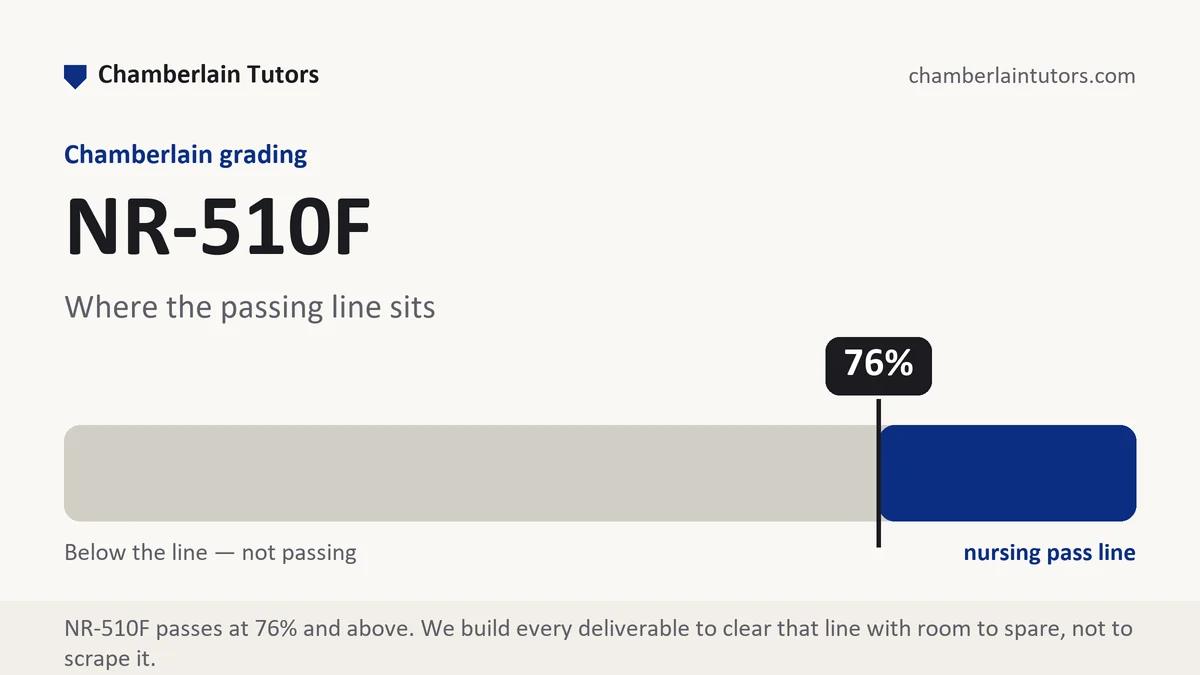
Core nursing courses at Chamberlain pass at 76 percent. On the nurse practitioner specialty scale there is no C band at all, so 84 becomes the last passing number and a merely adequate run of weeks lands under it faster than students expect. Supplementary work cannot repair a weak weighted average, which removes the usual late rescue.
The calendar compounds it. Sixteen week semesters split into two eight week sessions, up to six starts a year, deliverables every week. A role course early in a track feels low stakes precisely because it is not clinical, and that misreading is what produces a first transcript line nobody wanted.
Turn the criterion rows into a plan
Open the scoring guide before the prompt. Paste the rows into a blank document in the order printed, then reduce each row to its working verb: appraise, plan, justify, integrate, evaluate. Those verbs become headings, and holding the guide's order means a grader looking for row three lands on section three.
Now price the rows. Say the week caps you at 1,600 words with four rows weighted 30, 25, 25 and 20 percent. That is roughly 480 words, 400, 400 and 320. The shape is telling: nothing dominates, so no section can be written luxuriously at another's expense, and the 320 word row at the end is the one people skip when the week gets ugly. Skipping it costs a fifth of the assignment, which no amount of polish elsewhere recovers.
Keep the number beside the heading while you draft. Any section that finishes at half its budget is telling you the thinking underneath it is thin, not that you were admirably concise. Your title page and reference list stay outside the count unless the guide says differently.
The shape of a role transition plan
Most graded writing here is some form of transition plan: a professional development document, a portfolio artifact, a philosophy statement, a self appraisal against a set of standards. Each of the six is a thing a grader goes looking for, in roughly this order.
| Part | What it has to establish | How the thin version reads |
|---|---|---|
| Current position, stated plainly | Your setting, licence, years, scope and the decisions you make today, in three or four sentences. | A career narrative starting with nursing school. |
| The target role, defined from a source | What the advanced practice role requires, taken from a standards document or a certifying body rather than from memory. | A description of the role built from what colleagues have said. |
| The honest gap | Named shortfalls between the two, with the uncomfortable one included. | A self appraisal in which the writer is already almost there. |
| Actions with owners and dates | Specific steps, each with a month, a resource and a person or body involved. | A list of intentions written in the future tense with no dates. |
| Evidence that the plan is sound | Literature or standards showing this approach to transition works, cited and described before use. | Personal conviction carrying the whole section. |
| How you will know it worked | An observable marker for each action: a credential earned, a log of mentored hours, a portfolio artifact completed. | A closing paragraph promising continued growth. |
Evidence and citation craft in a role course
Writing about yourself does not lower the evidence standard. It raises it, because the reader has no independent way to check you.
- Use the current edition of any standard and name it. Scope and standards documents, certification handbooks and accreditation criteria are revised on their own schedules. Quoting a superseded edition describes a rule that no longer applies, and dating the version you read costs one clause.
- Cite the certifying body, not the forum post. Eligibility rules, examination content outlines and renewal requirements come from the organization that runs the credential. Student forums are useful for morale and worthless as citations.
- Set up a study before its result appears. Write that a longitudinal survey of 1,340 newly certified practitioners tracked role confidence across the first year, then the finding. Provenance before number, every time.
- Match the verb to the design. Transition to practice research is largely observational and self reported. Practitioners who reported formal mentorship also reported higher role clarity is honest. Mentorship produces role clarity is not.
- Give each rate a denominator and a period. Write that 612 of the 2,050 respondents surveyed in one calendar year changed employers within eighteen months, rather than that 30 percent did. Without the base and the window the figure is decoration.
The gap between a passing paper and a strong one
A passing NR-510F paper is warm, organized and optimistic. It describes the role accurately, lists reasonable goals, and closes on a commitment to lifelong learning. It could have been written by any student in the section, which is exactly the problem.
Strong papers are specific enough to be falsifiable. They name the setting and the shortfall rather than gesturing at growth areas. They attach a date and a mechanism to every action, so a reader could check in six months whether it happened. And they treat the standards document as a measuring instrument rather than a decoration, holding their own practice against particular clauses and reporting where it does not yet reach.
Six mistakes that cost points here
- Writing an autobiography. The reader needs your current scope, not your career. Three or four sentences of setting, then move to analysis.
- Goals with no dates. An action without a month is a wish. Every step in a development plan should be checkable on a calendar.
- Claiming a gap you do not have and hiding the one you do. Safe self criticism reads as evasion. Name the real shortfall; that is where the analysis marks are.
- Ignoring the catalog mismatch. If your section is running the informatics content printed under this title, a beautifully written role paper answers the wrong course. Confirm in week one.
- Posting to the discussion board straight from the text box. Chamberlain posts cannot be edited once submitted. Draft elsewhere, check the citation, paste once.
- Treating the portfolio as an appendix. Where a rubric row asks for an artifact, the artifact is graded. A curriculum vitae attached without formatting care costs the same points as a weak paragraph.
Questions NR-510F students ask
Why does the catalog description under this title talk about informatics?
How personal is too personal in a role development paper?
Can I reuse this plan in a later course?
The weeks, one by one
Week 1
NR-510F Week 1 opens a leadership and role development course, and the natural first territory is the advanced practice landscape itself: which roles exist, what each is licensed and educated to do, and where your own trajectory sits on that map. Read the full Week 1 manual.
Week 2
NR-510F Week 2 sits naturally on role transition: what happens to an expert registered nurse who becomes a novice advanced practice student, and how that passage is described in the transition literature. Read the full Week 2 manual.
Week 3
NR-510F Week 3 belongs, by the logic of a role development arc, to the legal and regulatory frame around advanced practice: state practice acts, licensure and certification, prescriptive authority, and the documents that decide what an advanced practice nurse may do where. Read the full Week 3 manual.
Week 4
NR-510F Week 4 reaches the leadership half of the course title, and the midpoint of an eight-week arc is where leadership theory typically gets applied: named models of how leaders influence teams, examined against your own observed style and the demands of the advanced practice role. Read the full Week 4 manual.
Week 5
NR-510F Week 5 typically moves leadership outward, from your own style to the interprofessional team the advanced practice nurse works inside and often coordinates: collaboration frameworks, communication structures, and the conflicts that arise where professions overlap. Read the full Week 5 manual.
Week 6
NR-510F Week 6, by the arc of a leadership and role development course, usually turns to policy and advocacy: how the advanced practice nurse influences the rules that shape practice, from a facility protocol to a state provision, and how advocacy is written rather than just felt. Read the full Week 6 manual.
Week 7
NR-510F Week 7, in the closing arc of a leadership course, typically lands on accountability for outcomes: how the advanced practice nurse leads quality - measures, audit cycles, improvement methods - and how that accountability is argued in writing. Read the full Week 7 manual.
Week 8
NR-510F Week 8 is the closing stage, and closing stages in role development courses almost always ask for synthesis: a paper or presentation that gathers the session's threads - the role landscape, your transition, scope, leadership, collaboration, policy, quality - into one argued account of who. Read the full Week 8 manual.