NR-506NP puts three things in one course: healthcare policy, advanced practice leadership, and the ethical and legal decision making a practitioner has to do with all of it. The deliverables that score are the ones that keep those three registers separate on the page. What the law requires, what ethics recommends and what policy currently permits are different questions, and papers lose points mostly by answering one while appearing to answer another.
What NR-506NP actually grades
Four things run through the scoring rows. Whether you can describe a policy or regulation as a mechanism rather than as a position. Whether you can locate authority correctly, meaning you know which body actually decides the thing you are writing about. Whether you can work an ethical problem by weighing options rather than announcing the humane one. And whether you can propose leadership action that a practitioner could take, at the level a practitioner operates on, without either shrinking to helplessness or claiming powers the role does not carry.
The specific difficulty of an NP section is that scope of practice sits under almost every topic. Anything you write about what a practitioner may do is a claim about a particular jurisdiction at a particular time, and a national generalization is nearly always wrong somewhere. Graders in this course notice that faster than in any other.
How we help in this course
Send the prompt, the scoring guide from Canvas, and the jurisdiction you want the paper anchored in, since specificity about place is what keeps regulatory claims defensible. The draft comes back with legal, ethical and policy claims separated and labelled, authority attributed to the body that holds it, an ethical section that weighs at least two defensible options before choosing, and leadership recommendations sized to what a practitioner can actually do.
Orders run the whole pipeline: guide decoded row by row, core deliverables tagged apart from supplemental, a writer matched to policy, ethics and advanced practice material, a rubric pass followed by an independent APA and originality pass, the scale check against your section's floor, delivery inside 24 to 48 hours. What we never touch: clinical hours, preceptor or site contact, placement paperwork and logs. Those are yours alone, without exception.
How to write this course's deliverables
Chamberlain publishes no syllabi outside Canvas, so nothing here guesses at your week. The craft below applies to whatever the prompt turns out to be: pricing the scoring guide in words, the shape an ethical and legal decision analysis takes, and how to source claims about law and regulation so they survive being checked.
In NR-506NP right now?
Send the week and the rubric from Canvas. First premium sample free, floor-checked, back in 24 to 48 hours.
Graded on a scale with no C
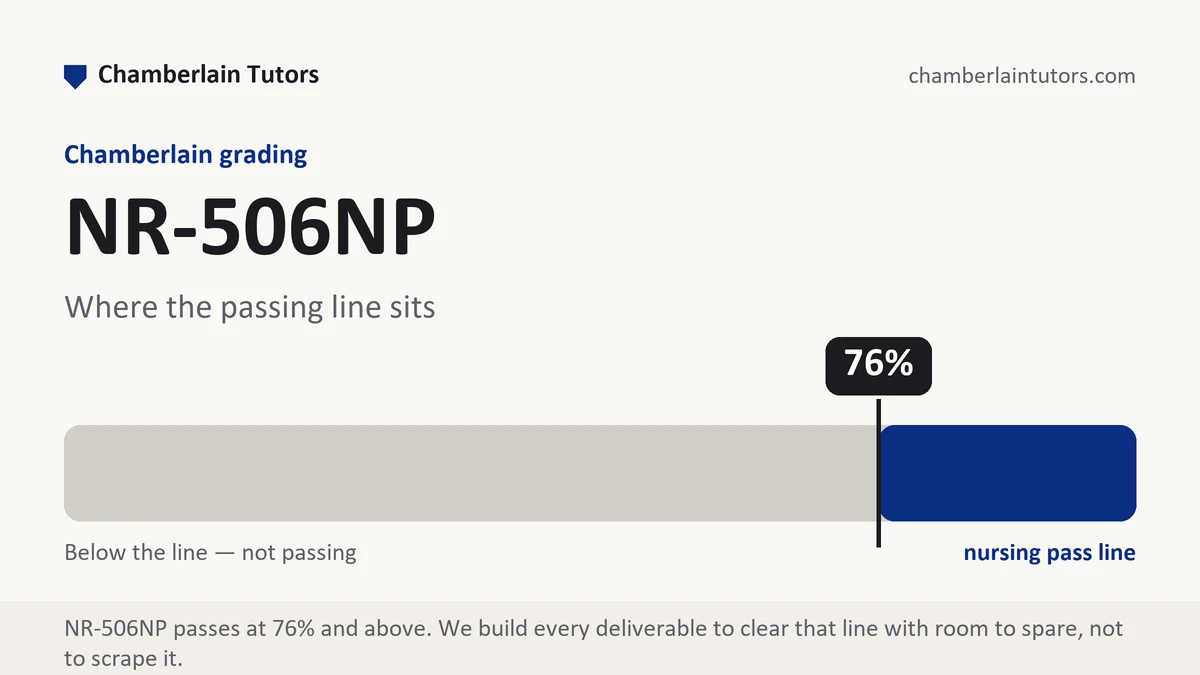
Specialty coursework in the NP tracks runs on a scale that has no C band, which means 84 is the last passing number and there is nowhere soft to land. This course produces near miss grades in a particular way: the writing is fluent, the position is sympathetic, and the analysis rows keep scoring in the low eighties because options were never weighed. Supplementary work cannot lift a weighted average once the graded pieces have averaged out, so each week has to carry itself.
The calendar is unforgiving too. Sessions run eight weeks inside a sixteen week semester with weekly deliverables, and boards do not reopen once a post is submitted at Chamberlain. In a course covering ethics and workplace conflict, that permanence matters more than usual. Compose the post elsewhere, strip anything that identifies a patient, a colleague or an employer, then paste.
Price the guide before you take a position
Read the scoring guide first, then decide what you think. Doing it the other way round produces a paper built around a conclusion, and the rows in this course are mostly about the reasoning that leads to one. Copy each row as a heading in the guide's order, then label it with the register it belongs to: legal, ethical, policy or leadership. Papers go wrong when a row asking a legal question gets answered in ethical language, and labelling in advance makes that mistake visible before drafting.
Then attach words. Say the paper is capped at 1,250 words with four rows: the issue described with its legal and regulatory context at 35 percent, ethical analysis at 25, leadership response at 25, and scholarly writing with APA at 15. Multiplied against the cap that gives 437 words, 312 words and 312 words, with the writing row's 187 words covering the opening, the closing and the joins between sections.
The number to respect is 312 for ethical analysis, because an ethical section of that length cannot be a paragraph naming two principles and choosing one. It has room for the option you rejected, argued at its strongest, before you commit. That structure is what the row is buying. If your guide gives points instead of percentages, divide the words available by the points available and apply the rate, and where a row's language is more demanding than its weight suggests, take the extra words from whichever row asks only for description.
The shape of an ethical and legal analysis
Whatever the deliverable is called, this ground has to be covered, and each part has a version that reads as unfinished.
| Part | What it has to establish | The version that loses points |
|---|---|---|
| The situation, narrowly | One decision point, with the facts that actually bear on it and nothing else | A long narrative in which the difficult choice never gets isolated |
| The legal frame | What the applicable rule or regulation requires, in which jurisdiction, attributed to the body that issued it | A claim that something is illegal, with no source and no place named |
| The policy frame | What the relevant institutional or public policy currently permits or funds, which is not the same as what the law requires | Law, policy and professional guidance treated as one undifferentiated set of rules |
| The ethical tension | Two principles genuinely pulling in different directions, each stated as a real claim on the decision | One principle named and the other implied as obviously less important |
| Options weighed | At least two defensible courses of action, each with its consequence for the parties involved | A single option presented as the only humane choice |
| The decision and its grounds | What you would do and which considerations outweighed which, said explicitly | A conclusion that restates the ethical principle without applying it |
| Leadership action and accountability | What a practitioner does next, who else is involved, and what gets documented or escalated | Advocate for the patient, with no mechanism and no accountability |
Sourcing law, ethics and policy without blending them
Four habits keep this kind of writing defensible.
Say which body holds the authority. Practice authority for advanced practice nurses is set at state level and varies, so every claim about what a practitioner may do needs a place attached to it. Name the regulator or the rule, name the state, and give the year of the version you read. A sentence that says practitioners have independent authority, with no jurisdiction attached, is disprovable by anyone who picks a different state.
Keep law, ethics and professional guidance in separate sentences. A statute requires. A professional code recommends. An ethical principle claims. Papers that run the three together produce statements no reader can verify, and the analysis rows treat that as imprecision rather than as style.
Date what expires and cite the record. Regulations get amended and bills move. Write the version year or the date you checked, and cite the official text rather than a summary of it where you can. Where your guide sets no recency rule, treat five years as the working boundary for commentary and analysis, and prefer the current version of any rule regardless of how good an older discussion of it was.
Numbers carry their base and their window. Access, workforce and utilization figures are common in this course and often quoted bare. Write that 1,240 of the 8,900 residents in a defined county lacked a usual source of care during a stated year rather than giving a percentage alone. Match verbs to design as well: policy comparisons across states or periods are observational, so was associated with and coincided with are the honest options, while reduced and caused require a study that isolated the policy from everything else changing at the same time.
Passing paper, strong paper, in NR-506NP
A passing NR-506NP paper describes a difficult situation, names an ethical principle, notes that regulation varies, and calls for advocacy. It is decent and it is safe, and safe sits near the line on a scale with no C.
A strong paper does three specific things. It puts the rejected option on the page at full strength, because an ethical analysis that never shows the other course of action has not analyzed anything. It anchors every regulatory claim in a place and a date, which takes one extra clause per sentence and protects the whole paper. And it ends with action a practitioner could actually take, naming who else is involved and what gets documented, rather than with a call for advocacy addressed to no one. Papers with those three features read as prepared for practice, which is precisely what the course is assessing.
Six mistakes that cost points here
- National claims about state level authority. Scope varies by jurisdiction. A sentence with no state attached is the easiest error to find in the paper.
- Ethics answered with law, or law answered with ethics. Label each row's register before drafting and the confusion disappears.
- One option presented as the only choice. The weighing is the assignment. A single option is a position statement.
- Advocacy as the recommendation. Name the action, the parties and the documentation, or the leadership row has nothing to score.
- Undated rules and unversioned guidance. Regulations change, and a claim with no year is a claim about an unknown moment.
- Identifiable workplace detail. Remove names, employers and anything that could identify a patient before a post or paper is submitted anywhere.
Questions NR-506NP students ask
Scope of practice differs by state. How do I write about it without being wrong?
Can I use an ethical situation from my own workplace?
How much law do I actually need to cite, and where do I find it?
The weeks, one by one
Week 1
NR-506NP Week 1 starts where every policy course has to start, with the question of how a difficulty that nurses live with every day becomes something a policy can act on. Read the full Week 1 manual.
Week 2
NR-506NP Week 2 follows a policy through the machinery that produces it, which is where most students discover that a law is only half the story. Read the full Week 2 manual.
Week 3
NR-506NP Week 3 lands on the question every nurse practitioner student eventually has to answer precisely: what am I permitted to do, who decided that, and where does the permission stop. Read the full Week 3 manual.
Week 4
NR-506NP Week 4 turns to money, because coverage decides who walks through a clinic door and payment decides which services exist to be walked into. Read the full Week 4 manual.
Week 5
NR-506NP Week 5 moves from the system to the individual decision, and the scoring changes with it. Read the full Week 5 manual.
Week 6
NR-506NP Week 6 asks what happens when practice goes wrong and someone has to answer for it. Read the full Week 6 manual.
Week 7
NR-506NP Week 7 takes the leadership half of the course into the building. Read the full Week 7 manual.
Week 8
NR-506NP Week 8 is where the session's pieces get assembled into something aimed at a person. Read the full Week 8 manual.