NR-506 covers how health policy gets developed, analyzed and felt, from a single institution up to the global level. The graded skill is analysis rather than advocacy. A paper that argues passionately for a position it never tested against costs, stakeholders or feasibility scores lower than a colder one that examined the same policy from three sides. This page is the manual for writing the colder version well.
What NR-506 actually grades
The scoring rows want a policy treated as a mechanism rather than as a moral position. That means naming what the policy actually does, in the sense of what it requires, funds, restricts or reimburses. It means identifying who gains and who pays, since every policy redistributes something. It means saying whether the thing could be enacted where you are proposing it, which involves cost, authority and political appetite rather than merit alone. And it means predicting consequences, including the ones the policy's supporters would prefer not to discuss.
Nurses often arrive with strong convictions about health policy and write persuasive essays instead of analyses. The two look similar and score very differently. An analysis can reach a firm conclusion, but it earns that conclusion by examining what the alternatives would have achieved and what the chosen option costs.
How we help in this course
Send the prompt, the scoring guide from Canvas, and the policy issue or jurisdiction you are working with. The draft comes back with the policy described mechanically before it is judged, cost and coverage figures anchored to their years and their sources, stakeholders identified with their actual interests rather than their stated ones, and a feasibility section that treats political and financial constraints as facts rather than obstacles to complain about.
The order runs the pipeline: scoring guide decoded row by row, core deliverables separated from supplemental ones, a writer matched to health policy material, a rubric pass followed by an independent APA and originality pass, the scale check against your section's floor, delivery inside 24 to 48 hours.
How to write this course's deliverables
Chamberlain publishes no syllabi outside Canvas, so this manual describes craft, not weeks. It covers turning the scoring guide into a section plan with words attached, the parts a policy analysis has to contain, and the sourcing habits that keep policy writing from aging badly between the day you draft it and the day it is graded.
In NR-506 right now?
Send the week and the rubric from Canvas. First premium sample free, floor-checked, back in 24 to 48 hours.
The gradebook behind the debate
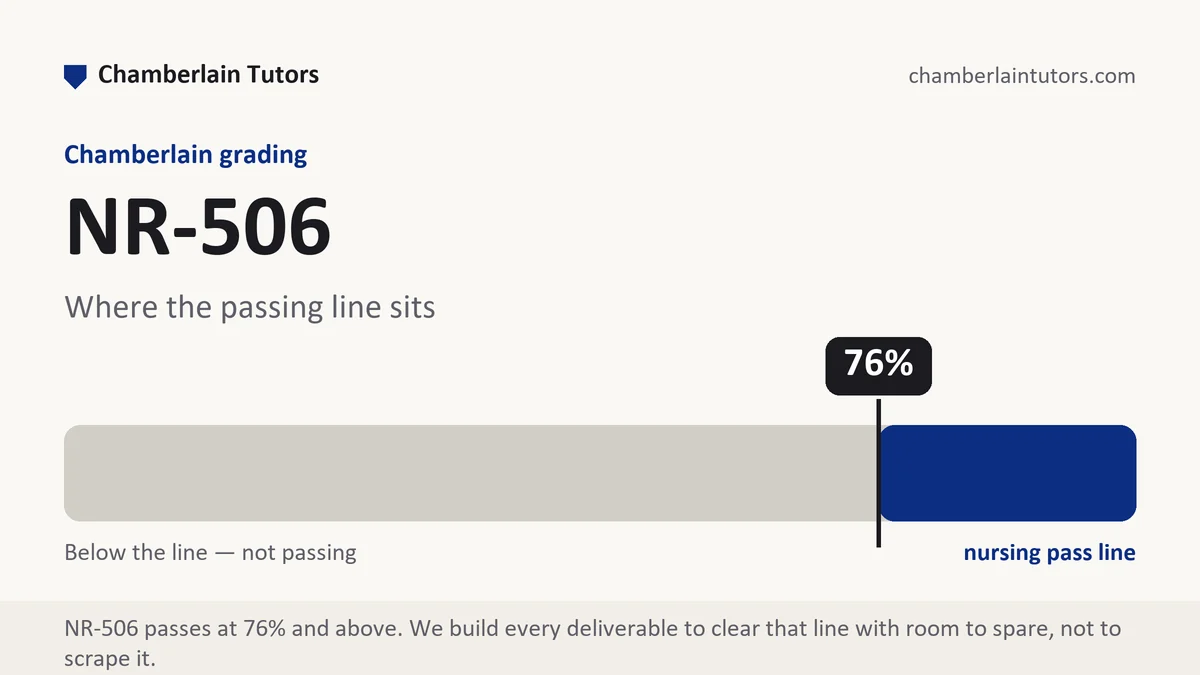
The 76 percent floor applies here as in every core nursing course, core assignments are averaged apart from supplemental ones, and supplementary points cannot repair a weighted average that has already dropped. Policy courses produce a specific pattern of loss: students write well, argue confidently, and lose points steadily in the analysis rows for never examining the other side of their own position.
The session structure adds pressure. Eight weeks inside a sixteen week semester, deliverables every week, and discussion boards that do not reopen once a post is submitted at Chamberlain. Policy boards are the ones most likely to produce a post written quickly and regretted later, because political topics invite a tone that reads differently on a screen than it felt at the keyboard. Draft the post elsewhere, read it once for tone and once for evidence, then paste.
Turn the guide into a section plan with words attached
Read the scoring guide first, because policy prompts are broad and the guide is what narrows them. Copy the rows as headings in the guide's order, then mark each with what it actually demands: description, analysis, prediction or recommendation. Those four take different amounts of room and different kinds of evidence, and confusing them is why policy papers sprawl.
Now price them. Suppose the analysis is capped at 1,800 words across six rows: the problem framed with data at 20 percent, the policy option described and analyzed at 20, stakeholder analysis at 15, feasibility at 15, implementation pathway at 20, and APA with scholarly writing at 10. Multiply against the cap and the plan appears: 360 words for the problem, 360 for the policy, 270 for stakeholders, 270 for feasibility, 360 for the pathway, and the writing row's 180 words spent on the opening, the closing and the transitions between sections.
Two observations that change how papers get written. Feasibility at 270 words is a real section, not a closing caveat, and it is the section most often reduced to two sentences about needing funding. And if your section asks for a brief rather than an essay, keep the same budget but change the packaging: headings that state conclusions, short paragraphs, and the recommendation near the front rather than saved for the end. A brief is read by someone in a hurry, and the format is part of what is being graded.
The parts of a policy analysis
Whatever your section calls the deliverable, this ground has to be covered. The right column shows what a grader reads as advocacy standing in for analysis.
| Part | What it has to establish | The advocacy version |
|---|---|---|
| The problem, quantified | Who is affected, how many, where, and over what period, with a source behind each figure | A description of suffering with no numbers attached to it |
| What the policy actually does | The mechanism: what it requires, funds, restricts or reimburses, and who administers it | The policy's goals restated as though goals were mechanisms |
| Level and authority | Whether this sits with an institution, a state, a federal agency or an international body, and who has power to act | A proposal addressed to nobody in particular |
| Stakeholders and their interests | Who gains, who pays, and what each party would say if asked, including parties you disagree with | A list of supporters, with opponents characterized rather than described |
| Feasibility | Cost, administrative burden and political appetite, treated as constraints rather than obstacles | A sentence saying funding would be required |
| Consequences, both directions | The intended effects and at least one plausible unintended one, with reasoning | Benefits only, which reads as a brochure |
| Recommendation and next step | A specific action by a named actor, and what would have to happen first | Nurses should advocate for change |
Sourcing policy so the paper does not age badly
Policy writing decays faster than any other kind in a nursing program, and four habits slow the decay.
Separate what the law says from what people say about it. Statutes, regulations and agency documents state what is required. Advocacy organizations, professional bodies and commentators state what they want. Both belong in a policy paper, and blending them silently is the fastest way to lose the analysis row. Name the source type in your sentence so the reader always knows which register they are in.
Date every status claim. A bill's position in the process changes, so write the stage and the date you checked rather than saying legislation is pending. A sentence that says as of the date of writing, the measure had advanced to a particular stage stays true afterwards. A sentence that says a bill is currently under consideration becomes false without warning and a grader may well know it.
Give money a year and a base. Cost figures are meaningless without the year they were estimated in and what was included, so write that a projected annual cost was estimated at a stated figure in a named report covering a named period. The same discipline applies to any rate: say what was counted, out of how many, and across what stretch of time. Nineteen thousand of a defined population over three years is evidence; a percentage alone is decoration.
Keep causal language proportionate. Policy evaluations are mostly observational, comparing places or periods, so the honest verbs are was associated with, coincided with and occurred more often among. Reduced and caused require a design that isolated the policy from everything else happening at the same time, which is rare. Where a study did manage it, say how, because that sentence is worth points.
Passing analysis, strong analysis, in NR-506
A passing NR-506 paper picks a real issue, explains why it matters, describes a policy that addresses it, and urges nurses to get involved. It is accurate and sincere, and it sits in the middle of the scale because nothing in it was tested.
A strong paper differs three ways. It states the mechanism before the judgment, so the reader knows precisely what the policy does before being told whether it is good. It represents opposition fairly, giving the strongest version of the case against rather than the weakest, which is the single clearest marker of analytical writing. And it names a cost it accepts, saying what the recommended option would sacrifice, because a proposal with no downside has not been examined. Papers that do those three things read like policy work. Papers that do none read like a letter to a representative.
Six mistakes that cost points here
- Advocacy in place of analysis. Passion is not a scoring row. Mechanism, stakeholders, feasibility and consequences are.
- Goals described as mechanisms. What a policy hopes to achieve is not what it does. The rows want the requirement, the funding stream or the restriction.
- Undated legislative claims. Status changes. Write the stage and the date checked, or the sentence expires before grading.
- Opponents summarized rather than quoted. Characterizing the other side weakens your own case and the stakeholder row at once.
- Cost figures with no year or scope. A number with no base year and no definition of what it includes cannot support a feasibility argument.
- A recommendation with no actor. Someone specific has to be able to do the thing you are proposing, at a level that has the authority to do it.
Questions NR-506 students ask
Do I have to write about a specific bill, and what if it changes while I am writing?
How do I write about a politically charged issue without losing points?
What actually separates a policy analysis from an opinion paper?
The weeks, one by one
Week 1
NR-506 Week 1 sets the vocabulary the rest of the session runs on and asks you to state a policy problem in a form policy can actually act on. Read the full Week 1 manual.
Week 2
NR-506 Week 2 asks how a problem becomes something anyone in authority is obliged to deal with. Read the full Week 2 manual.
Week 3
NR-506 Week 3 asks who gains, who pays and who can stop it. Read the full Week 3 manual.
Week 4
NR-506 Week 4 follows the money, because almost every policy argument eventually becomes an argument about who pays. Read the full Week 4 manual.
Week 5
NR-506 Week 5 takes apart the assumption that being covered and being able to get care are the same thing. Read the full Week 5 manual.
Week 6
NR-506 Week 6 asks who enforces quality and what happens when a measure becomes a target. Read the full Week 6 manual.
Week 7
NR-506 Week 7 lifts the analysis to the level where nations and international bodies set policy, and it asks the hardest question in comparative work: what can one country actually borrow from another. Read the full Week 7 manual.
Week 8
NR-506 Week 8 closes the session with the document that has to persuade someone who has four minutes. Read the full Week 8 manual.