NR-504 asks you to apply leadership knowledge, skills and attitudes to the master's prepared nursing role across practice settings. In graded terms that means writing about leadership as something with evidence behind it rather than as a set of admirable qualities. The papers that score are the ones where a specific situation gets analyzed through a named framework and produces a plan someone could hold you to. This page is the manual for building one.
What NR-504 actually grades
The scoring rows in this course are built around a single suspicion: that leadership writing drifts into vocabulary. Words like collaboration, empowerment, transformational and advocacy are easy to produce and impossible to score, so the guides push in the other direction. They want a named framework rather than leadership in general, a specific situation rather than a category of situation, evidence rather than conviction, and a development plan detailed enough that a reader could check next month whether anything happened.
There is a second thing being graded that the guide rarely says outright: whether you understand the difference between authority and influence. Many students in this course hold no formal management position, which is not an obstacle, because the master's prepared role is largely about influence exercised without a title. A paper that treats leadership as something you can only do once promoted has misread the assignment.
How we help in this course
Send the prompt, the scoring guide from Canvas, and a short account of the situation or setting you want the paper built on. Two or three sentences are enough; the specifics make the difference between a paper about leadership and a paper about your unit. The draft comes back with a framework named and used consistently, the situation analyzed through its terms, evidence carrying the claims rather than adjectives, and a development plan written in actions with a way to verify each one.
The order runs the usual route: scoring guide decoded row by row, core deliverables separated from supplemental ones, a writer matched to leadership and role development material, a rubric pass and then an independent APA and originality pass, the scale check against your section's floor, delivery inside 24 to 48 hours.
How to write this course's deliverables
Chamberlain publishes no syllabi outside Canvas, so nothing below claims to know your week's prompt. What it gives you instead is craft that holds across prompts: how to build a word budget when the guide gives points and no word count, what a leadership analysis has to contain, and how to source claims about leadership without leaning on assertion.
In NR-504 right now?
Send the week and the rubric from Canvas. First premium sample free, floor-checked, back in 24 to 48 hours.
A soft sounding course with a hard floor
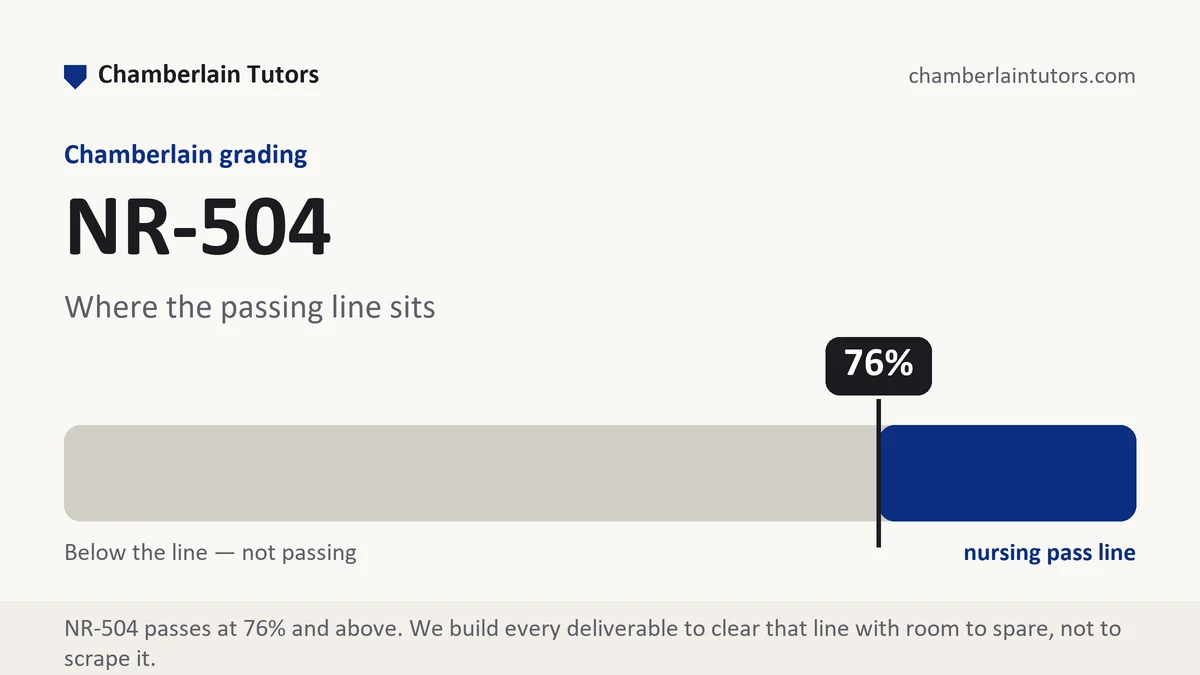
Leadership courses read as the gentle part of a graduate program, and the gradebook does not share that impression. The 76 percent floor applies as in any core nursing course, core assignments are averaged separately from supplemental ones, and supplementary points cannot repair a weighted average that has already dropped. Because the writing here feels comfortable, students often submit a first draft, which is where the average starts sliding.
Two mechanics matter. Sessions are eight weeks long inside sixteen week semesters, so weekly deliverables come in fast and there is very little recovery room after a poor start. And discussion boards do not reopen after submission at Chamberlain, which matters more in a course where posts often ask you to describe a workplace situation. Write it in a separate document, remove anything that identifies a patient or a colleague, then paste.
Budgeting words when the guide gives no word count
Some scoring guides in this course set a page or word limit and some do not. When one does, multiply the weights against the cap and write the targets beside your headings. When one does not, build the budget from the heaviest row instead, which is a more useful method than it sounds and produces a paper that is proportioned rather than merely long.
Here is the arithmetic. Say the guide totals 100 points across four rows: analysis of a leadership situation at 45, the framework or style applied at 25, the development plan at 20, and scholarly writing with APA at 10. Start with the heaviest row and ask what a complete version of it needs. If a thorough analysis of one situation takes roughly 550 words, that sets your rate at about 12 words per point. Apply the rate outward: the framework row earns around 305 words and the development plan about 245. Add 150 words for the opening and closing and the paper lands near 1,250 words, which is a size the content justified rather than a number you aimed at.
The method has a second benefit. If applying the rate produces a paper far longer than you can sustain, the heaviest section was overbuilt, and if it produces something thin, the analysis was never complete in the first place. Either way the arithmetic tells you something before you have written the middle of the paper.
The parts of a leadership analysis
However your section frames the deliverable, the ground below has to be covered. The right column shows what a grader reads as vocabulary in place of thought.
| Part | What it has to establish | The version that scores low |
|---|---|---|
| The situation, specifically | One setting, one recurring problem, who was involved and what was at stake, told in enough detail to analyze | A general account of communication problems in healthcare |
| The framework named | Which leadership theory or style you are using, attributed, with the elements you will actually apply | Transformational leadership mentioned once as a compliment |
| The analysis proper | The framework's elements used one at a time on the situation, including where the situation fits badly | The situation retold in the same order with framework words inserted |
| Evidence for the claims | Literature supporting what you say a leadership approach does, with the study behind it visible | Assertions that a style improves morale, offered as common knowledge |
| Your own position in it | What influence you actually held, used or failed to use, without inflating your authority | A paragraph describing what management should have done |
| The development plan | Two or three actions, each with a timeframe and something observable that would show it happened | Improve communication skills and continue to develop as a leader |
| Evaluation of the plan | How you would know the change worked, stated as something countable or checkable | Better outcomes and improved team dynamics |
Evidence craft in leadership writing
Leadership literature is where graduate papers most often stop citing and start asserting. Four habits prevent that.
Attach a study to every claim about what leadership does. Statements like a supportive style reduces turnover are empirical claims, and they need a source with a design behind them. Name the kind of study and its setting in the sentence, since leadership research conducted among executives in one industry does not automatically describe a hospital unit, and a grader who reads your reference will notice the gap before you do.
Cite the instrument, not just the result. If your paper uses a self assessment tool, name it, attribute it, and say what it measures. A score reported without its instrument is a number without a scale, and the reflection built on it cannot be evaluated.
Any organizational figure carries its base and its stretch of time. Turnover, vacancy, incident and satisfaction numbers get quoted loosely. Write that 9 of the 64 nurses on the unit left during the twelve months after the change rather than that turnover was 14 percent, because the reader needs to know the size of the group and the window before the proportion tells them anything. Keep the verbs matched to the design too: observational and survey work supports was associated with and occurred more often among, while improved and reduced belong only where something was changed deliberately and the result measured.
Separate your experience from your evidence. Experience is what makes the paper specific and it is not proof. Use it to establish the situation, then support the analytical claims from the literature. The papers that read as weakest are the ones where the only evidence for a general statement about leadership is that the writer once saw it happen.
Passing paper, strong paper, in NR-504
A passing NR-504 paper describes a workplace situation, names a leadership style, says the style would have helped, and closes with a plan to keep growing. Every sentence in it is defensible. None of it is checkable, which is why it sits mid scale.
A strong paper is different in three visible ways. It analyzes rather than retells, so the framework's elements appear as the organizing structure of the section instead of as decoration on a narrative. It admits a limit, saying where the framework does not explain what happened, which is the single fastest way to move an analysis row. And it writes a development plan with edges: a specific action, a timeframe, and something a reader could verify. Vague plans are safe from criticism and score exactly like the safety they buy.
Six mistakes that cost points here
- Leadership vocabulary standing in for analysis. Empowerment, collaboration and advocacy are words a grader cannot score. Situations, frameworks and evidence are.
- A situation too general to analyze. If the account could describe any unit anywhere, nothing in the framework will attach to it.
- Naming a framework and then ignoring it. The framework has to structure the section, not appear in its first sentence.
- Blaming management. A paper about what others should have done leaves the writer with no role to develop and the guide with nothing to score.
- Unsourced claims about what leadership achieves. These read as opinion at graduate level, however widely believed they are.
- A development plan of intentions. Continue to grow is not an action. A dated action with a way to check it is.
Questions NR-504 students ask
I am a staff nurse with no management role. What do I write about?
Can I write in first person and use my own experience?
My development plan keeps scoring low. What does a strong one look like?
The weeks, one by one
Week 1
NR-504 Week 1 pulls apart two things most nurses arrive holding as one idea. Read the full Week 1 manual.
Week 2
NR-504 Week 2 is where the course stops describing leadership in general and turns the lens on you. Read the full Week 2 manual.
Week 3
NR-504 Week 3 takes the middle of the leadership core into the thing leadership actually runs on, which is what gets said and how it is heard. Read the full Week 3 manual.
Week 4
NR-504 Week 4 moves the course from one leader to a group, and the graded question changes with it. Read the full Week 4 manual.
Week 5
NR-504 Week 5 asks the hardest practical question in the leadership core: why the change everyone agreed with did not happen. Read the full Week 5 manual.
Week 6
NR-504 Week 6 puts the leader inside an organization and asks how anything gets decided there. Read the full Week 6 manual.
Week 7
NR-504 Week 7 turns to the conditions leaders are responsible for creating, and to the harm that happens when they are not. Read the full Week 7 manual.
Week 8
NR-504 Week 8 is where the session has to add up to something. Read the full Week 8 manual.