NR-500, Foundational Concepts and Applications, is a three credit graduate course that introduces the conceptual foundations, the professional practice framework and the scholarly communication skills a master's prepared nurse is expected to own from here forward. The unusual thing about it is that the writing is not the wrapper around the content. The writing is a large part of the content, and it is scored as such. This page is the manual for that.
What NR-500 actually grades
Two things run in parallel through every graded piece. The first is conceptual: can you take a framework, a standard or a professional concept and use it as a lens on nursing practice rather than reciting its definition. The second is communicative: can you write like a graduate student, which means an argument that has a position, evidence that carries weight rather than decorates, paraphrase instead of quotation, and citation mechanics that hold up when a grader checks them against the reference list.
Experienced nurses often find the second half harder. A nurse who can defend a plan of care at the bedside in ninety seconds will still write a paragraph that opens with a definition, adds an anecdote, and never states what it is arguing. The scoring rows notice that gap immediately, because it is the gap the course exists to close.
How we help in this course
Send the prompt and the scoring guide from Canvas together, plus any framework or standard your section has assigned. The draft comes back written in graduate register from the first sentence, with the framework applied to a practice situation instead of summarized, sources selected for the weight they carry, and APA handled at the level graders check rather than the level students hope they check. The walkthrough attached to the draft names why each paragraph is shaped the way it is, so the second paper you write yourself goes faster than the first.
Work runs through the whole pipeline: your guide decoded row by row, core deliverables tagged apart from supplemental ones, a writer matched to graduate foundations work, a rubric pass followed by an independent APA and originality pass, a scale check against your section's floor, and delivery inside 24 to 48 hours.
How to write this course's deliverables
Chamberlain publishes no syllabi outside Canvas, so any guide claiming to know what week four asks for is inventing it. What can be taught is the craft: converting your scoring guide into a plan with a word budget attached, the shape a foundations paper takes, and the source habits that separate graduate writing from an upgraded undergraduate essay. Everything below survives whichever prompt your section is running.
In NR-500 right now?
Send the week and the rubric from Canvas. First premium sample free, floor-checked, back in 24 to 48 hours.
Your first graduate grade sets the arithmetic
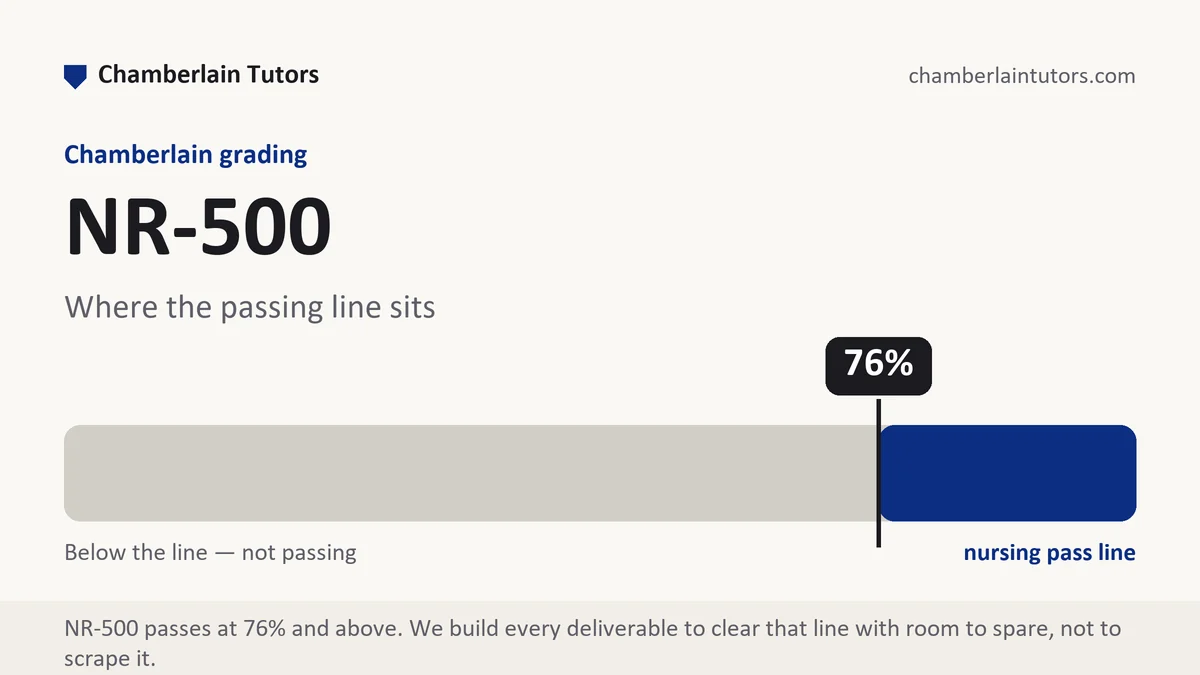
NR-500 usually arrives first in the sequence, which makes its gradebook consequential out of proportion to its content. Core nursing courses carry a 76 percent floor, core assignments are averaged separately from supplemental ones, and supplementary work cannot rescue a weak weighted average once the core pieces have landed. In an eight week session with weekly deliverables, one week spent learning the rules the hard way is an eighth of the course, and the recovery has to come from weeks that have not been written yet.
Two structural details bite early. Discussion boards do not reopen once a post is submitted at Chamberlain, so the first version you paste is the graded one. And a graduate APA deduction is not a rounding error, because the writing row in a foundations course is the only row where the loss is entirely avoidable.
Read the rubric before the prompt, then price the sections
The prompt tells you the topic. The scoring guide tells you what the topic is worth, section by section, and that second document is the one your grade is calculated from. Open it first. Copy each criterion row into an empty file as a heading, keep the guide's order so a grader reading downward keeps meeting the section they expected next, and reduce each row to the verb it actually asks for: describe, apply, analyze, evaluate, support. Those verbs set the depth of each section before you write a word.
Then attach numbers. Say your paper is capped at 1,200 words and the guide lists four rows: the professional practice framework applied at 30 points, evidence supporting your position at 30, application to your own practice setting at 25, and APA with scholarly writing at 15. Lift that last row out of the allocation, because it is scored across the document rather than in a section of its own. Reserve about 120 words for the opening and closing, which leaves 1,080 words against 85 points, close to 12.7 words per point. The framework row earns roughly 380 words, the evidence row the same, and the application row about 320.
Run those numbers yourself rather than borrowing these, and then look at what the arithmetic just told you. Three hundred and eighty words on framework application is far more than most students give it, because framework work feels like preamble and application to practice feels like the real answer. The guide disagrees, and the guide is what gets totalled. Write each target beside its heading and strike it out when the section reaches it. Any section that finishes at half its share is short of reasoning, not admirably concise.
The shape of a foundations paper
Whatever your section calls the deliverable, a graduate foundations paper moves through the same parts. Each one proves something specific, and each one has a weak version that graders see constantly.
| Part | What it has to prove | The version that loses points |
|---|---|---|
| Position stated early | What you are arguing, said inside the first two sentences with no runway before it | Two hundred words on why nursing matters before the topic appears |
| The framework or concept named | Which framework, whose, and why this one fits the situation you chose rather than a different one | A definition copied forward and never used again |
| Framework applied to a real situation | The framework's own terms doing work on a specific practice problem, so the analysis could not be lifted to another topic | The situation described first, then the framework mentioned at the end as agreement |
| Evidence with weight | Sources chosen because of what they establish, with their type and recency visible to the reader | Citations attached to sentences that nobody would have doubted |
| Application to your setting | What changes on Monday in a named setting, at your level of authority, with something a reader could check | Recommendations general enough to fit any unit in any hospital |
| Scholarly voice throughout | Third person where the guide requires it, hedged claims where evidence is thin, no unattributed assertion | Bedside register: confident, warm, and unsourced |
Source habits that graduate writing assumes
Four habits carry most of the distance between an undergraduate essay and a master's level one.
Paraphrase by default, quote by exception. A quotation proves you found a sentence. A paraphrase proves you understood it well enough to rebuild it. Graduate scoring guides reward the second, and a paper that quotes three times per page reads as assembled rather than written. Quote only when the exact wording is the point, such as a legal definition or a standard's phrasing, and keep it short.
Cite what you actually read. The trap in a foundations course is the textbook that cites a study, which you then cite as though you read the study. If you only saw it secondhand, either find the original or attribute the secondary source honestly. Graders in this course check reference lists against in text citations mechanically, and mismatches in either direction are among the easiest points to lose.
Date and attribute professional documents. Standards, position statements and scope documents are issued by organizations and revised on their own schedule, so name the issuing body and the edition or year in the sentence rather than leaving the reader to find it in the reference list. A standard cited without its year is a claim about the present made from an unknown date.
Any number arrives with its base and its window. If you write that a proportion of patients experienced something, the sentence needs how many were counted and over what period before the percentage means anything. Write that 23 of 140 patients admitted during a six month period met the criterion, not that 16 percent of patients did. And keep the verb honest to the source: observational work supports was associated with and occurred more often among, while caused and reduced belong only where something was deliberately changed and the result measured.
Passing paper, strong paper, in NR-500
A passing NR-500 paper defines its framework accurately, cites real sources in mostly correct APA, and applies the framework to a situation in the final third. It clears the floor and reads like careful undergraduate work in professional clothes.
A strong one differs in three visible ways. It commits early, so a grader knows what is being argued before the end of the first paragraph and every later section either supports or qualifies that claim. It uses the framework as a tool rather than a topic, which means the framework's own vocabulary appears in the analysis paragraphs and not just the definition paragraph. And it makes its application specific enough to be wrong: a named setting, a named practice, a stated change, something a reader could test. Vagueness is safe and it scores like safety.
Six mistakes that cost points here
- Writing in bedside register. Warm, confident, unsourced prose reads as clinical authority at work and as missing evidence on a graduate scoring guide.
- Defining instead of applying. A framework section that stays at the level of definition has answered a question the guide did not ask.
- Quoting to fill. Three quotations in a page usually means the source was not digested, and the writing row is where that shows up.
- Citing the textbook for someone else's study. Either read the original or say plainly where you saw it. Reference lists get checked against the text.
- Treating a discussion post as a draft. Posts do not reopen at Chamberlain. Compose elsewhere, reread once, then paste.
- Personal experience carrying an argument alone. Experience earns you the example. Evidence earns you the claim, and the two need to appear in that order.
Questions NR-500 students ask
How different is graduate writing from what got me through my BSN?
Do I really lose points for quoting?
My framework section keeps coming back marked as description. What does analysis look like here?
The weeks, one by one
Week 1
NR-500 Week 1 is the stage where a registered nurse starts writing as a master's student, and the opening work almost always turns on identity: who you are in practice now, who the degree is moving you toward, and what has to change in between. Read the full Week 1 manual.
Week 2
NR-500 Week 2 is where the writing itself becomes the graded object: sentence register, paraphrase discipline, and the citation mechanics a grader can check line by line. Read the full Week 2 manual.
Week 3
NR-500 Week 3 is where sourcing becomes a skill with a procedure attached: building a search that finds the right literature, and judging what you find rather than accepting it. Read the full Week 3 manual.
Week 4
NR-500 Week 4 turns to the documents that define professional nursing practice, and to the difference between what the law permits, what the profession expects, and what an employer allows. Read the full Week 4 manual.
Week 5
NR-500 Week 5 asks what a master's prepared nurse does with the data the health record already collects: how raw entries become information, how information becomes something a clinician can act on, and what is owed to the patient whose record it is. Read the full Week 5 manual.
Week 6
NR-500 Week 6 examines how professions actually work together, which means handoffs, escalation, disagreement and the communication structures built to survive all three. Read the full Week 6 manual.
Week 7
NR-500 Week 7 turns to improvement itself: how a system is changed on purpose, how safety failures are read as system events rather than personal ones, and how anybody knows whether the change worked. Read the full Week 7 manual.
Week 8
NR-500 Week 8 closes the session by asking for a plan that reaches past graduation: the credential you are working toward, the steps between here and it, and the evidence that each step happened. Read the full Week 8 manual.