NR-447M is the version of Collaborative Leadership in Healthcare that carries an experiential component: 3.8 theory credits, 0.2 clinical, and roughly 9.6 experiential contact hours attached to an otherwise identical leadership course. Those hours are small enough to be spent badly in one afternoon, and the writing is what they get converted into. This page is the manual for scoping a leadership project that fits inside them and writing it up so the hours look like evidence rather than an errand.
What NR-447M actually grades
The course content matches NR-447: leadership and management in healthcare organizations, written by working nurses about workplaces they know. The M variant adds a small experiential requirement, and that addition changes the grading question from what do you think about this to what did you find out and what will you do with it. Roughly 9.6 contact hours will not support an implemented project, so your scoring guide is almost certainly asking for something tighter, usually a focused inquiry with a proposal at the end. The rows reward a question sized to the hours, preparation done before the hours are spent, and a write-up a manager could read without a translator.
How we help in this course
We draft the written layer: the leadership analyses, project proposals, experiential write-ups and reflections. The hours themselves are yours. We do not complete experiential or clinical hours, arrange or attend a meeting, contact anyone at your organization, sign paperwork, or fill an hour form. Send your unit context and a short note on what you found out during the hours, and the draft comes back built on that rather than on a generic hospital.
Every order runs the full pipeline: guide decoded row by row, core work tagged apart from supplemental, a writer matched to nursing leadership work, a rubric pass then an independent APA and originality pass, the scale check against your section's floor, delivery inside 24 to 48 hours.
How to write this course's deliverables
No syllabus is published outside your Canvas shell, so a week-numbered manual would be instruction invented rather than reported. Technique survives that gap, and technique is what follows: a budgeting method for very short papers, the anatomy of a small-hours project write-up, and how to use what people told you so it strengthens the paper instead of undermining it.
In NR-447M right now?
Send the week and the rubric from Canvas. First premium sample free, floor-checked, back in 24 to 48 hours.
Scoping a project to the hours you have
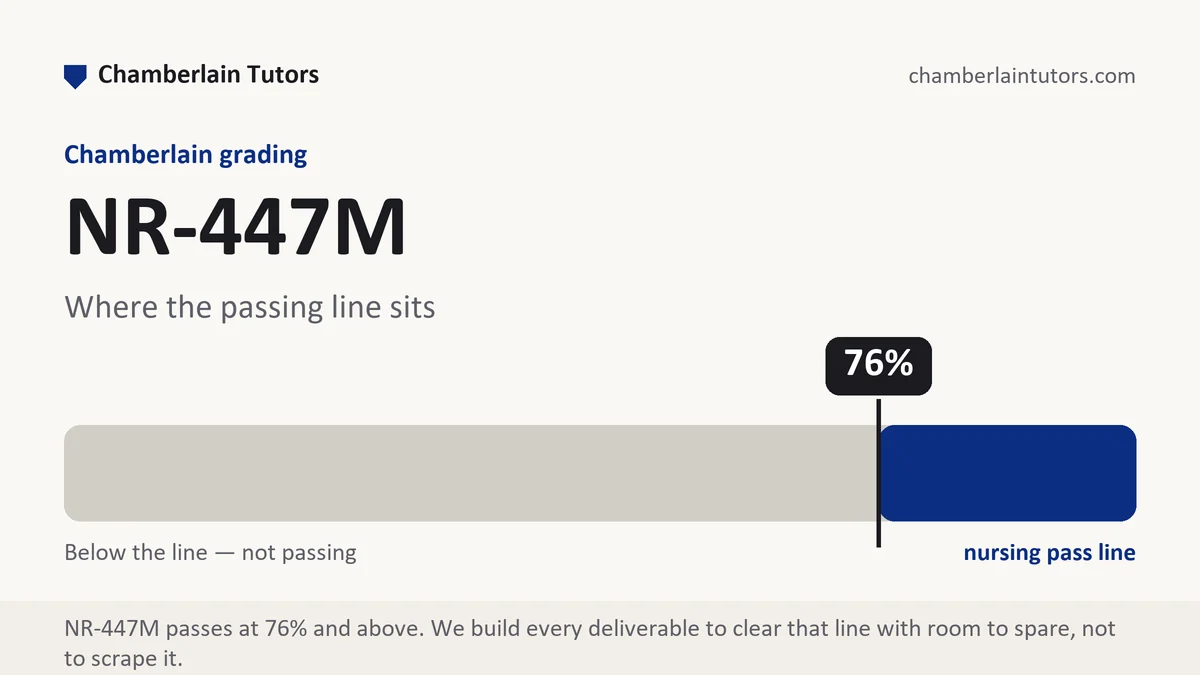
Nine and a half hours is one working day spread across an eight week session, and most of the trouble in this course comes from students planning as though it were a placement. A project that requires attending three committee meetings, shadowing two managers and surveying a unit cannot be finished, and an unfinished project makes for a write-up with a hole where the findings belong. Scope to a question one conversation and one document review could answer, then use the remaining hours to check what you were told against something written. The 76 percent floor is live here as in every nursing course, so core work averages on its own and has to hit 76 before supplemental points count toward anything. Nothing submitted later rescues an average that has already gone under. Boards do not reopen once posted, and deadlines run Mountain Time.
Read the rubric before the prompt, then rank and ration
Open the scoring guide first. The prompt describes the project; the guide records what is being paid for. Paste each row into an empty document as a heading, hold the guide's order, and set a word target beside each before drafting, because short leadership write-ups overspend on background more reliably than anything else in the program.
Short papers need a floor as well as a ratio. Take a 1,000 word cap with five rows: the leadership issue and its context at 25 points, the experiential inquiry and what it produced at 25, the evidence base at 20, the proposal with its costs at 20, and APA with scholarly writing at 10. Lift the writing row out, since it is judged across the document. Give every remaining row a floor of 120 words so no section collapses into a sentence, which spends 480 of your 1,000. Reserve 80 words for opening and closing material. The 440 words left over get shared across the four scored rows in the ratio 25:25:20:20, which adds another 122 words to each of the first two and 98 to each of the last two. Final targets land near 242, 242, 218 and 218.
Use your own guide's weights rather than these. The point of the floor-first method is that in a 1,000 word paper a strict proportional split can leave a 15 point row with 90 words, which is not enough to answer anything, and rows answered in one line score as mentioned rather than met. Set the floor, then distribute what is left.
The parts of a small-hours project write-up
However your section frames it, this write-up holds one shape. Each part earns its place, and the thin version of each is what a grader sees when the hours were spent without a plan.
| Part | What it has to prove | The weak version |
|---|---|---|
| The question, sized | Something a single focused inquiry could genuinely answer inside the hours available | A question requiring months of access, left half answered at the deadline |
| Preparation before the hours | The reading and the document review you did first, so the contact time was not spent learning basics | Hours spent asking someone to explain what a policy already said |
| Who you approached and why | The role you chose and the reason that role holds the answer, described without naming the person | Whoever was available, with no account of why they were the right source |
| What you asked | The questions themselves, so a reader can judge whether the answers mean what you say they mean | A summary of a conversation with the questions invisible |
| What you learned, labeled | Findings marked as what one person reported, kept separate from published evidence | An interview treated as a citation, so opinion enters the paper wearing evidence clothing |
| The evidence layer | Peer-reviewed work supporting both your reading of the problem and your proposed response | A single article, or textbook references carrying an organizational argument |
| The proposal, priced | What you recommend, who owns it, what it costs in hours or money, and what it replaces | Improve communication, which names no owner, no cost and nothing given up |
| The reflection, on a named skill | One leadership capability you now handle differently, with the moment that changed it | The experience was valuable, which reports a feeling rather than a change |
What people tell you is not yet evidence
The experiential component introduces a source type students often mishandle. Four habits sort it out.
Label reported material as reported. What a manager told you about staffing is a first-hand account of one person's view, which is genuinely useful and is not a research finding. Write that a nurse manager described the escalation pathway as rarely used at night, then let a published source carry any general claim. Papers that quietly convert conversations into evidence lose the evidence row even when the conversation was excellent.
Keep people unidentifiable. Roles, not names. Avoid quoting anything distinctive enough to identify the speaker to a colleague, and leave employer names, unit names and dates precise enough to locate a meeting out of the draft entirely.
Every study arrives with its size attached. Name the design, the population and how many people were in it, then give the finding. Then match the verb to the design: surveys of nurses support was associated with, reported alongside and predicted, while reduced, improved and caused belong only to work where something was changed on purpose and measured. Leadership literature is full of single-site improvement projects that read like trials, and treating one as though it proved causation is the fastest way to lose an evidence row you had already won.
Give organizational numbers a denominator and a window. A turnover figure means nothing until you say which staff group, counted how, over what period. The same goes for vacancy rates, overtime hours and any benchmark you borrow. Where the number is your own workplace's, label it as internal and unpublished, strip anything identifying, and use it to illustrate rather than to prove.
Passing write-up, strong write-up, in this course
A passing NR-447M paper reports that hours were completed, summarizes a conversation, cites a leadership model and recommends better collaboration. It clears the floor and leaves a grader unable to tell what the experiential component added.
Three things mark the write-ups that score at the top. The preparation is visible, so the reader can see that you arrived knowing the policy and spent the contact time on what only a person could tell you, which is the difference between an interview and a briefing. The proposal is priced, naming who chairs it, whose hours it consumes, what existing meeting or task it displaces and what it would cost to try once, because a recommendation specific enough to be refused is the only kind that gets taken seriously. And the reflection attaches to a named skill with a moment behind it, rather than reporting that the experience was worthwhile. Prepared, priced, specific about what changed in you.
Six mistakes that cost points here
- A project the hours cannot cover. Scope is the first thing graded in practice, because everything downstream inherits it.
- Spending contact time on readable facts. Anything a policy or an org chart could have told you is time taken from what only a person knows.
- Treating a conversation as a citation. Reported material belongs in the paper labeled as reported, with published sources carrying the general claims.
- An identifiable interviewee. A distinctive quote plus a unit description can name someone to any colleague reading the paper.
- A proposal with no cost. If nothing is given up and nobody owns it, the proposal row has nothing to weigh.
- A generic reflection. The reflection carries real weight in most guides, and a closing paragraph about the experience being valuable throws away points that cost nothing to earn.
Questions NR-447M students ask
Am I in NR-447 or NR-447M, and does it change the writing?
The experiential hours are tiny. What actually counts toward them?
Can you arrange the meeting for me, or sign off the hours form?
The weeks, one by one
Week 1
NR-447M Week 1 opens the version of Chamberlain's collaborative leadership course that carries a small experiential component, listed in the catalog at 9.6 clinical contact hours, alongside the lecture content. Read the full Week 1 manual.
Week 2
NR-447M Week 2 typically pairs the course's communication and style content with the first writing that draws on real observation: an account of a practicing leader, watched through the lens you built in Week 1, analyzed rather than admired. Read the full Week 2 manual.
Week 3
NR-447M Week 3 usually turns the course's interprofessional collaboration content into observational work: watching how professions actually negotiate a shared patient, then writing an analysis of the structures, hierarchies, and communication moves that made the collaboration work or wobble. Read the full Week 3 manual.
Week 4
NR-447M Week 4 typically brings the course's delegation and supervision content together with the experiential thread: instead of analyzing delegation only from your own past shifts, you write about it as watched practice, real handoffs of work between roles, observed during your hours or your. Read the full Week 4 manual.
Week 5
NR-447M Week 5 typically carries the course's quality and patient safety content, and in the M-section it gains an observational edge: safety culture stops being an abstraction once you have watched a leader respond to a near miss in real time. Read the full Week 5 manual.
Week 6
NR-447M Week 6 typically asks for change leadership: a named change model applied to a practice change, with resistance anticipated and leader moves planned. Read the full Week 6 manual.
Week 7
NR-447M Week 7 usually carries staffing, scheduling, and resource stewardship, and the M-section gives the topic a vantage most RN-to-BSN students never get: watching the decisions from the manager's side of the desk. Read the full Week 7 manual.
Week 8
NR-447M Week 8 closes both threads of the course at once: the concepts, through a synthesis of what eight weeks changed in your leadership reading, and the experiential component, through whatever final written account your section requires of what the observation hours produced. Read the full Week 8 manual.