NR-395 carries a single theory credit and covers current professional trends around integrity, professional behavior, ethical issues in today's healthcare environment, and responsible communication through technology. One credit means few graded pieces, which means each one moves your average further than it would in a three-credit course. What earns the points is visible reasoning: a stated conflict, an applied standard, a defended decision, and an answer to the strongest objection against it.
What NR-395 actually grades
This course looks easy from the outside because everyone already believes they are ethical. That belief is the problem. Graders are not scoring whether you hold the right view; they are scoring whether you can show the work behind it. An ethical conflict is only interesting when both options cost something, and a submission that picks the obviously decent answer without acknowledging what it sacrifices has skipped the analysis entirely.
The technology half of the course carries its own weight. Responsible communication now covers messaging, social platforms, photographs, workplace group chats and anything else that leaves a record, and the professional standard for identification is wider than students assume. Removing a name is not the same as removing identification, which is the distinction most weak submissions miss.
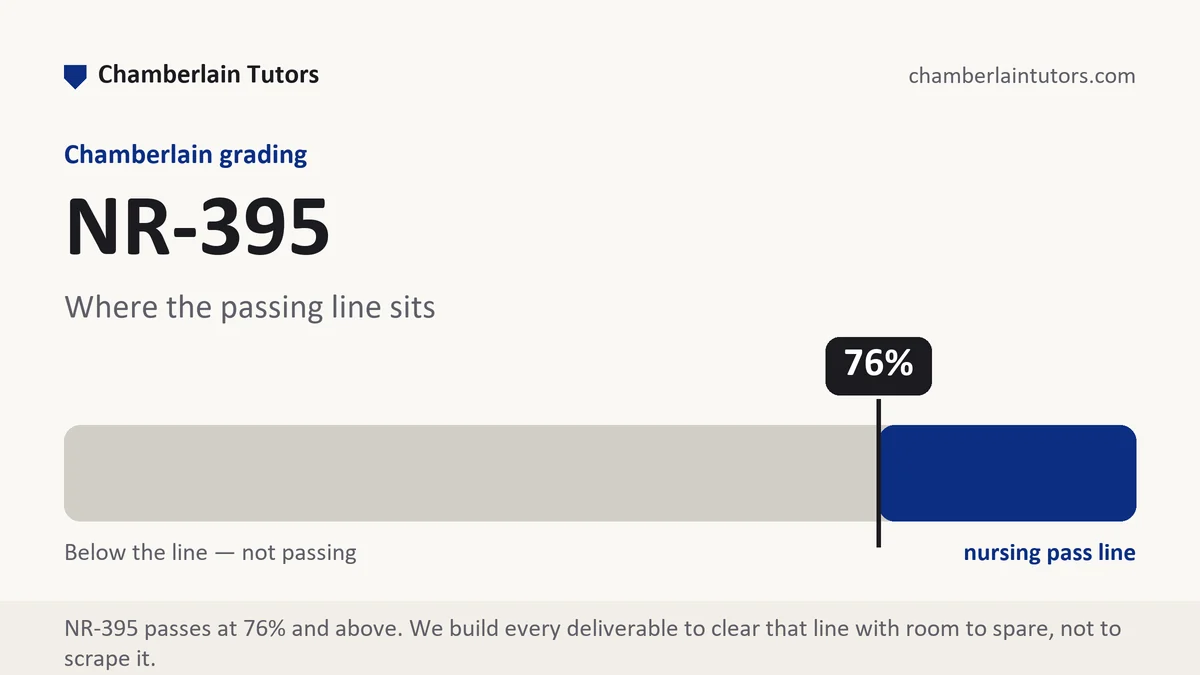
Then there is the arithmetic of a one-credit course. The session is eight weeks inside Chamberlain's sixteen-week semester, work is due weekly in Canvas, and discussion posts lock permanently when you submit them. The passing floor for core nursing coursework is seventy-six percent, extra work does not repair a weighted average, and with fewer graded pieces to average across, one weak submission here is heavier than the same submission would be in a larger course. Treat the small course with the same care as the big one.
How we help in this course
Every draft here makes the reasoning auditable: the conflict named as a conflict, the professional standard applied by its actual provision rather than gestured at, the decision defended, and the strongest counterargument met head on instead of ignored. Short pieces get the same pipeline as long ones, because in this course the short pieces are the whole grade.
The service terms are the site's standard: an original premium draft inside 24 to 48 hours, aimed at the A band of your real scale, two independent quality passes and the floor check, revisions free until it lands.
Rubric first, especially when the word count is small
Short assignments punish poor planning far more than long ones. A wandering opening leaves you nothing to recover with, which is why the scoring guide comes first here and the prompt second.
Copy the criterion rows out of Canvas, one per line, and reduce each to its verb: identify, analyze, apply, defend, evaluate. Keep them in the rubric's order and let them be your headings, even if you delete the headings before submitting. In an ethics course one of those verbs will be defend or justify, and that row is where the grade is decided.
Now do the arithmetic, which is brutal at this length. Picture a week that holds a response to 600 words across three rows at 45, 35 and 20 percent. That is 270 words, then 210, then 120. Two hundred and seventy words is two paragraphs, so if the 45 percent row is the analysis of the conflict, two paragraphs is your entire ethical argument. Then notice what has no allocation at all: nothing is set aside for retelling the scenario, nothing for a general opening about the importance of ethics in nursing, and nothing for a summary conclusion. Those three habits routinely eat 200 words out of a 600-word piece, a third of the submission spent on material the guide cannot score.
Write the number in brackets after each heading and hold yourself to it. At this length, going 60 words over on the background costs you a whole idea somewhere else.
The shape of a short ethical analysis
The dominant deliverable is a compact ethical position piece: a situation, a conflict, an applied standard, a decision. It shows up as a paper, as a response to a scenario, and as a graded discussion post. These are the parts, and at 600 words each one may be a single tight paragraph.
| Move | What it establishes | Where it goes wrong |
|---|---|---|
| The situation, stated neutrally | That you can describe what happened without the verdict already baked into the adjectives. Two or three sentences at most. | A retelling of the whole scenario, loaded with words like careless or shocking. |
| The ethical question | One sentence naming precisely what is in dispute, phrased so that a reasonable person could answer it either way. | A question with only one possible decent answer, which means the real conflict was never found. |
| The values in tension | Two duties that genuinely pull against each other, with what each one protects and who it protects. | Four principles listed in a row, defined, and never used again. |
| Standard applied by provision | The specific part of the professional code or policy that governs this, quoted or paraphrased closely enough to be checked. | A sentence saying the code requires professional conduct. |
| The decision and its cost | What you would do, in the order you would do it, and an honest statement of what that choice gives up. | A recommendation to follow policy and report concerns appropriately. |
| The strongest objection, answered | The best case against your position, stated fairly, then addressed on its merits. | A straw objection nobody would make, dismissed in half a sentence. |
In NR-395 right now?
Send the week and the rubric from Canvas. First premium sample free, floor-checked, back in 24 to 48 hours.
Evidence craft for ethics and trend claims
Ethics writing draws on two different kinds of support, and mixing them up is the most common evidence error in this course.
Three authorities, kept separate. A law says what is permitted, a professional code says what the profession expects, and an employer policy says what your organization requires. They overlap and sometimes disagree, and a submission that treats them as one voice cannot analyze the interesting cases. Name which one you are invoking each time you invoke it.
Cite a code by its provision. Professional codes are organized into numbered provisions and interpretive statements exactly so they can be cited precisely. Pointing at the document as a whole reads as not having opened it. Pointing at the provision, with a close paraphrase of what it obligates, reads as applied knowledge and takes one extra sentence.
Trend claims need recency and two points in time. A trend is a direction, so a single cross-sectional number cannot establish one. If you write that something is increasing, either show two measurements or attribute the direction to a source that did. Hold trend sources to the last five years unless you state why an older one still holds, since this material moves quickly.
Design and sample before findings. "In a national survey of 2,900 registered nurses with a 31 percent response rate" tells a reader how much to trust what follows. Workforce surveys carry heavy self-selection, and naming that is a strength rather than a weakness in the writing.
Verbs matched to the design, denominators before rates. Staffing, burnout, turnover and moral distress are correlated in ways no survey can untangle, so use "was associated with" and "was reported more often among" unless the design supports more. And never let a percentage stand alone: "roughly one in four of the 2,900 respondents reported considering leaving within twelve months" carries a base and a window, while "25 percent plan to quit" carries neither.
Sincere versus reasoned in NR-395
A passing NR-395 submission is sincere and correct. It names the relevant principles, arrives at the decent conclusion, mentions the code, and closes with a note about integrity. It reads like a person with good values, which is not the same as a person who can reason, and it typically lands in the seventies or low eighties without the writer seeing why.
A strong submission does three things visibly. It admits the cost: it says plainly what its recommended course of action sacrifices, because a conflict with no cost was never a conflict. It applies rather than cites: the standard appears attached to the specific facts of the situation, not in a paragraph of its own. And it steelmans the other side, giving the strongest version of the opposing position a fair hearing before answering it. There is a fourth marker that graders notice without listing: a strong answer says what would change its mind. Naming the fact that would flip your conclusion is the clearest evidence that you reasoned to it rather than started there.
Five mistakes that cost real points in NR-395
- Spending the word count on the scenario. Your grader wrote the scenario. Two or three sentences of neutral restatement is generous; anything more is budget taken from the analysis row.
- Listing principles instead of using them. Defining autonomy, beneficence, nonmaleficence and justice in a row proves you read a chapter. Showing two of them colliding over these particular facts proves you can think.
- Treating legal and ethical as the same question. Some things are permitted and still wrong, and a few obligations run ahead of what any policy requires. Collapsing the two is what makes an analysis sound like a compliance memo.
- Assuming a removed name means a de-identified post. Unit, shift, timing, diagnosis, a photograph's background and the size of a community can identify a patient together when no single detail would alone. Write about online communication as if identification is cumulative, because it is.
- Posting a graded response you have not reread. Chamberlain boards do not reopen after submission, and in an ethics course a sentence that sounds dismissive of a classmate's position is not something you can quietly fix later. Draft outside Canvas, read it once as though you disagreed with it, then paste.
Questions NR-395 students send
How do I write an ethics paper that is more than my opinion?
The assignment is only a few hundred words. What do I cut first?
Can I write about something that actually happened at work?
The weeks, one by one
Week 1
NR-395 opens with the word that names the whole course: integrity, defined not as a personality trait but as a working standard a nurse can be measured against. Read the full Week 1 manual.
Week 2
Week 2 of an ethics arc is where the vocabulary arrives: autonomy, beneficence, nonmaleficence, justice, fidelity and veracity, the six principles that turn a gut feeling about a case into a graded argument. Read the full Week 2 manual.
Week 3
By the third stage of an ethics arc the course usually stops handing you principles one at a time and hands you a full dilemma instead: a situation where every available action violates something, and the task is to walk a structured decision process from facts to a defensible choice. Read the full Week 3 manual.
Week 4
The middle of an ethics arc typically turns from patients toward the profession itself: incivility between colleagues, academic integrity in nursing school, and the professional behaviors that make a nurse trustworthy to the people she works beside. Read the full Week 4 manual.
Week 5
The technology stage of an ethics arc takes the integrity standard built in earlier weeks and applies it to the places nurses now actually communicate: phones, social platforms, group chats, patient portals and the electronic record itself. Read the full Week 5 manual.
Week 6
With the ethics vocabulary built, the arc of this course typically widens its lens: the trends stage asks you to pick one current movement reshaping professional nursing, document that it is actually happening, and analyze what it changes for patients, nurses and the integrity standards the earlier weeks established. Read the full Week 6 manual.
Week 7
Late in an ethics arc the course usually asks for its most demanding written form: a position argument on a live ethical issue in today's healthcare environment, one where reasonable professionals disagree and your job is to take a side with evidence, meet the strongest objection honestly, and stay. Read the full Week 7 manual.
Week 8
Closing stages in short ethics courses almost always ask for synthesis: a culminating reflection or plan in which you show how the session's threads, integrity, principles, dilemma method, professional conduct, technology discipline and trend awareness, now operate together in one practitioner, you. Read the full Week 8 manual.