NR-394 is a three-credit lecture course on transcultural nursing theory and its use across the lifespan, in groups, in communities and in delivery systems worldwide. The trap is that the subject rewards good intentions in conversation but not in writing. What the rubric pays for is a named theory used as a working instrument, a clear line between a group pattern and an individual assessment, and care recommendations specific enough that someone could carry them out.
What NR-394 actually grades
The catalog puts three levels in one course: culture as it shapes an individual through the stages of life, culture as it operates in groups and communities, and global nursing as it presses on how care is delivered. Scoring guides in this course tend to follow that ladder, which means a paper that stays at the bedside and never reaches the system, or one that discusses populations and never touches a person, will be missing a row it did not notice.
The second thing under examination is theory use. Transcultural nursing has a published body of models, and a week that asks you to apply one is asking for its domains to become your working categories, its language to appear in your analysis, and its logic to shape what you recommend. Summarizing a theory and then writing a paper that would look identical without it is the single most common reason a well-written submission scores in the seventies.
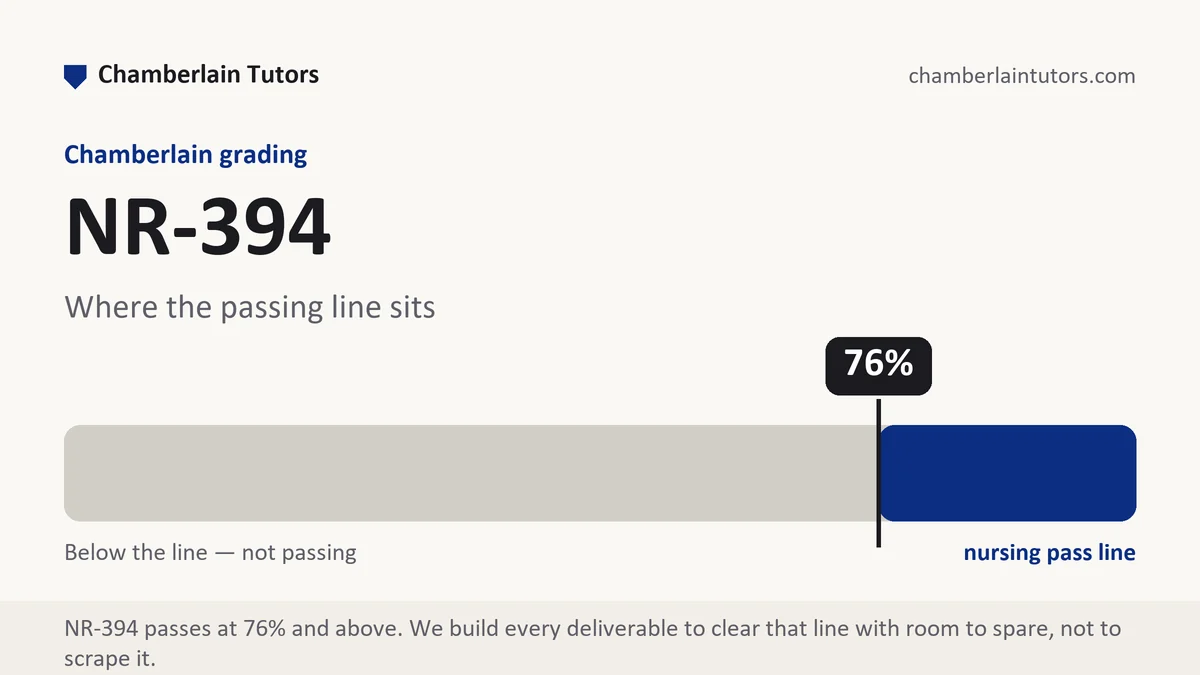
Course mechanics are the usual Chamberlain rhythm. Eight-week sessions inside a sixteen-week semester, up to six starts across the year, deliverables due every week in Canvas, and discussion posts that lock the moment you submit them. Seventy-six percent is the passing floor for core nursing coursework, an elective does not get a softer line, and there is no supplementary work that repairs a weighted average after the fact.
How we help in this course
Work here keeps the assigned model load-bearing from the first section to the last, separate what is known about a group from what must be asked of a patient, and build recommendations that name an action, a setting and a way to tell whether it worked. Respectful writing is the floor in this course, not the achievement.
The terms are the ones the rest of the site runs on: an original premium draft in 24 to 48 hours, aimed at the A band of your course's real scale, two independent quality passes plus the floor check, revisions free until the grade lands.
Read the rubric first, then the prompt
Prompts in transcultural nursing are invitations. Discuss a population, explore an encounter, consider a global issue. Invitations produce sprawl, and sprawl is why students who care about this material still lose points on it. The scoring guide is the document that says how much of each thing is wanted.
Lift the criterion rows into an empty file and cut each one down to its verb: describe, apply, analyze, plan, evaluate, reflect. Keep the rubric's order and let those verbs be your headings. Watch particularly for a row whose verb is apply while the prompt's verb is discuss, because the row wins and the two require different paragraphs entirely.
Then turn weight into words. Picture a week holding the paper to 1,600 words with four rows at 45, 25, 20 and 10 percent. That hands you 720 words for the heaviest row, then 400, 320 and 160. If the 45 percent row is the application row, 720 words belong to running the theory over your case or population, which is four or five solid paragraphs and several times what most drafts allocate. The background description that felt like the whole assignment is probably living under the 10 percent row at 160 words, which is three or four sentences. Confirm in your own guide whether the title page and references sit inside that ceiling.
Leave the target in brackets beside each heading until the section earns it. In this course the section that stays short is almost always the one converting theory into action, and that is the section carrying the weight.
The shape of a cultural care analysis
The dominant deliverable is some version of a cultural care analysis: a bounded subject, a theory applied to it, and a plan that follows. Whether the week calls it a paper, a case analysis or an extended post, these are the parts a grader hunts for.
| Component | What a grader is checking for | The version that scores low |
|---|---|---|
| Bounded subject | Exactly who you are writing about: which population or which patient, which setting, which stage of life, and why that boundary makes sense. | An entire nationality treated as one homogeneous group. |
| Theory named and unpacked | The model you were assigned, its domains listed in its own terms, and a sentence on what each domain is designed to surface. | The theorist's name in the introduction and nowhere else. |
| Assessment organized by domain | Findings sorted into the theory's categories rather than into a free-form narrative, so the model is visibly doing work. | A story about an encounter with the theory pasted on top afterwards. |
| Where care and system collide | The concrete friction point: language access, appointment structure, dietary provision, family decision-making, insurance rules, distance to services. | A general statement that barriers exist. |
| Negotiated plan | What you would keep unchanged, what you would adapt, and what would need restructuring, each with the person's own preferences driving it. | A recommendation to be respectful and deliver culturally sensitive care. |
| Evaluation and reflexivity | How you would know the plan worked, plus one honest line about an assumption of your own that the case tested. | No measure of success and no acknowledgement that the nurse has a culture too. |
In NR-394 right now?
Send the week and the rubric from Canvas. First premium sample free, floor-checked, back in 24 to 48 hours.
Evidence craft when the claims are about people
Cultural claims are unusually easy to write and unusually easy to get wrong, so the sourcing has to be tighter here than in most undergraduate work.
Currency, and the vintage of the data behind the source. Hold interpretive sources to the last five years unless you say why an older one still stands, and check the year the underlying data was collected rather than the year the article appeared. A 2024 paper reporting a survey fielded in 2011 is a 2011 finding, and migration patterns, language use and insurance coverage all move faster than that.
Design and sample before findings. Name the study behind a number before the number is allowed to do any work. "In a community survey of 612 first-generation adults recruited through two clinics" tells a reader how far the finding travels; the same sentence without it invites them to assume it describes everyone. Convenience samples are common in this literature and should be named as such rather than quietly upgraded.
Verbs that respect confounding. Culture rarely arrives alone. Income, insurance status, language access, education, rural distance and immigration history travel with it, and a study that did not separate them cannot support a causal verb. Use "was associated with", "was more frequently reported among", "differed between". Reserve "caused" and "led to" for designs that earned them. A paper that says a cultural belief caused an outcome has usually just attributed a system failure to a patient.
Denominator and window before any rate. Write "roughly one in five of the 1,450 respondents surveyed over eighteen months reported delaying care" instead of "20 percent delay care". The base, the count and the period are what keep a group-level number from hardening into a claim about the individual in front of you.
Group pattern is a hypothesis, not a finding about a person. The strongest sentence pattern in this course is the one that pairs them: state what the literature reports about the group, then state the question you would ask this patient to find out whether it applies. That pairing is also the clearest possible demonstration that you understand the difference.
Respectful versus analytical in NR-394
A passing NR-394 paper is warm and careful. It describes a group, lists beliefs and practices, warns against stereotyping, and recommends cultural sensitivity. Nothing in it is wrong. It also reads as interchangeable, and interchangeable writing does not reach the upper column of a rubric that asks you to apply and evaluate.
A strong paper shows three things a passing one does not. It uses the model structurally, so the theory's domains are visible as the paper's own architecture and a reader could tell which model you were given without being told. It keeps the individual and the group distinct, treating published patterns as questions to verify rather than facts to apply. And its recommendations survive contact with a real shift: an interpreter arranged through the proper channel rather than a family member pressed into service, a visiting schedule adjusted in a named way, a discharge instruction rebuilt around who actually makes decisions in that household. Specificity is what turns respect into a gradeable analysis.
Six mistakes that cost real points in NR-394
- The trait list. A paragraph of beliefs and customs presented as facts about everyone in a group is the highest-risk paragraph in the course. Attribute patterns to their source and mark them as patterns.
- Culture reduced to nationality. The course explicitly runs across the lifespan and into communities. Age cohort, migration generation, language, religion, rural distance and disability all belong in scope, and a paper that sees only ethnicity has answered a smaller question than the one it was given.
- Theory as decoration. Naming a model, summarizing it, then writing a paper that never uses its categories again. Graders check whether the analysis would collapse without the theory. It should.
- Interventions no one could perform. "Increase cultural awareness" is not a plan. Name the action, who does it, in what setting, and what would count as it having worked.
- Skipping the system and global level. Delivery systems are part of this course's subject. A paper that never mentions how services are organized has left an entire dimension of the rubric untouched.
- Posting before proofreading. Discussion posts at Chamberlain cannot be edited once submitted, and this is the course where an awkwardly phrased generalization is hardest to leave standing. Compose in a document, reread once for how a member of that group would hear it, then paste.
Questions NR-394 students send
Can I write about a patient I actually cared for?
How do I describe a group without sliding into stereotyping?
My paper explains the theory well but the grade says I did not apply it. What is the difference?
The weeks, one by one
Week 1
NR-394 Week 1 opens a lecture-only elective in which the entire grade lives in written work, and the opening stage almost always asks you to define culture's place in nursing care and to examine your own cultural lens before you examine anyone else's. Read the full Week 1 manual.
Week 2
NR-394 Week 2, by our reading of the catalog arc, is where the course introduces the field's theoretical equipment: culture care theory and the assessment models that turn respect for culture into an organized set of questions a nurse can actually ask. Read the full Week 2 manual.
Week 3
NR-394 Week 3, as we place the arc, moves from theory to the individual: how culture shapes a single person's health beliefs and behaviors differently at each stage of life, and how a nurse asks about it without assuming. Read the full Week 3 manual.
Week 4
NR-394 Week 4, in our reading of the arc, widens the aperture from the individual to the family, the group, and the community: how culture organizes households and decision-making, how shared patterns show up at the level of populations, and how a nurse assesses a community the way earlier weeks assessed a person. Read the full Week 4 manual.
Week 5
NR-394 Week 5, as we place the arc, examines the moments where culture speaks loudest: birth and the postpartum period, the transitions of aging, and dying, death, and mourning. Read the full Week 5 manual.
Week 6
NR-394 Week 6, by our reading of the arc, takes up communication across language and culture: qualified interpretation versus improvised workarounds, the legal and ethical footing of language access, and the communication habits, teach-back, plain language, attention to nonverbal norms, that make care understandable. Read the full Week 6 manual.
Week 7
NR-394 Week 7, as we read the arc, lifts the course to the global level: how nursing is educated, licensed, and deployed around the world, how nurse migration moves expertise between systems, and how global health priorities shape care delivery everywhere, including the unit where you work. Read the full Week 7 manual.
Week 8
NR-394 Week 8, as we place the close of the arc, asks for synthesis: one piece of writing that runs the course's whole method, self-awareness, theory, individual and community assessment, life passages, communication, and the global frame, through a single sustained case or plan for culturally congruent care. Read the full Week 8 manual.