NR-307C Advancing Equity, Inclusion, and Diversity in Healthcare is the three credit lecture variant, carrying the same equity, diversity and inclusion content as the one credit version across triple the contact hours. At three credits the writing usually goes one step past analysis: having explained how structural conditions and systemic inequities reach patient outcomes, you are asked to propose something. That final step is where grades separate, because a recommendation is judged by evidence that it might work, and most students support the problem thoroughly and the solution not at all.
What NR-307C actually grades
Two arguments held to different standards in the same paper. The analysis argument has to show that a specific condition produces a specific outcome, sourced with population data. The proposal argument has to show that a specific change is plausible, feasible in the setting you named, and measurable afterwards. Students carry the first standard into the second and assume that proving a problem justifies their preferred solution, which it does not, and the proposal rows say so.
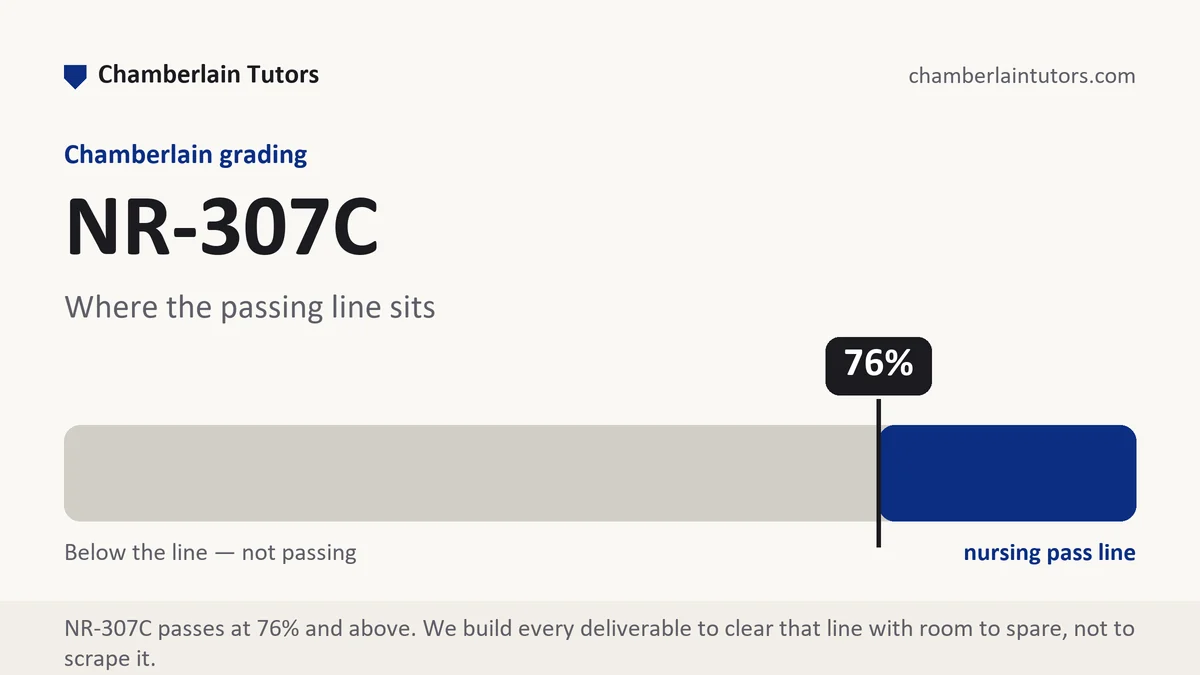
The same 76 percent passing floor that governs core nursing courses sits underneath this one. At three credits the paper is long enough that structure alone moves grades: a submission with clean section boundaries and correctly allocated space routinely outscores a better-informed one that runs everything together.
How we help in this course
We write the full paper: the population and determinants analysis, the proposal with its own evidence base, the feasibility discussion, the measurement plan and the reflection. The repair we make most often is separating the two evidence bases, so the sources proving the problem stop being asked to do work they cannot do for the recommendation.
The stance is yours to hold. We provide the structure, the sourcing discipline and the register, and we will tell you when a claim in your outline is larger than the evidence you have for it.
In NR-307C right now?
Send the week and the rubric from Canvas. First premium sample free, floor-checked, back in 24 to 48 hours.
Read the rubric before the prompt
Longer assignments have more rows, and more rows means more opportunities to leave one empty. Copy the criterion rows into a blank file, reduce each to a verb, analyze, propose, justify, evaluate, reflect, and note that the last three all belong to the proposal half of the paper. That distribution is the thing to see before you start.
Convert to a word budget. An 1,800 word paper with five rows at 25, 25, 20, 20 and 10 percent gives roughly 450, 450, 360, 360 and 180 words. Notice that the analysis, which most students treat as the paper, holds about a quarter of it. The proposal, its justification and its measurement together hold more than half. A submission with 1,200 words of beautifully sourced problem description and 300 words of recommendation has inverted the guide, and no quality of analysis compensates for three thin rows.
Bracket the targets and check them at the halfway mark rather than at the end. If you reach 900 words without having proposed anything, the paper is already out of shape.
One planning move keeps the two halves of this paper honest. Before writing, put two columns on a page, one headed problem and one headed change, and sort every source you have collected into one of them. Sources that will not sit in the change column are telling you that your proposal is currently unsupported, and you have found that out while there is still time to search rather than in the grader's comments. Most students discover their change column is empty, which is precisely the finding that turns an average paper into a strong one when acted on early.
The shape of an analysis with a change proposal
The dominant deliverable at this credit level joins two documents. These parts are what a grader reads for.
| Part | What it has to prove | The version that stalls |
|---|---|---|
| Setting and population | One bounded setting and group, defined tightly enough that a change could reach them. | A national problem with no place a change could be made. |
| The inequity, quantified | The outcome difference with bases, period and rate type stated. | A ratio with no denominators and no data year. |
| Determinants traced | The concrete conditions and the path each takes to the outcome. | A list of factors with no route between them and the result. |
| The proposed change | One change, described operationally: who does what, when, with what resources. | A recommendation to improve access, with no operations behind it. |
| Evidence for the change | Sources showing this kind of change has produced results elsewhere, with design and sample. | The problem sources reused as though they endorse the solution. |
| Feasibility and objection | Cost, staffing, workflow, and the strongest reasonable objection answered. | An assumption that willingness is the only barrier. |
| Measurement plan | What would be measured, in what unit, over what period, and what would count as failure. | Evaluate effectiveness, stated as a phrase. |
Evidence and citation craft at this level
The defining skill in this paper is knowing which claim a source can support. Four habits carry it.
Two evidence bases, kept apart. Problem evidence describes a disparity. Change evidence describes what happened when someone tried something. They are different literatures, and a paper that cites only the first has argued that something is wrong without arguing that anything would help, which is the single most common structural fault at this credit level.
Design and sample before every borrowed result, currency checked. Say what produced it: "in a pre and post study across four clinics with 1,900 patients" or "in a cluster randomized trial of 22 practices". Treat anything past five years as needing a stated reason, especially for delivery models, which change faster than the principles behind them.
Association verbs for determinants and honest verbs for your proposal. Observational work supports association. Your recommendation supports even less: it is a proposal, so write that a change of this kind has been associated with improvement elsewhere and that you would expect a similar direction here, not that it will reduce anything. Overclaiming in the proposal section is the fastest way to lose the justification row.
Denominator, window and rate type before any figure. Give both bases in every comparison and the period for every rate: "14 of every 1,000 against 6 of every 1,000, age-adjusted, across two years". A proposal argued on figures a reader can verify survives scrutiny; one argued on bare percentages does not, and this paper is long enough that a grader has time to check.
What separates a passing paper from a strong one
A passing NR-307C paper analyzes well and recommends vaguely. The problem is documented, the determinants are named, and the closing pages call for expanded access, more training or better outreach with no operational detail and no supporting evidence. It scores in the low eighties because three of the guide's rows are about the part that was written last and fastest.
Strong papers do three things. They operationalize the change, saying who performs it, during which part of which process, using what resource, so a reader can picture Tuesday morning. They answer the strongest objection rather than a weak one, which is what separates a proposal from an aspiration. And they define failure in advance, naming the measure, the period and the result that would mean the change did not work. Operational detail, a real objection answered, a measurable definition of failure.
Mistakes that cost points here
- Spending the budget on the problem. The analysis is roughly a quarter of the paper by weight. Writing it as though it were the whole assignment starves three rows.
- Reusing problem sources as proposal evidence. A study documenting a disparity says nothing about whether your intervention works. Find the second literature.
- Recommendations with no operations. Improve access is a direction, not a change. Name the person, the step in the workflow and the resource.
- Ignoring the obvious objection. Cost, staffing time and workflow disruption are the objections a reader will raise. Answer the strongest one in the paper rather than leaving it for the grader.
- No definition of failure. A measurement plan that cannot produce a negative result is not a measurement plan, and the evaluation row will read as unaddressed.
- Register drift in the closing pages. Papers written late tend to slide from evidence into advocacy in the last section. Keep the same sourcing standard on the final page as on the first.
Questions NR-307C students ask
How do I find evidence that a proposed change works, rather than that a problem exists?
My proposal feels too small to matter. Should I aim bigger?
How do I answer an objection without weakening my own argument?
The weeks, one by one
Week 1
An equity course at full weight opens by building the conceptual toolkit the rest of the session will spend: disparity, inequity, equity, the social determinants that generate all three, and the difference between describing a gap and explaining one. Read the full Week 1 manual.
Week 2
After the vocabulary comes the evidence, and the second stage of a full-weight equity course usually asks you to find, read and accurately report published disparity data: who measures the gaps, what the measures mean, and how a nurse writes about numbers without distorting them. Read the full Week 2 manual.
Week 3
The third stage of a full-weight equity course turns to the clinician's own cognition, and the written work examines how implicit associations and stereotyping distort assessment, pain management and communication. Read the full Week 3 manual.
Week 4
The middle of a full-weight equity course often gives an entire stage to language access, because communication across a language barrier is the equity problem with the clearest safety data and the clearest institutional machinery. Read the full Week 4 manual.
Week 5
The fifth stage of a full-weight equity course usually assembles everything so far into a single sustained case analysis: one population, one health outcome, one documented disparity, examined from data through determinants and bias to the care encounter. Read the full Week 5 manual.
Week 6
The sixth stage of a full-weight equity course lifts the analysis from the encounter to the institution, and the written work examines how organizations produce equity or inequity through their policies, their workforce and their defaults. Read the full Week 6 manual.
Week 7
Near the end of a full-weight equity course the writing turns constructive, and the assignment asks you to propose a specific, evidence-supported practice change that narrows a disparity in a defined setting. Read the full Week 7 manual.
Week 8
A full-weight equity course ends on a synthesis paper, and the assignment is architectural: take the session's accumulated work, concepts, data, mechanisms, institutional analysis, proposal, and build one argument about equitable nursing practice that could not have been written from any single week. Read the full Week 8 manual.