NR-307B Advancing Equity, Inclusion, and Diversity in Healthcare is the two credit lecture variant, carrying the same equity, diversity and inclusion content as the one credit version at twice the contact hours. The extra hours buy room for a real population analysis, which changes the assignment type: instead of a compact brief you are writing a paper that describes a specific group, quantifies what happens to them, and explains the determinants behind the numbers. That makes data handling the deciding skill, because a population paper lives or dies on whether its figures mean what the writer thinks they mean.
What NR-307B actually grades
Whether you can define a population precisely, quantify a difference honestly, and account for it with named social and structural determinants rather than with the population itself. The last part is the one that separates bands. Writing that a group has worse outcomes because of who they are attributes an outcome to identity; writing that a group experiences worse outcomes under conditions that include distance to care, insurance churn, interpreter availability and unstable scheduling attributes it to structure, which is what the course is teaching.
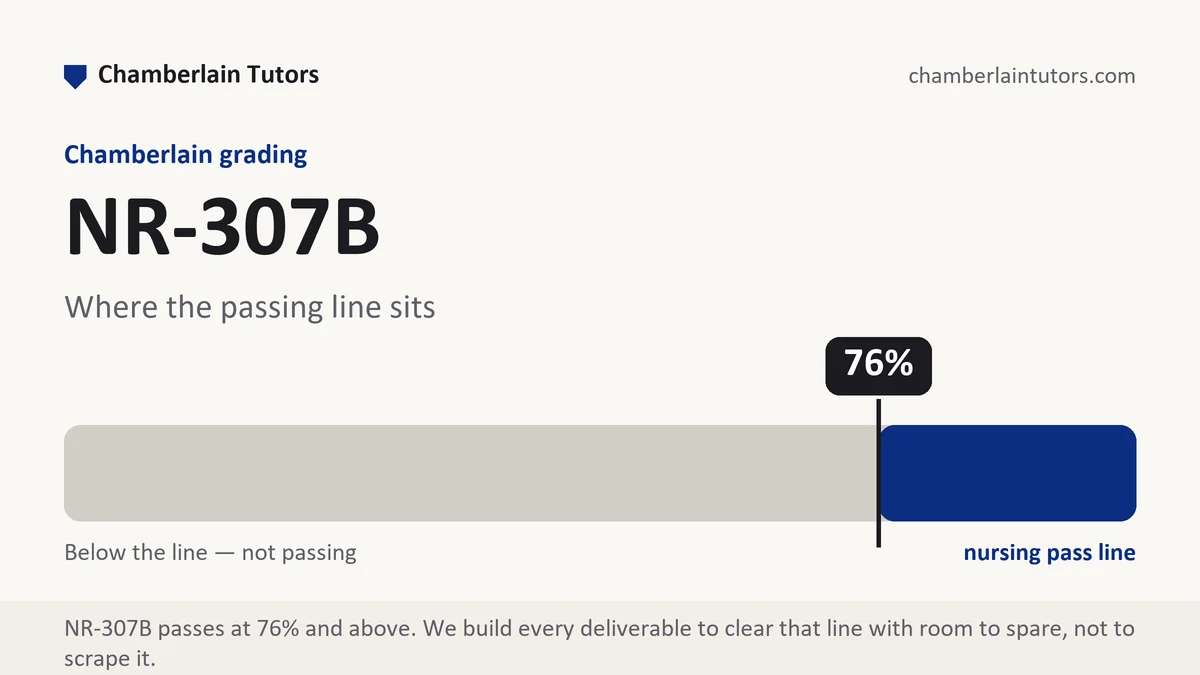
A 76 percent floor governs core nursing courses, this one included. At two credits there are enough graded pieces that recovery is possible, but the paper carrying the population analysis is almost always the heaviest single item in the course, and it usually arrives late enough that a weak draft cannot be rebuilt.
How we help in this course
We write the population analysis, the determinants sections, the sourced data tables, board responses and reflective pieces. What our drafts add most often is numerical discipline: every figure arrives with its base, its period and its source design, and comparisons are framed so they can survive a reader who checks them.
The position you take stays yours. We supply structure, sourcing and register, not conclusions about your own practice or community.
In NR-307B right now?
Send the week and the rubric from Canvas. First premium sample free, floor-checked, back in 24 to 48 hours.
Read the rubric before the prompt
Population papers have more moving parts than students plan for, so the guide has to be read first. Copy the criterion rows into a blank document, reduce each to its verb, define, quantify, explain, apply, and check which row carries the determinants, because that is usually where the weight sits rather than on the description of the population.
Then convert the weights into words. A 1,300 word paper with rows at 30, 30, 25 and 15 percent gives roughly 390, 390, 325 and 195 words. Two rows tied at 30 usually means description and explanation are equally valued, and students almost always overspend on description because demographic material is easy to find and easy to write. If your population section runs 700 words, you have taken 300 of them out of the determinants section, which is the section the course exists to teach.
Bracket each target beside its heading. A determinants section that will not fill usually means you have named categories rather than conditions, and the repair is to replace each category with something a person could point at.
Before drafting, do the sourcing in the opposite order to the one that feels natural. Find the dataset first and let it define the population, rather than choosing a group and then hunting for numbers to describe it. Papers written the second way end up with a population the available data cannot actually measure, and the quantification row suffers for a decision made in the first ten minutes. Starting from a real dataset also tells you immediately which comparison is available, which rate type it reports and which year it was collected, and all three of those facts belong in your sentences anyway.
The shape of a population determinants analysis
The dominant deliverable here assembles from these parts, and each is separately scorable in the guides students send us.
| Part | What it has to establish | The version that loses the band |
|---|---|---|
| Population defined | Who exactly, where, over what period, with the boundary of the group stated. | A broad label covering millions of people with nothing in common but a category. |
| The outcome quantified | The specific measure being compared, with both groups' bases and the data year. | A ratio quoted with no denominators and no source year. |
| Comparison handled properly | Whether rates are crude or adjusted, and what the adjustment does to the comparison. | Two rates set side by side with different underlying age structures. |
| Determinants named | Concrete conditions: distance, hours, cost sharing, language access, housing stability, work schedules. | Social determinants listed as a phrase with no local content. |
| Mechanisms traced | How each named condition reaches the outcome, step by step. | A determinant asserted next to an outcome with no path between them. |
| Nursing application | What changes in assessment, teaching, scheduling or referral for this population. | General advice about cultural awareness. |
Evidence and citation craft at this level
Population writing fails on data handling more often than on argument, and the failures are consistent enough to list. Four habits fix nearly all of them.
Currency, argued when it lapses. Surveillance data is released on a cycle, so give the collection year in the sentence and treat anything past five years as needing a reason. A figure that was current when a source was written is not current because the source is recent.
Crude against adjusted, named explicitly. Two populations with different age structures cannot be compared on crude rates, and this is the most common technical error in these papers. Say which kind of rate you are quoting. If your source reports age-adjusted figures, use that phrase, because it signals to a grader that you know why the adjustment exists.
Association verbs for determinants, without exception. Determinants research is observational by nature. It supports "was associated with", "occurred more often among", "predicted". A sentence saying a determinant causes an outcome is unsupported by the design, and in this course it also misrepresents a body of work that is careful about exactly that point.
Denominator and window before every rate, both sides of every comparison. Write "18 of every 1,000 in the first group and 7 of every 1,000 in the second, across 41,000 records over three years" rather than "the first group was two and a half times more likely". The ratio may be the headline, but the bases are what make it evidence, and a paper that supplies them can be checked and therefore believed.
What separates a passing analysis from a strong one
A passing NR-307B paper describes a group accurately and lists determinants correctly. It scores in the low eighties because the two halves never touch: the reader is given a population, then given a list of factors, and left to assume a connection the paper never draws.
Strong analyses do three things. They narrow the population until the data can actually describe it, preferring one county, one clinic catchment or one clearly bounded group over a national category. They quantify with bases on both sides, which makes every comparison in the paper checkable. And they trace at least one determinant through its full path to the outcome, so the explanation row has something to score other than a list. Narrow population, comparable numbers, one path followed to the end.
Mistakes that cost points here
- Defining the population too broadly. A category of millions has no consistent data behind it, and every claim afterwards inherits the vagueness.
- Comparing crude rates across different age structures. It is the technical error graders in this course look for first, and it invalidates the comparison the paper is built on.
- Attributing outcomes to identity. The course teaches that structures produce outcomes. Writing as though the group itself is the cause fails the central idea of the paper.
- Determinants as a list. Naming five determinants and tracing none of them scores lower than naming one and following it to the outcome.
- Ratios without denominators. Twice as likely is a headline, not evidence. Give both bases and the period every time.
- Application written as awareness. Being mindful is not an action. Say what changes in scheduling, teaching format, interpreter use, follow-up or documentation.
Questions NR-307B students ask
How narrow should the population be?
What is the difference between a crude rate and an adjusted one, in practice?
My paper has good data but scores low on application. What is missing?
The weeks, one by one
Week 1
NR-307B opens with vocabulary, and the opening written work in an equity course almost always asks you to use that vocabulary correctly on a real clinical situation rather than recite it. Read the full Week 1 manual.
Week 2
The second stage of an equity course usually moves from vocabulary to mechanism, and social determinants of health are the mechanism: the conditions in which people live, work, learn and age that shape outcomes before a nurse ever meets the patient. Read the full Week 2 manual.
Week 3
By the third stage an equity course usually turns the lens inward, and the written work asks you to examine implicit bias: the automatic associations that shape clinical judgment without permission or awareness. Read the full Week 3 manual.
Week 4
The midpoint of an equity course typically lands on communication, and the written work asks you to apply a cultural assessment or communication framework to a concrete care encounter. Read the full Week 4 manual.
Week 5
Past the midpoint, an equity course usually turns to health literacy, because unequal understanding produces unequal outcomes even when access is identical. Read the full Week 5 manual.
Week 6
The sixth stage of an equity course usually widens the lens from the bedside to the system, and the written work asks you to analyze the barriers that decide who reaches care at all: cost, coverage, distance, hours, transportation, trust. Read the full Week 6 manual.
Week 7
Late in an equity course the writing usually narrows to a specific population, and the assignment asks you to analyze the documented care barriers one group faces and the concrete practices that make a unit genuinely inclusive of it. Read the full Week 7 manual.
Week 8
Closing stages of an equity course fold the session's threads into a final piece about the nurse as advocate: what you will actually do, at the bedside and on a unit, with seven weeks of vocabulary, mechanisms and practices. Read the full Week 8 manual.