NR-307A Advancing Equity, Inclusion, and Diversity in Healthcare is the one credit lecture variant of the course, covering dimensions of diversity and how social and structural determinants of health and systemic inequities affect patient care and outcomes. One credit means short deliverables, and short deliverables are graded differently from long ones. There is no room to warm up, no space for a general introduction, and a single unsupported sentence occupies a much larger share of the page than it would in a term paper.
What NR-307A actually grades
Precision about mechanism. The course is not scored on whether you believe inequity exists; it is scored on whether you can explain how a specific structural condition reaches a specific patient outcome through a chain a reader can follow. Transport to appointments, pharmacy hours, interpreter availability, the way a clinic schedules follow-up: those are the mechanisms, and a brief that names one and follows it to a measurable outcome scores far above one that describes a disparity in general terms.
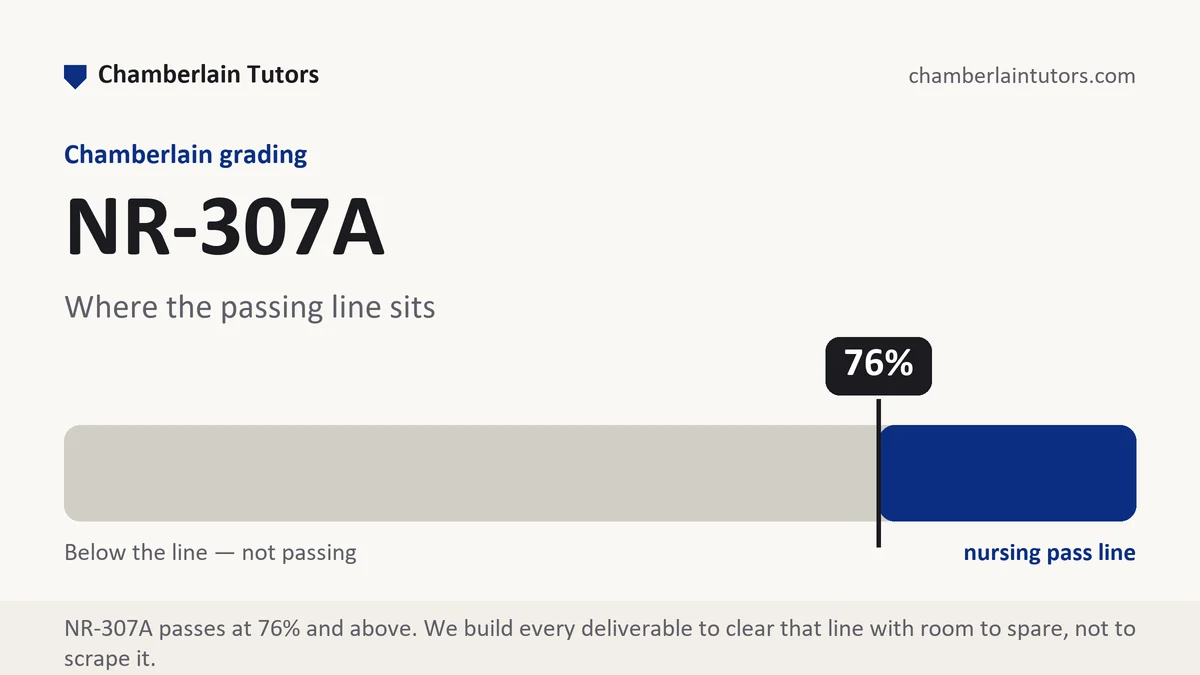
The second thing graded is discipline with claims. Equity writing attracts strong language, and strong language without a source behind it reads as opinion in an academic paper. The 76 percent floor for core nursing courses applies, and in a one credit course with few graded pieces, one opinion-heavy submission is a large fraction of the average.
How we help in this course
We write the briefs, the analytic short papers, the discussion responses and the reflective pieces, sourced properly and written in the register this material needs, which is measured rather than heated. The most common repair we make is converting a strongly felt paragraph into a chain of evidence that carries the same point and survives a grader who disagrees with you.
What we do not do is hand you a position. The material asks you to think about who is served badly by systems you work inside, and the thinking is yours; the structure, the sourcing and the sentence craft are what a model draft can supply.
In NR-307A right now?
Send the week and the rubric from Canvas. First premium sample free, floor-checked, back in 24 to 48 hours.
Read the rubric before the prompt
Short assignments punish poor allocation more than long ones do. Open the scoring guide, copy the criterion rows into a blank file, and reduce each to its verb: describe, connect, support, apply. Then count the rows against the word cap, because that ratio is the whole strategy for a one credit deliverable.
Convert weights to words immediately. A 700 word brief with three rows weighted 40, 35 and 25 percent gives roughly 280, 245 and 175 words. That is three paragraphs and nothing else. There is no introduction in that budget, no definition section, and no closing summary, which is precisely where most one credit submissions spend a third of their length. Open with the mechanism in the first sentence, spend the middle on evidence, and close with the practice implication. Anything that could be described as setting the scene has to go.
Bracket the targets beside each paragraph and hold them ruthlessly. In a brief this size, 100 words of preamble is a full band.
One test before you submit anything at this length. Read your brief and cross out every sentence that would still be true if you swapped the dimension of diversity you chose for a different one. If more than two sentences survive the crossing out, the piece is general rather than analytic, and generality is what the middle band is made of. A brief that passes this test reads as though it could only have been written about one situation, which is exactly the quality a scoring guide describes when it asks for specific application rather than broad discussion.
The shape of a short analytic brief
The dominant deliverable at this credit level is the brief: a compact analytic piece, sometimes submitted as a paper and sometimes as a substantial board response. These parts do the work.
| Part | What it must do in a small space | What wastes the budget |
|---|---|---|
| The dimension named | State which dimension of diversity you are writing about in the first line. | A paragraph on the importance of diversity before the topic appears. |
| The structural condition | Name one concrete condition, not a category: clinic hours, interpreter access, transport, cost sharing. | Inequity described as a general force with no specific location. |
| The mechanism | The steps from that condition to a patient outcome, in order, with nothing skipped. | A leap from the condition straight to a disparity statistic. |
| The evidence | One or two sourced findings placed where they do work, with design and base visible. | Three citations clustered in one sentence to look supported. |
| The nursing implication | What a nurse in that setting does differently tomorrow because of the chain you described. | A call for systemic change with no action a reader could take. |
Evidence and citation craft at this level
With room for only two or three sources, each one has to be handled correctly. Four habits carry a short paper.
Current data, with older sources justified in the sentence. Population figures are revised on a cycle and inequity data especially so. Anything past five years needs a stated reason, and if the most recent reliable figure is older, say when it was collected rather than letting the reader assume it is current.
Design and sample before the finding. Say what produced the number: "in a national survey of 26,000 adults" or "in a single-center review of 900 visits". A brief that names its sources' designs reads as careful even when it is short, and a brief that quotes bare findings reads as borrowed.
Association verbs, held firmly. This is the course where the discipline matters most, because the causal story feels obvious. Observational data supports "was associated with", "occurred more often among", "predicted". Reserve causal verbs for controlled work, and note that using the weaker verb strengthens your argument rather than weakening it, since a grader who was going to challenge the claim now has nothing to challenge.
Denominator and window before any rate, and both groups when comparing. A disparity claim needs two bases. Write "12 of every 100 in the first group and 5 of every 100 in the second, among the 3,400 patients reviewed over two years" rather than "more than twice as likely". Ratios without bases are the most common unsupported sentence in equity writing, and they are trivially easy to fix.
What separates a passing brief from a strong one
A passing NR-307A brief is sincere and general. It states that a group faces barriers, cites something, and concludes that nurses should be aware. It scores in the high seventies or low eighties because awareness is not an outcome and generality is not analysis, and in 700 words there is nowhere for that weakness to hide.
Strong briefs do three things. They pick one mechanism and follow it all the way, refusing the temptation to mention four. They put a number with its base in the middle of the argument, so the claim rests on evidence rather than on agreement. And they end with an action at the level of a working nurse, something like scheduling, teaching format, interpreter use or documentation, rather than a call for policy change nobody in the room can execute. One mechanism, one anchored number, one action a nurse can take.
Mistakes that cost points here
- Spending the opening on importance. In a brief, the first sentence has to carry content. Preamble is the single most expensive habit at this length.
- Naming a category instead of a condition. Structural barriers is a category; a clinic that closes at four and a bus that runs hourly is a condition, and only conditions produce mechanisms.
- Ratios with no bases. Twice as likely means nothing without two denominators, and a grader marking support will treat it as unsupported.
- Heat instead of evidence. Strong feeling is welcome in the reflection; in the analysis rows it has to arrive as a sourced chain or it does not score.
- Implications nobody can act on. Systems should change is not a nursing implication. Say what changes in one encounter or one schedule.
- Board posts written in the box. Posts cannot be edited once submitted at Chamberlain, and in a course about language the cost of a hasty sentence is higher than usual.
Questions NR-307A students ask
How do I write about inequity without sounding like I am giving an opinion?
Can a one credit brief really carry a full argument?
The prompt asks for personal reflection as well as analysis. How do I balance them?
The weeks, one by one
Week 1
NR-307A Week 1 opens the one-credit version of Chamberlain's equity, inclusion, and diversity course, and it almost certainly begins with vocabulary: the dimensions along which patients and colleagues differ, and the working distinction between equality, equity, and inclusion. Read the full Week 1 manual.
Week 2
NR-307A Week 2 usually turns the lens inward: what implicit bias is, how it differs from prejudice, and how a nurse examines their own assumptions in writing without either confessing dramatically or claiming to have none. Read the full Week 2 manual.
Week 3
NR-307A Week 3 typically introduces the social determinants of health: the conditions of living, working, learning, and aging that shape outcomes before any clinician is involved. Read the full Week 3 manual.
Week 4
NR-307A Week 4 usually climbs from conditions to causes: how policies, institutional practices, and historical decisions distribute the social determinants unevenly, producing systemic inequities that no individual clinician chose and every clinician inherits. Read the full Week 4 manual.
Week 5
NR-307A Week 5 usually puts numbers under the concepts: how health disparities are measured, what a gap between groups does and does not prove, and how to report a published statistic accurately in your own writing. Read the full Week 5 manual.
Week 6
NR-307A Week 6 usually brings the course to the encounter itself: culturally responsive communication, language access, health literacy, and the practical craft of caring well for a person whose background differs from yours. Read the full Week 6 manual.
Week 7
NR-307A Week 7 typically moves from understanding inequity to acting on it at nursing scale: advocacy inside the encounter, on the unit, and in the small institutional openings where a pre-licensure nurse actually has a voice. Read the full Week 7 manual.
Week 8
NR-307A Week 8 closes the one-credit equity course with synthesis: gathering the session's concepts, dimensions of diversity, bias, determinants, structure, data, communication, advocacy, into a working lens you can show applied to your own future practice. Read the full Week 8 manual.