NR-300A Directed Independent Study is the one credit hour version of Chamberlain's service learning study: you connect academic learning to community service on a real-world problem of professional interest, you plan the experience yourself, and you reflect on it in writing. Because it is student-planned, the course has no content to memorize and nowhere to hide. At one credit, the single most consequential document you write is the plan itself, and a weak plan produces a weak everything afterwards.
What NR-300A actually grades
Three things, in this order. Whether the problem you selected is real, local and narrow enough that one credit of effort could touch it. Whether your objectives are written so that someone else could tell if you met them. And whether your reflection connects the service back to nursing knowledge rather than reporting that the experience was rewarding.
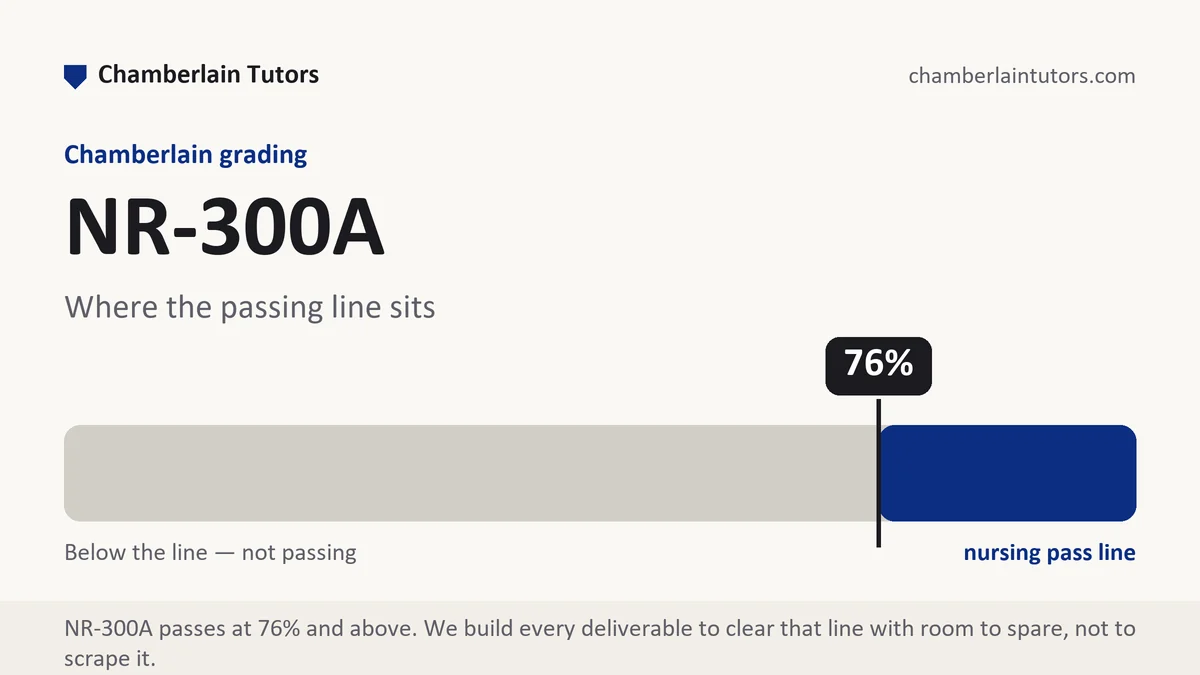
The self-directed format is the difficulty. In a lecture course the assignment arrives fully specified; here you are writing the specification and then being graded against it, which means a vague plan is a trap you set for yourself in week one and spring in week eight. The 76 percent floor applies as it does across core nursing courses, and with few graded pieces in a one credit study, a single unfocused submission is a large share of the average.
How we help in this course
We write the documents: the study plan or proposal, the objective statements, the background section that justifies the problem, the reflection, and any board or summary post attached to the study. Our drafts turn a loose intention into a scoped, sourced, measurable plan you can actually deliver in the hours available.
The service itself is yours. We do not arrange sites, contact organizations, sign anything, or record hours you did not spend. What we supply is the writing that surrounds the experience, built to your assignment's scoring guide.
In NR-300A right now?
Send the week and the rubric from Canvas. First premium sample free, floor-checked, back in 24 to 48 hours.
Read the rubric before the prompt
Self-directed courses tempt students to write from enthusiasm. Open the scoring guide first instead, copy the criterion rows into a blank document, and strip each to its verb: identify, justify, plan, implement, reflect. Those become your headings in the guide's order, which matters more than usual here because a self-designed project has no natural structure of its own.
Then convert the weights into words. A 900 word proposal with four rows weighted 35, 30, 20 and 15 percent gives roughly 315 words to the first row, 270 to the second, 180 to the third and 135 to the last. In a one credit study the heaviest row is usually the justification of the problem, which surprises students who assumed the activity plan would carry the grade. Justification means data about a specific community, not a paragraph about why the topic matters in general, and 315 words of it requires at least two real sources.
Bracket the numbers beside each heading. A justification section that will not reach its budget is telling you the problem is too broad to have local evidence, which is exactly the finding you want in week one rather than week seven.
One more move before you draft, and it takes ten minutes. Write the sentence you would say to a site coordinator describing what you want to do and how long it will take. If that sentence needs a comma splice and two qualifiers, the project is still too broad for a one credit study and the proposal will show it. Shrink the sentence until it is plain, then build the plan behind the shrunken version. Students who do this in week one usually finish; students who skip it usually spend weeks three and four renegotiating a scope they never tested out loud.
The shape of a service learning study plan
The dominant deliverable at this credit level is the plan or proposal. These parts recur in the guides students send us, and each one is separately scorable.
| Part | What it has to establish | The version that stalls |
|---|---|---|
| Problem statement | One specific problem in one identifiable population or setting, sized to the hours you have. | A national issue no single credit hour could touch. |
| Local evidence | Data describing the problem where you are, with source, base and period. | A national statistic used as though it described your county. |
| Professional relevance | Why this problem sits inside nursing practice and inside your own path. | Personal interest asserted with no link to practice. |
| Objectives | Two or three statements with an action, a measure and a deadline. | Learn more about the topic, which nobody can grade. |
| Planned activity | What you will actually do, where, with whom, and in what hours. | Volunteer at a site, with no defined role. |
| Evaluation method | How you will know each objective was met, decided before you start. | Reflection, named as the method and the outcome at once. |
Evidence and citation craft at this level
A proposal is an argument that a problem exists and is worth your hours, so its evidence has to be handled carefully even at one credit. Four habits do most of the work.
Current data, with any older source justified. Community health data is republished on a cycle, so anything past five years needs a stated reason. If the most recent county-level figure available is older, say so in the sentence and cite the release rather than pretending it is current.
Design and sample before the finding. Announce what produced a number before quoting it: "in a county health survey of 2,800 residents" or "in a needs assessment conducted at three clinics". Community data comes from wildly different instruments, and a grader marking your justification row is checking whether you noticed which one you used.
Association verbs for community problems. Neighborhood conditions co-occur with health outcomes in observational data. Write "was associated with", "occurred more often in", "predicted", and reserve causal verbs for controlled work. The proposal reads as more rigorous, not less, when the verbs match the evidence.
Denominator and window before any rate. A local rate without a base is unusable for planning. Write "roughly 1 in 7 of the 4,100 adults surveyed in the county reported no usual source of care in the past year" instead of "14 percent lack a provider". The base tells your reader whether the problem is large enough to justify a project, which is the entire point of the section.
What separates a passing plan from a strong one
A passing NR-300A plan is sincere and unfocused. It names a worthy problem, describes a general intention to help, and promises reflection afterwards. It scores in the seventies or low eighties because nothing in it could be checked, and an ungradeable plan produces an ungradeable project.
Strong plans differ in three ways. They shrink the problem until it fits the hours, choosing one clinic, one neighborhood group or one specific gap rather than an issue. They write objectives that can fail, with a number and a date attached, because an objective nobody could miss is not an objective. And they decide the evaluation method before the activity begins, so the final reflection has something to measure against rather than a memory to describe. Narrow scope, failable objectives, an evaluation chosen in advance.
Mistakes that cost points here
- Choosing a problem too large for one credit. Ambition reads as vagueness in this course, and the guide grades scope directly.
- National data standing in for local evidence. The justification row wants your community. A country-wide figure is context, not evidence for your project.
- Objectives written as intentions. Learn, understand and become aware cannot be evaluated. Use verbs that produce something someone could count.
- Reflection as a substitute for evaluation. How you felt is not whether the objective was met. Both belong in the paper, in separate sections.
- Leaving the site question late. Access takes longer than anyone plans, and a study that starts in week five cannot deliver in week eight.
- One-shot posts drafted in the box. Discussion posts do not reopen once submitted at Chamberlain, so compose in a document and paste once.
Questions NR-300A students ask
How small should a one credit service learning project be?
What makes an objective measurable in a study like this?
Can you find me a site or contact an organization for me?
The weeks, one by one
Week 1
NR-300A Week 1 is the stage where a working registered nurse sits back down in a classroom, and the writing that opens an RN-to-BSN foundations course is almost always about re-entry: introducing yourself as a professional, reading a rubric for the first time in years, and trading charting. Read the full Week 1 manual.
Week 2
By the second stage of an RN-to-BSN foundations course, the writing usually turns inward: who are you as a nurse, what do you believe nursing is, and can you argue that belief instead of announcing it. Read the full Week 2 manual.
Week 3
Somewhere in the early arc of a professional nursing concepts course, the lens usually swings outward: how the profession became what it is, and how the public still pictures it. Read the full Week 3 manual.
Week 4
The middle of a professional nursing concepts course typically arrives at the documents that define the job: practice standards, the nurse practice act, and the boundary lines of scope. Read the full Week 4 manual.
Week 5
An ethics stage in an RN-to-BSN foundations course asks for something specific: take a situation where good people could disagree, apply the profession's ethical code and the classic principles to it, and reason to a defensible position in writing. Read the full Week 5 manual.
Week 6
Late-middle in a foundations course, the spotlight usually lands on the machinery of scholarship itself: what counts as a scholarly source, how to find one in a library database, how to paraphrase without stealing, and how APA holds the whole apparatus together. Read the full Week 6 manual.
Week 7
Near the end of a foundations course, the pieces built across the session usually get assembled: a paper that takes a position on a real professional issue and defends it with scholarly sources, in clean APA, in the register the course has been teaching since its first week. Read the full Week 7 manual.
Week 8
Closing stages of an RN-to-BSN foundations course tend to look forward on purpose: a professional development plan or synthesis reflection that takes what the session built, identity, standards, ethics, source literacy, and converts it into goals with dates, artifacts and a trajectory through the rest of the program. Read the full Week 8 manual.