MSW-554 carries 1 theory credit and 2 practicum credits, with 16 lecture hours and 168 hours in the field, and it introduces practice from non-Western perspectives while decentring White Western norms and values. The word in the title that governs the grading is techniques. This is not the values course; it is the course where the commitment has to show up in what you say in a session, what you write in a record and which question you drop from an assessment.
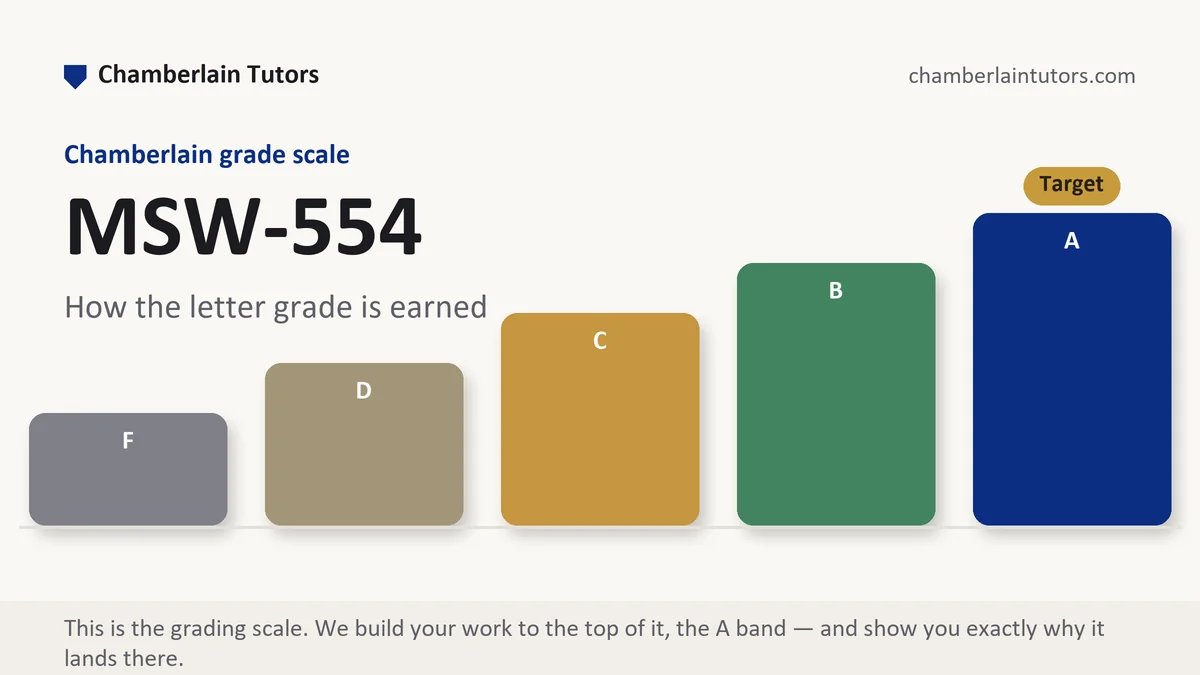
What MSW-554 actually grades
The first thing scored is whether you can identify a norm inside a technique you were taught. Most practice methods carry assumptions: that the individual is the unit of help, that talking about difficulty relieves it, that eye contact indicates engagement, that emotional expression is progress, that a professional relationship should stay inside an office and an hour. None of these are universal, and the course asks you to find them in your own practice rather than to list them in the abstract.
The second thing scored is what you did with the finding. Decentring is an action: changing who is invited to a meeting, asking a family how decisions are properly made before proposing one, dropping an assessment question that assumes a household shape, using an interpreter differently, holding a conversation outside a clinical room, recording strengths in the language the family used rather than translating them into professional categories. Papers that analyse the norm and stop have done half the assignment.
The third strand is the position of your own placement. You are practising inside an organisation with forms, timescales and categories that carry the same norms, and the honest version of this paper says what you could change, what you could not, and how you handled the gap. That analysis is more useful than either compliance or complaint, and it is the register the rubric is written for.
How we help in this course
Send the assignment page, the scoring guide and your de-identified practice material. A premium original draft returns in 24 to 48 hours: the embedded norm named inside a specific technique, the alternative practised and described concretely, non-Western frameworks cited to their own scholars, and the organisational constraint handled honestly rather than ignored. Two quality passes and free revision until it lands.
The practicum boundary does not move. Your hours are yours. We do not complete them, contact your field instructor, your agency or a site, sign placement paperwork, or fill in hour logs. We draft the writing around the practice you do.
Read the guide before you pick the technique
This course rewards planning because the evidence has to be generated in placement. Read the rows in the first week and choose, deliberately, one technique you use often enough to examine: your opening question, your assessment sequence, how you handle silence, who you invite to a meeting, how you write strengths in a record. A technique you use weekly gives you several attempts; a technique you used once gives you an anecdote.
Convert the weights into words. Say your guide totals 100 points across four rows at 40, 25, 20 and 15, with an 1,800 word cap. Each point buys 18 words: 720 words for the 40 point row, 450 for the 25, 360 for the 20 and 270 for the 15. If the 720 word row is the applied technique analysis and your draft has spent 600 words defining anti-racist practice, the definitions have taken the section that carries the grade.
One habit makes the evidence usable. Record what you actually said, in your own words, on the day. Technique analysis depends on the exact phrasing, and reconstruction two weeks later produces the sentence you wish you had used rather than the one you did.
Writing a technique analysis for MSW-554?
Send your practice notes and the scoring guide. First premium sample free, back in 24 to 48 hours.
The shape of an anti-racist technique analysis
Whatever your week's rubric calls it, the dominant deliverable here examines a specific practice move and what changed when you altered it. These parts recur.
| Section | What it has to establish | The weak version |
|---|---|---|
| The technique | One concrete practice move, described precisely enough to be repeated. | Names a broad approach rather than a technique. |
| Where it came from | The tradition and assumptions built into it, with sources. | Treats the method as neutral professional practice. |
| The embedded norm | The specific assumption about persons, families or help that it carries. | Refers to Western bias in general terms. |
| What it produced in practice | An actual instance where the assumption did not hold, with what was said. | Hypothesises a client who might react differently. |
| The alternative frame | A named non-Western or community based account and what it proposes instead. | Describes collectivist values without a source. |
| What you changed | The altered move, written as words and actions, with the date. | Commits to being more culturally responsive. |
| What happened next | The client's or family's response, including where the change did not help. | Reports that the client seemed more comfortable. |
| Organisational friction | What the agency's forms, timescales or categories made difficult, and how you handled it. | Omits the constraint or blames the agency wholesale. |
| What you will keep | The practice you are carrying into your next placement or post, stated specifically. | A general commitment to continued growth. |
Include the attempt that did not work. Adapting a technique can also misfire, and an honest account of a change that a family did not want is stronger evidence of judgment than a series of successful adjustments.
Sourcing writing that decentres a canon
In a course about whose knowledge counts, the reference list is part of the argument and graders read it as such.
- Cite scholars from within the traditions you use. Practice frameworks from outside the Western canon have their own authors, and reaching them through a Western summary repeats the pattern the course names.
- Be specific about the tradition. Name the community or lineage rather than a continent, since practices differ as much within regions as between them.
- Attribute anti-racist practice literature properly. This is a developed field with named contributors, and treating its concepts as general vocabulary loses the scholarship rows.
- Do not use one client as a source for a people. What a family told you is their account, valuable and singular, and it should be labelled as such.
- Ground the professional obligation in the Code. The standards on discrimination, social diversity and self-determination make this practice a requirement rather than a preference.
- Protect the placement and the people in it. De-identify the family, the agency and any colleague whose practice you discuss, and write about practices rather than individuals.
What separates a passing paper from a strong one
A passing paper explains anti-racist practice correctly, acknowledges that professional methods carry Western assumptions, and commits to cultural humility. It is articulate and unevidenced, because nothing in the writer's own practice was examined closely enough to change.
Strong papers do three things. They get specific enough to be uncomfortable, examining a sentence the writer actually says in every first meeting and what it assumes. They name the tradition they are learning from and use it as an explanatory framework rather than as a gesture, which requires reading its scholars rather than summaries of them. And they report what happened when the technique changed, including the times it landed badly, since a paper where every adaptation succeeded is describing an intention rather than a practice.
Six mistakes that cost points here
- Values essay instead of technique analysis. The course title says techniques, and the heaviest rows follow it.
- Borrowing a practice without its framework. Taking a ritual or a method as a tool while keeping your own assumptions intact is appropriation, and it is analysed as such.
- Treating clients as cultural informants. Asking someone to educate you is work you are asking them to do in a session they came to for help.
- Claiming transformation. Sweeping personal change reads as performance; one specific altered practice with an outcome reads as evidence.
- Ignoring the agency's part. Forms, timescales and categories carry norms, and a paper that only examines the practitioner has stopped short of the structure.
- Posting practice detail to the board. Chamberlain discussion posts cannot be edited once submitted, and this material identifies both families and colleagues.
Questions MSW-554 students ask
How do I find the Western assumption inside a technique I use automatically?
How do I learn from a tradition I do not belong to without appropriating it?
What if my agency's required forms carry the assumptions I am trying to change?
Where MSW-554 sits in Chamberlain's programs
Open the exact program map for sequence, credit, and option context. The current student schedule and syllabus remain authoritative after transfer evaluation, electives, state rules, and approved plan changes.
The weeks, one by one
The public curriculum verifies MSW-554 but does not publish its Week 1 through Week 8 Canvas assignments. Week manuals are added only from verified real deliverables; session length is never used to invent them.