MSW-553 carries 1 theory credit and 2 practicum credits, with 16 lecture hours and 168 hours in the field, and it advances understanding of human development, family structure, aging, mental illness, addiction, poverty and inequality, including perspectives from outside the Western canon. The practicum is what makes this different from a classroom theory course. Your writing has to test theory against a real caseload, and the rows reward the places where the theory did not fit.
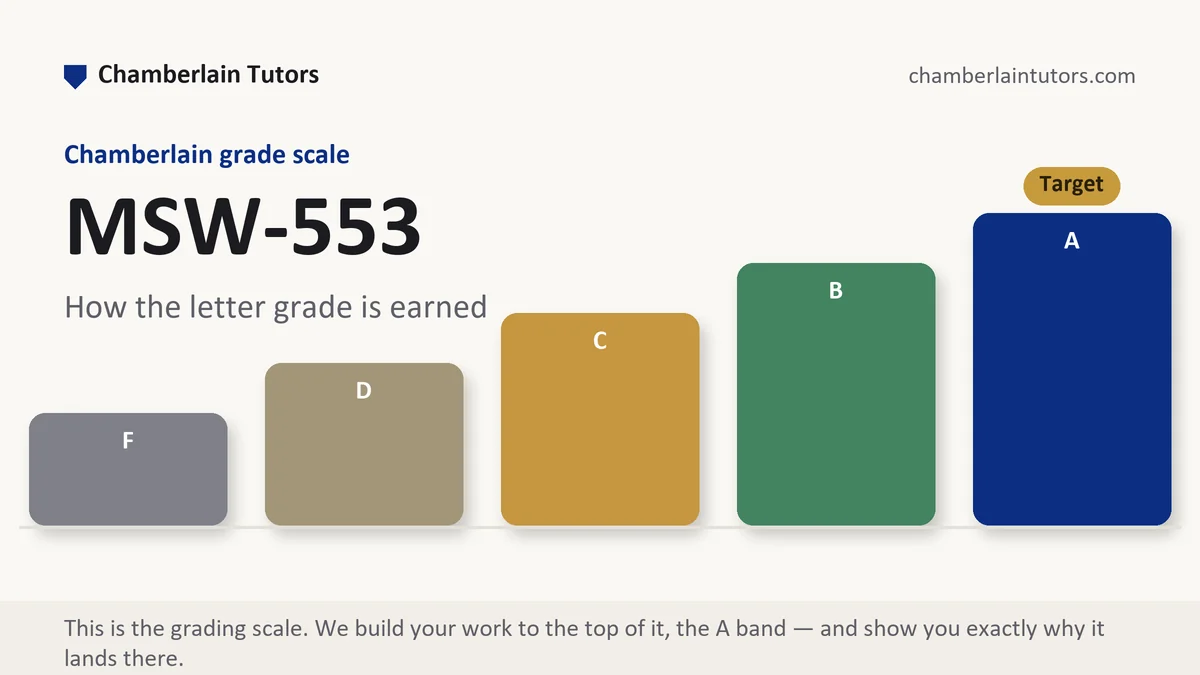
What MSW-553 actually grades
The first thing scored is whether the theory did any work in your placement. Not whether you can explain a framework, which the earlier courses established, but whether applying it changed a decision: what you asked, what you noticed, how you understood a family's response, what you brought to supervision. Writing that describes a case and then attaches a theory afterwards is retrofitting, and it reads exactly as it is.
The second thing scored is scale movement inside a single case. Your placement gives you one situation appearing at several levels at once: a person's difficulty, a household's arrangement, an agency's procedure and a policy's rule, all present in the same week. Advanced theory writing is expected to show a framework operating across those levels on that one case, which is a harder and more useful demonstration than four separate examples.
The third strand is theoretical honesty. Every framework fails somewhere, and a placement is where the failure becomes visible. A model built on stable housing and reliable services predicts poorly for a family moving between addresses. A developmental account calibrated on one population misreads a young person carrying adult responsibilities. Naming that mismatch, and saying what a better account would need to include, is the highest scoring move available in this course.
How we help in this course
Send the assignment page, the scoring guide and your de-identified case material. A premium original draft returns in 24 to 48 hours: theory applied to a real situation rather than illustrated by it, the same framework carried across system levels, non-Western perspectives used as explanation rather than as acknowledgment, and the misfits named with what follows from them. Two quality passes and free revision until it lands.
The practicum boundary is absolute here as everywhere. Your hours belong to you. We do not complete them, contact your field instructor, your agency or a site, sign placement paperwork, or fill in hour logs. The written work around the practicum is what we take.
Read the guide before the case chooses itself
In practicum linked theory courses, the case you write about is usually whichever case was most dramatic that month, and that is rarely the one the rubric can reward. Read the rows first and identify what the assignment needs: a case with several system levels visible, or one where a cultural framework is doing real work, or one where a theory clearly failed. Then choose deliberately from what your caseload offers.
Convert the weights into words. Suppose your guide runs on percentages with rows at 34, 26, 22 and 18 against a 2,000 word cap: 680 words for the 34 percent row, 520 for the 26, 440 for the 22 and 360 for the 18. If the 680 word row is theoretical application and your draft has 700 words of case description, the paper has become a case study with citations.
One discipline improves these papers immediately. Write the case in no more than 250 words, as a situation to be explained rather than a story to be told, and spend everything else on explanation. Graders in this course have read hundreds of case descriptions and very few genuine applications.
Writing a theory to practice paper for MSW-553?
Send your case notes and the scoring guide. First premium sample free, back in 24 to 48 hours.
The shape of a theory to practice integration paper
Whatever your week's rubric calls it, the dominant deliverable here connects a framework to work you are actually doing. These parts recur.
| Section | What it has to establish | The weak version |
|---|---|---|
| The practice puzzle | One thing in your placement that you could not explain, stated as a question. | Opens with a theory and looks for a case to fit it. |
| The case, briefly | Enough de-identified detail to make the puzzle legible, and no more. | Narrates the case history at length. |
| The framework | Its central claim, its unit of analysis and what it treats as a cause. | A textbook definition with no argument attached. |
| Application at the person level | What the theory explains about this individual's behaviour or response. | Relabels the case in the theory's vocabulary. |
| Application at the family or group level | What changes when the household or network is the unit. | Repeats the individual analysis in plural form. |
| Application at the agency or policy level | What the theory explains about the systems this person meets. | Comments generally on service pressures. |
| Non-Western frame | A different account of personhood or healing, and what it changes about the reading. | Adds a sentence acknowledging cultural differences. |
| Where the theory failed | The part of the case it could not account for, named precisely. | Reports that the theory fitted well overall. |
| What changed in your practice | The specific thing you did differently, and what happened. | Concludes that theory informs practice. |
Write the practice change section as an event with a date and an outcome. Something you did differently in a session last week, and what the client did in response, is evidence; something you intend to do in future is an intention.
Sourcing theory writing anchored in a real caseload
Mixing scholarship with live practice material has rules that this course grades directly.
- Read the theorist, not only the application. Advanced work is expected to engage the primary formulation, since the claim you are testing needs to be stated precisely.
- Cite the traditions you draw on by name. Relational and communal accounts of personhood, kinship obligation and community healing have specific authors and lineages, and attributing them to a region rather than to scholars is a visible weakness.
- Distinguish theory currency from data currency. A framework can be decades old and still testable; the prevalence, service and policy data you use alongside it cannot.
- Keep supervision separate from citation. Your field instructor's view is practice knowledge to be analysed, not a source, and mixing the two weakens both.
- Protect the case absolutely. Remove names, the agency, the town, dates and any unusual detail, and never reproduce record material in an assignment.
- Check what your placement allows. Some agencies restrict what students may write about their cases, and asking early prevents a rewrite late.
What separates a passing paper from a strong one
A passing integration paper explains a framework accurately, describes a placement case, connects the two plausibly and concludes that theory helps make sense of practice. It is competent and closed, because the theory was never at risk of being wrong.
Strong papers do three things. They start from a puzzle rather than a framework, which guarantees the theory is being used rather than displayed. They carry one framework across the levels of a single case, showing what it explains about a person, a household and an institution at once. And they report a failure of fit and take it seriously, since the moment a model stops predicting your caseload is the moment you are doing advanced work rather than advanced coursework.
Six mistakes that cost points here
- Case description as the paper. The narrative is the setup, and it is the cheapest row on any guide in this course.
- Retrofitted theory. Choosing a framework after the fact to describe what you already concluded produces writing a grader can spot in a paragraph.
- One level only. A paper that stays at the individual has not met the across systems requirement in the course title.
- Non-Western material as acknowledgment. If removing that paragraph would change nothing else in the paper, it was decoration.
- No failure reported. A framework that fitted perfectly usually means the case was selected to flatter it.
- Posting placement material to the board. Chamberlain discussion posts cannot be edited after submission, and specialised year cases are unusually identifiable.
Questions MSW-553 students ask
How is this different from the theory course without practicum hours?
My caseload is narrow. How do I show application across systems?
What do I write when the theory clearly does not fit my client?
Where MSW-553 sits in Chamberlain's programs
Open the exact program map for sequence, credit, and option context. The current student schedule and syllabus remain authoritative after transfer evaluation, electives, state rules, and approved plan changes.
The weeks, one by one
The public curriculum verifies MSW-553 but does not publish its Week 1 through Week 8 Canvas assignments. Week manuals are added only from verified real deliverables; session length is never used to invent them.