MSW-512 Direct Practice II completes the direct practice sequence, taking Motivational Interviewing beyond the individual into families, groups, communities and organisations. The writing changes with the system size. A conversation with one person can be analysed line by line; a group cannot, so the deliverables ask you to account for what happened between members, how you handled the person nobody wanted to hear from, and what your facilitation choices did to the room.
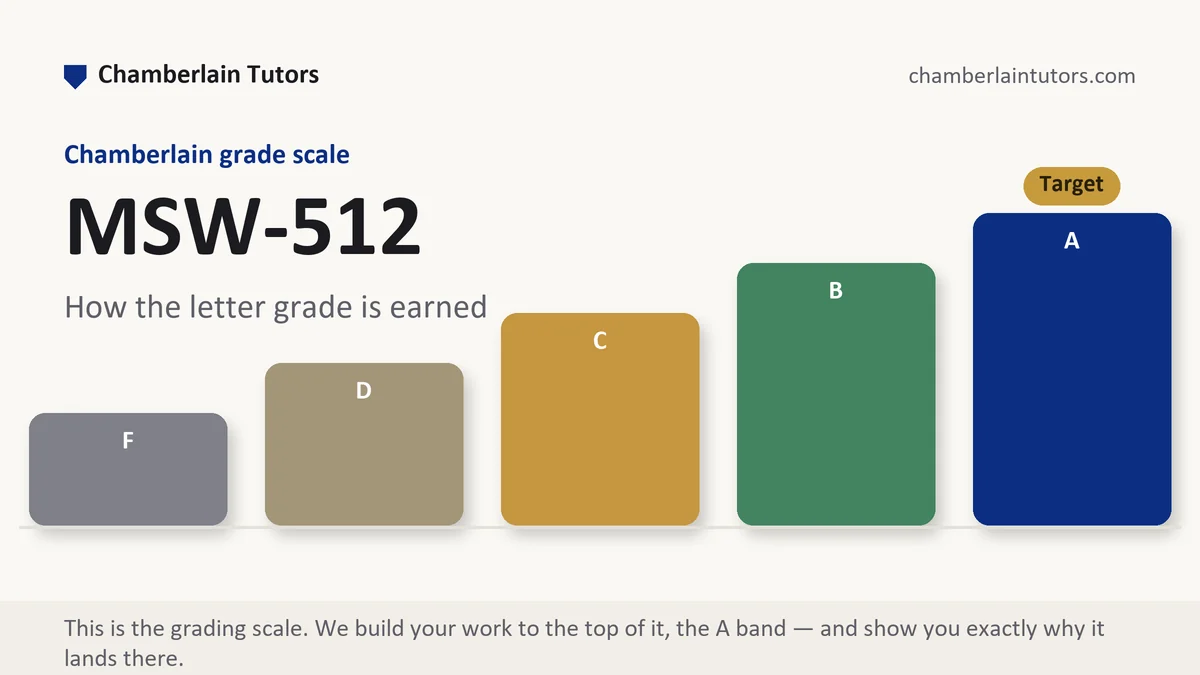
What MSW-512 actually grades
The first thing scored is whether you can see the system rather than a queue of individuals. In a family session, a mother's complaint is also a bid for an alliance, a teenager's silence is also a position in the room, and a father's late arrival is data about how the household distributes obligation. Writing that reports each person's contribution in turn has described a meeting. Writing that names the pattern connecting them has analysed a system, and only the second earns the analysis rows.
The second thing scored is facilitation as an intervention. Every choice you make in a group is a technique: who you invite in first, whether you let a silence run, how you interrupt a member who is dominating, when you name conflict aloud. The deliverables ask you to identify those choices by name and justify them, and the common failure is a write-up in which the group simply happened while the student was present.
The third strand is scaling the model honestly. Motivational Interviewing was built for conversations about individual change, and moving it into a community meeting or an organisational consultation requires you to say what carries and what does not. The stance carries: collaboration, evoking reasons for change rather than supplying them, respecting autonomy. The mechanics change, because in a room of twenty people ambivalence is distributed across factions rather than held inside one person. Writing that shows this thinking is the difference between the top two bands.
How we help in this course
Send the assignment page and the scoring guide from Canvas together with your notes from the session, meeting or role play. A premium original draft comes back in 24 to 48 hours: the interaction reconstructed as a system, your facilitation choices named in the course's vocabulary, the group processes identified, and the reflection written analytically rather than apologetically. Two quality passes and free revision until it lands.
We draft the written analysis around practice you did. We do not attend, facilitate or record a session, and we do not write words for other participants beyond what you report they said.
Read the guide before you reconstruct the session
Group and family assignments produce more raw material than any word count can hold, so the guide is what decides which forty minutes matter. Read the rows and mark which want the plan, which want the account of what happened, which want your skill analysis and which want theory applied to group development. Then choose your segment to feed the highest weighted rows rather than the most interesting story.
Set the budget in words. Suppose the guide runs on percentages with rows at 30, 30, 25 and 15, and the write-up is capped at 2,000 words. That gives 600 words to each of the first two rows, 500 to the third and 300 to the last. Two rows at 600 words means two substantial sections, not two paragraphs, and students who discover that after drafting usually find they have spent 900 words describing the room.
One planning note specific to this course. If your assignment includes a proposal for a group before the group runs, write the evaluation method into the proposal at that point. Retrofitting a measure onto a group that has already met is the reason so many write-ups end with an assertion that members seemed to benefit.
Writing up a group or family session for MSW-512?
Send your session notes and the scoring guide. First premium sample free, back in 24 to 48 hours.
The shape of a group or family session write-up
Whatever your week's rubric calls it, the dominant deliverable moves from an individual transcript to an account of a system, and these parts recur.
| Section | What it has to establish | The weak version |
|---|---|---|
| Purpose and composition | Why this group exists, who is in it, how they came to be there and what they were told. | Describes the topic without saying how members were recruited or referred. |
| Stage of development | Where the group is in its life, with evidence from what members did rather than from the session number. | Names a stage model and assigns a stage by counting meetings. |
| Your plan for the session | The intended arc, the openers, the questions held in reserve, the plan for silence. | An agenda with times and no rationale. |
| What actually happened | The sequence of interaction, including who spoke to whom and what shifted the room. | A summary of topics discussed. |
| Group processes | Alliances, scapegoating, silence, humour used to deflect, the member who speaks for everyone. | Reports that the group was engaged. |
| Your facilitation choices | Each significant move named as a technique with the reasoning behind it. | Says you encouraged participation. |
| Difference and power in the room | How language, status, gender, age or mandate shaped who was heard. | Treats the group as a set of equal participants. |
| Evaluation | What told you the session did what it was meant to, beyond the mood at the end. | Members appeared to find it helpful. |
| Next session | Two concrete adjustments and what they respond to. | Plans to keep building rapport. |
Write the difference and power section deliberately rather than leaving it to the closing paragraph. In mandated or mixed status groups it is often the most important analysis available, and it is the section most students skip.
Evidence craft for group, family and community work
The sources shift once you leave the dyad, and using individual practice literature for group claims is a visible mismatch.
- Cite group work scholarship for group claims. Stage models, curative factors and facilitation technique all have their own literature, and borrowing an individual therapy source to justify a group decision reads as improvisation.
- Say which adaptation you are using. When a model built for individuals is applied to a family or a community meeting, name the adaptation and cite anyone who has studied it in that form.
- Community claims need local data. An argument about what a neighbourhood needs requires figures about that neighbourhood, with the source and the year, not national averages applied downward.
- Confidentiality in groups is a limited promise. When you write about it, be accurate: the facilitator can commit to their own conduct and can set an expectation for members, but cannot guarantee what members do.
- Attribute the organisational frame. If you analyse an agency using a systems or organisational model, cite it, since organisational claims made without a frame read as complaint.
- De-identify everyone, including the group. A group is easier to identify than an individual because its programme, location and timing narrow it quickly. Strip all three.
What separates a passing write-up from a strong one
A passing account describes a session that went acceptably, names a stage model, reports that most members participated and concludes that rapport is developing. It is orderly and it is invisible, because the writer could have been replaced by any competent adult with an agenda.
Strong write-ups do three things. They analyse a moment of tension in detail, the interruption, the member who left early, the joke that landed badly, because that is where group dynamics become legible. They take responsibility for the room, showing where the facilitator's own choice produced the silence or the alliance rather than treating dynamics as weather. And they distinguish what the group achieved from what the group enjoyed, which is the beginning of evaluating practice honestly rather than hopefully.
Six mistakes that cost points here
- Writing a group session as several individual sessions. If your account never describes an interaction between two members, the system never appeared on the page.
- Assigning a developmental stage by arithmetic. Stages are claims about behaviour, so evidence them from what members did, and say when a group has moved backwards.
- Confusing facilitation with participation. Contributing your own views is not facilitating, and write-ups that show the student talking most are graded accordingly.
- Ignoring the quiet member. Silence is data. An account that never mentions the person who said nothing has missed a third of the room.
- Applying an individual model to a community without translation. Say what changes at scale, or the theory row will read the transfer as unexamined.
- Posting group details to the board. Chamberlain discussion posts cannot be edited after submission, and group descriptions are easy to identify from small details.