MPH-508 Leadership and Administration in Public Health Systems is a three credit systems-thinking course covering management, leadership, quality improvement and strategic planning in public health organizations. The writing it grades is decision writing. A reader with authority should be able to finish your document, know what you are recommending, know what it costs, know who objects, and act. Analysis that stops before the recommendation is where most of the lost points sit.
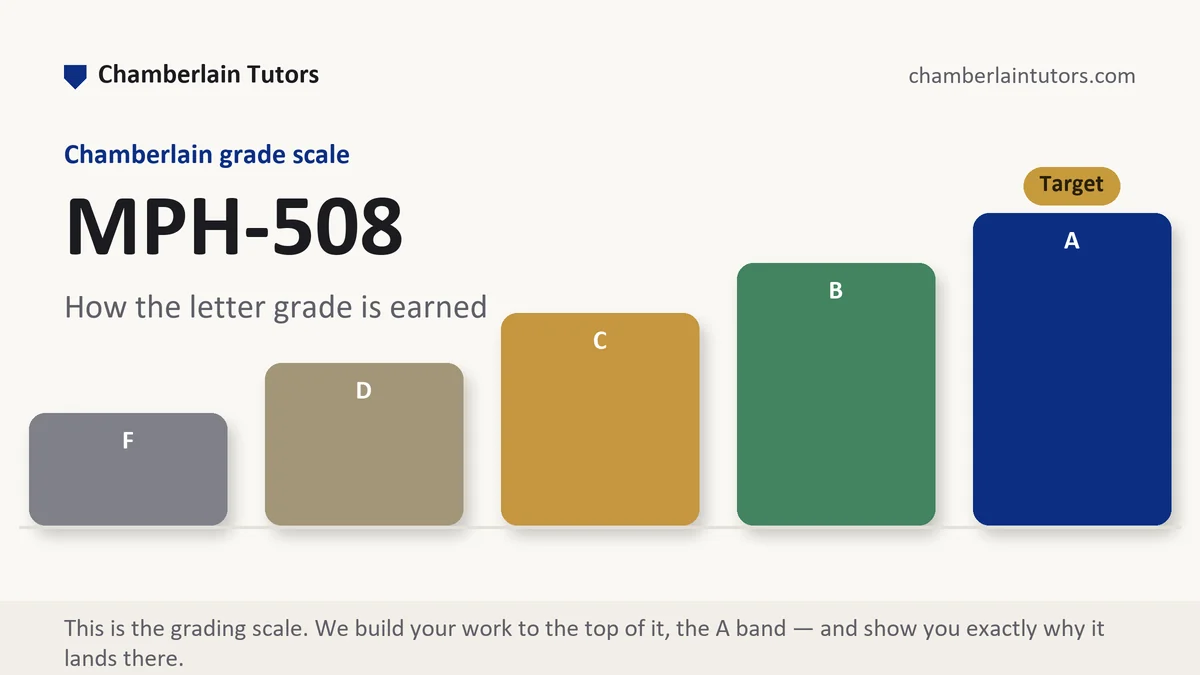
What MPH-508 actually grades
Systems thinking is the organizing idea, and it has a testable meaning here. It means treating an agency's problem as the product of a structure that keeps producing it: a workflow, an incentive, a reporting line, a funding rule, a hiring constraint. A submission that attributes a persistent problem to individual effort or attitude has answered a management question with a personnel anecdote, and the analysis rows in this course are built to notice.
The second thing the course tests is register. Administrative writing is not academic writing with a different topic. It is shorter, front loaded, and organized around a decision rather than around a thesis, and it names people and money without apology. Where the deliverable is a brief, a plan or a memo, format is a scored dimension in its own right, because a recommendation buried on page four of a document meant for a director has failed at the only job it had.
How we help in MPH-508
Our writers draft administrative work in the order a decision maker reads it: the ask first, then the situation, then the options with their tradeoffs priced, then the implementation and the measures. Structural causes are traced to the rule or process producing them, stakeholders are named with their actual interests, and the quality improvement sections carry a method rather than a slogan.
The desk runs one set of terms. An original premium draft comes back in 24 to 48 hours, targeted at the A band of the scale your section uses, through both quality passes and the floor check before it ships, and revised at no cost until the mark is right.
In MPH-508 right now?
Send the prompt, the scoring guide and the agency or scenario you are writing about. First premium sample free, inside 24 to 48 hours.
Read the guide, then decide what kind of document this is
Two questions have to be answered before drafting, and both live in the scoring guide rather than in the prompt. First, who is the reader: a governing board, an agency director, a funder, a staff team, or an academic grader standing in for one of them. Second, what is the document meant to make happen: approve a change, choose between options, adopt a plan, or understand a problem. A guide row that mentions professional format, executive summary or audience is the tell, and those rows are usually easy points that get thrown away.
Then price the rows in words. Take an administrative brief capped at 1,900 words with rows weighted 30 for the situation and systems analysis, 25 for the leadership or management framework applied, 25 for the recommendation and implementation, and 20 for measurement and quality improvement. That gives 570, 475, 475 and 380 words. Subtract 150 for the executive summary, which is written last and taken from the top of the whole budget, not from one section. The number that surprises people is the measurement allowance: nearly 400 words on how you will know it worked, in a document most students end with a paragraph of optimism.
Order the drafting to match the reading. Write the recommendation first, in one sentence, even though it will appear early in the final document and be written properly later. Everything else is either the evidence that leads there or the plan that follows from it, and a paper drafted without that sentence tends to arrive at three recommendations, none of which is defended.
The shape of an administrative brief or strategic plan
The parts below carry the deliverable regardless of what your prompt names it. The middle column is what each part has to prove to a reader who can say yes or no.
| Part | What it has to prove | How a thin version looks |
|---|---|---|
| Executive summary | The problem, the recommendation, the cost and the first step, in under 200 words, readable alone. | An introduction that promises to discuss the topic. |
| Situation, with numbers | What is happening now, measured: volume, wait, turnover, coverage, cost, error rate, whichever applies. | A description of a problem everyone agrees is bad, with no measurement. |
| Structural cause | The process, rule, incentive or reporting arrangement that keeps producing the result. | Staff described as unmotivated or resistant to change. |
| Framework applied | A named leadership, systems or improvement framework doing visible work on this situation, not summarized in the abstract. | A theory defined in one section and abandoned in the next. |
| Stakeholders and interests | Who gains, who loses, who has veto power, and what each one would say in the meeting. | A list of stakeholders with no positions attached. |
| Options with tradeoffs | At least two real alternatives, including doing nothing, each with cost, speed, risk and acceptability. | One preferred option and two straw men. |
| Recommendation | One choice, stated plainly, with the reason it beats the runner up on the criteria you set. | A recommendation that everything be considered further. |
| Implementation | Sequence, owner for each step, resources, timeline, and the decision points where the plan can be stopped. | A timeline with no owners and no stopping rule. |
| Measurement and improvement | The measures that will show whether it worked, the review cadence, and the improvement method you will apply when it does not. | A pledge to monitor progress and adjust as needed. |
Evidence craft in management writing
Administrative documents mix three kinds of evidence, and the rows that score well are the ones that keep them separate.
Keep organizational evidence separate from health evidence. Whether an intervention improves health is a question for the public health literature. Whether a management approach improves an organization is a question for the management and health services literature, which has its own designs and its own limits. Papers that support a staffing recommendation with clinical outcome studies are answering the wrong question, and reviewers notice the substitution.
Report the setting before the result. Management findings travel badly. A finding from a large integrated system may not survive the trip to a rural health department with nine staff, so write the setting, the size and the design into the sentence before the number. Fifteen words of context makes the difference between an evidence based recommendation and a borrowed enthusiasm.
Use the agency's own documents as primary sources. Strategic plans, annual reports, budget documents, accreditation materials and community health assessments are public for most agencies and carry claims that no journal article can supply: the actual mission language, the actual staffing, the actual funding streams. A brief that cites the organization it is about reads as prepared. Where you use internal information from your own workplace, describe it at the level of process rather than reproducing anything identifiable.
Date every organizational fact. Structures, budgets and leadership change, and an undated claim about how an agency is organized is a claim that may already be wrong. Where your guide sets no rule, treat organizational sources older than five years as needing either a current confirmation or an explicit historical framing, while foundational management and systems theory can stand at any age because there the age is not a defect.
What separates a pass from a strong pass here
A passing brief describes a genuine problem, cites a real framework and recommends something reasonable. What holds it in the middle band is that it never chooses. The options section presents alternatives evenly, the recommendation hedges, and the implementation section has no owners, so nothing in the document could be acted on. Across an eight week session that pattern produces an average built entirely from middling graded pieces, with nothing else available to raise it.
Strong briefs commit. They set the criteria before comparing options, so the choice looks like a method rather than a preference. They name who will object and answer the objection in the document instead of hoping the grader does not think of it. They assign a person or a role to every step, because a plan with no owner is a wish with a timeline. And they say in advance what result would make them stop, which is the sentence that separates a manager from a student writing about management.
Six mistakes that cost points in MPH-508
- Blaming people for a structural result. If a problem survives changes of staff, the cause is in the structure. Point at the process, the incentive or the rule.
- Framework as vocabulary. Naming a leadership model and then writing generically about communication earns nothing. The framework has to change what you propose, visibly.
- No option was ever rejected. A decision document with one option has skipped the analysis. Include doing nothing as a priced alternative, since that is the option that usually wins by default.
- Measurement written as monitoring. A promise to monitor is not a measure. Name the indicator, the source, the frequency and the person who reviews it.
- Academic shape for an administrative audience. A director reads the first paragraph and the headings. Putting the recommendation last is a formatting error that costs real points where the guide scores professional presentation.
- Posting a half formed position to the board. Chamberlain discussion posts lock on submission, and leadership threads invite classmates to test whether your recommendation survives a hard question. Draft outside Canvas, decide what you actually recommend, then post the one version.
Questions MPH-508 students ask
Can I write about my own workplace, and how much detail is safe?
What is the difference between the leadership section and the management section?
How do I include quality improvement without turning the paper into a project plan?
Where MPH-508 sits in Chamberlain's programs
Open the exact program map for sequence, credit, and option context. The current student schedule and syllabus remain authoritative after transfer evaluation, electives, state rules, and approved plan changes.
The weeks, one by one
The public curriculum verifies MPH-508 but does not publish its Week 1 through Week 8 Canvas assignments. Week manuals are added only from verified real deliverables; session length is never used to invent them.