MPH-503, MPH core course in the MPH path, gets the same promise as every course we cover, with the Chamberlain-specific machinery this school's rules demand.
What MPH-503 actually grades
An MPH core anchor where population-health writing takes its shape: data interpreted honestly, disparities described with precision, and public-health frameworks applied to problems that could actually be funded and run.
How we help in this course
Our public-health drafts keep the quantitative spine visible and the recommendations implementable, current surveillance and literature cited. The register transfers to the APE products later, which is the quiet reason to get it right early.
Orders run the full machinery: rubric decoded, core-versus-supplemental tagged, a program-matched writer, rubric QA then a separate APA and originality pass, the scale check, delivery inside 24 to 48 hours.
How this course's deliverables get written
Course materials at Chamberlain sit behind Canvas, so a manual keyed to week numbers would be invention rather than instruction. This one is keyed to the deliverable instead, and it holds whatever your guide happens to be asking for: how to budget a brief against its own weights, what a population health document has to establish before its recommendation is worth reading, and the rules for handling surveillance data that separate public-health writing from opinion with numbers attached. Work through it with your guide open.
In MPH-503 right now?
Send the week and the rubric from Canvas. First premium sample free, floor-checked, back in 24 to 48 hours.
Population writing with the quantitative spine showing
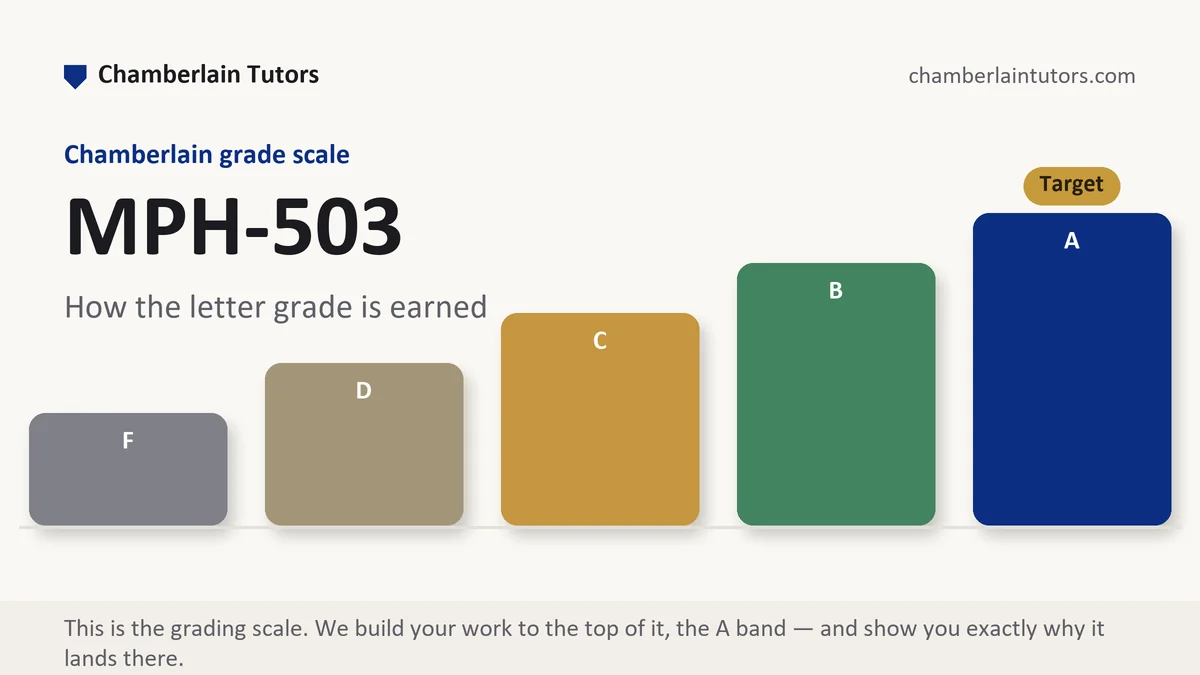
MPH-503 anchors the MPH core, and its writing standard is the discipline's: data interpreted honestly, disparities described with precision, frameworks applied to problems a health department could actually fund and run. On the MPH scale that standard is expensive, the A opens at 93 and the C band is four points wide, so vague public-health prose bleeds letter grades quickly. Our drafts keep the numbers visible in the argument, cite current surveillance and literature, and clear both QA passes before the floor check releases them.
Why the register built here pays off later
The program's documented arc runs toward the 144-hour applied practice experience, and the analytic voice this course grades is the same one the APE products will demand. Getting the register right in 503, recommendations implementable, denominators honest, frameworks applied rather than named, is quiet preparation for that later work, which is the strategic reason to take this course seriously beyond its own gradebook.
What does a scope request need for a 503 deliverable?
The prompt, the rubric, and any dataset or scenario the week supplies. The same-day reply names the analytic angle, the delivery slot inside 24 to 48 hours, and the Mountain-Time margin built in.
Is there a free way to test the public-health register?
The first premium draft is free, full deliverable with walkthrough, so the fit between our register and your section's expectations gets settled by reading, not guessing. Its walkthrough doubles as a framework-application primer you keep for the rest of the core.
Budget the brief against its own weights
Graduate public-health writing fails on proportion more often than on content. The brief runs three pages on the size of the problem, arrives at the program design exhausted, and gives the evaluation section four sentences, which is precisely backwards from what the guide is paying for. Fix it before drafting by turning the guide into an outline with a length beside each heading.
Take an illustrative split. Say the deliverable caps at 2,000 words and the guide weights burden and problem statement at 20, determinants and equity at 20, evidence and established practice at 20, program design at 25, and evaluation with metrics at 15. Remove 200 words from the top for the opening summary and the closing paragraph, which leaves 1,800 words against 100 points, or 18 words per point. Program design takes 450 words, the first three sections take 360 each, and evaluation takes 270. Those are not your numbers, so pull yours from Canvas and divide again, but keep the discipline: when a section has spent its allowance, the next sentence goes somewhere else.
One refinement matters at this level. Sections that argue need more room per point than sections that report, so if your guide bundles a heavy analytic demand into a lightly weighted row, borrow from a descriptive section rather than overrunning the total. Reviewers notice a brief that respects its own length limit; it is the first signal that the writer can work to a specification.
What a population health document must establish
Whatever the prompt is called, a 503 deliverable is asking you to make a case that a health department, a payer or a funder could act on. Each part answers a question the reader will ask whether or not the guide spells it out.
| Section | What it must establish | The reviewer's question |
|---|---|---|
| Burden and problem statement | The size and distribution of the problem in a defined population, with comparable figures | How big is this, in whom, compared with what? |
| Population defined | Boundaries, size and relevant structure of the group you are writing about | Who exactly is included, and who is not? |
| Determinants | Why the burden falls where it does, traced through conditions rather than listed as vocabulary | What produces this pattern, and at which level? |
| Evidence base | That the response you propose has been tried and studied somewhere relevant | Has this worked before, in whom, and how well? |
| Program design | Activities, staffing, setting, dose and timeline, specific enough to cost | Who does what to whom, how often, starting when? |
| Equity and feasibility | Who is reached, who is missed, and what would have to be true for this to run | Could this widen the gap it is meant to close? |
| Evaluation plan | Process measures and outcome measures kept separate, each with a data source and a horizon | What will you see at six months, and what only at five years? |
Surveillance data, cited so a reviewer cannot object
At this level the evidence rows are not asking whether you found sources. They are asking whether your numbers can be trusted next to each other.
Every figure carries a data year and a release. Surveillance publishes on a lag, and a figure from the most recent release may describe a period two or three years past. Name the collection period in the sentence, mark provisional data as provisional, and never let a reader assume a number is current because the citation is.
Describe the study before the effect. Design, setting, population and sample size come first, then what was found. A single-city natural experiment and a national cohort are both legitimate evidence and they support entirely different sentences, and the reader can only tell them apart if you say which is which.
Reserve causal language for designs that earned it. Cross-sectional and ecological data supports associated with, co-occurred with, predicted. Reduced, prevented and caused belong to designs where exposure was assigned or a credible counterfactual exists. This is the row where confident writing quietly costs the most.
No rate without its population at risk. State the numerator definition, the denominator, the geography and the time window, and say whether the figure is crude or age adjusted. Setting a crude rate from an older county beside an age-adjusted national figure is the most common self-inflicted wound in this genre, and it invalidates the comparison the whole paragraph was built on.
Say which case definition you used. Two surveillance systems counting the same condition by different criteria produce different numbers that cannot be pooled or compared. When you cross sources, name the definitions and say what the difference does to your comparison.
What a strong brief does that a passing one does not
A passing brief describes a problem with numbers attached and proposes a plausible program. It reads well enough, and it would not survive review by anyone who had to fund it.
A strong one is recognizable by five things. Its numbers are comparable to each other, adjusted the same way, drawn from the same window, counted by the same definition, so the comparisons in the argument actually hold. Its determinants section explains the pattern rather than naming categories, tracing how a specific condition produces the specific burden described two sections earlier. Its program is sized to a budget and an implementer that exist, with a dose and a schedule rather than an intention. Its equity discussion is an analysis of who the design reaches and who it structurally misses, not a paragraph asserting that equity was considered. And its evaluation separates what can move inside the project's own timeline from what cannot, which is the single clearest signal that the writer understands the difference between a program and a wish.
Where population health writing loses points
- Mixing crude and adjusted rates in one comparison. The sentence looks fine and the conclusion is unsupported, which is worse than an obvious error.
- A determinants section that is a glossary. Listing the categories proves reading; explaining how one of them produces this burden in this population proves analysis.
- A program with no owner and no money. If nobody is named to run it and no funding path is sketched, it is a topic rather than a proposal.
- Causal verbs on cross-sectional evidence. One word can cost an evidence row that the rest of the paragraph had earned outright.
- Outcome measures that cannot move in time. Promising a mortality shift from a one-year pilot tells the reviewer the evaluation was written without thinking.
- A stale figure presented as current. When the data year is far behind the publication year and you did not say so, the reader who checks stops trusting the rest.
Questions students bring to this course
How current does a surveillance figure have to be?
The data does not exist for the geography I need. What do I write?
How do I write about disparities without it reading as blame?
Where MPH-503 sits in Chamberlain's programs
Open the exact program map for sequence, credit, and option context. The current student schedule and syllabus remain authoritative after transfer evaluation, electives, state rules, and approved plan changes.
The weeks, one by one
Week 1
An advocacy course opens on the least intuitive skill in the field: turning a condition that many people dislike into a problem a government can be asked to solve. Read the full Week 1 manual.
Week 2
Law is the second word on this course's title line, and an early stage is where it stops being background and becomes the analysis itself. Read the full Week 2 manual.
Week 3
Economics sits first on the catalog list of disciplines this course draws on, and there is a reason: almost every public health proposal is decided in a room where the binding constraint is a budget line rather than a research finding. Read the full Week 3 manual.
Week 4
Ethics appears on this course's catalog line beside economics and law because public health routinely asks people to accept a restriction for someone else's benefit, and a policy that cannot justify that request has a defect no amount of effectiveness data repairs. Read the full Week 4 manual.
Week 5
Political science is on this course's catalog line, and by the middle of the session it stops being an abstraction: the stage asks who can stop your proposal, who can carry it, what each of them wants, and what you would trade. Read the full Week 5 manual.
Week 6
Communication is on this course's catalog line because analysis that nobody reads changes nothing. Read the full Week 6 manual.
Week 7
Management and technology round out the catalog list of disciplines this course draws on, and they arrive late for a good reason: the fight most advocates lose is the one that happens after the vote. Read the full Week 7 manual.
Week 8
The closing stage of an advocacy course usually does two jobs at once: it asks how anyone would know whether a policy worked, and it asks you to assemble the term's separate analyses into one document that argues a single case. Read the full Week 8 manual.