BIOS-150 Human Biology with Lab is the four credit introduction to the normal human body: biological principles, the structure and function of the major organ systems, virtual labs and case studies, with roughly 48 contact hours of lecture beside 32 of lab. That split is where the grade lives. Part of your written work explains how a system works when nothing has gone wrong; the rest reports what a simulated exercise produced and what it means. Neither one is an essay, and students who write them like essays lose marks to structure before content is read. This page is the manual for both: turning your scoring rows into a word budget, the parts a lab write-up has to carry, how citation works in a science course, and where the points leak.
What BIOS-150 actually grades
The course rewards explanation over recall. Naming the four chambers of the heart is a quiz item; saying why the chamber that pumps to the lungs has a thinner wall than the one pumping to the body is what the written work asks for. Every organ system here arrives with the same question attached: what is this built like, what does that build let it do, and what happens to the body when it does its job well.
The second graded product is the write-up that follows a virtual exercise. Simulated labs still produce data, still have a purpose and a procedure, and are marked as reports rather than worksheets. When a simulation hands you clean numbers the temptation is to skip to the conclusion, and the section a grader reads most carefully is the one where you interpret those numbers rather than repeat them.
The third is the case study, the course's way of checking that normal physiology means something outside a diagram. All of it lands inside Chamberlain's rhythm: a 16 week semester split into two 8 week sessions, as many as six starts across the year, graded work opening weekly in Canvas. Discussion posts do not reopen once they publish, so a wrong mechanism typed into a board reply stays wrong all session.
How we help in this course
We build the written layer: the lab report drafted from the observations you recorded, the case study analysis, the board post written to final quality before it publishes, and the short structure-and-function explanations that make up most of the weekly work. Send the exercise sheet and your raw numbers and the report comes back assembled, with the analysis section actually analyzing. Two things stay yours by design. We do not run your virtual lab or click through a simulation on your behalf, and we do not sit quizzes or exams.
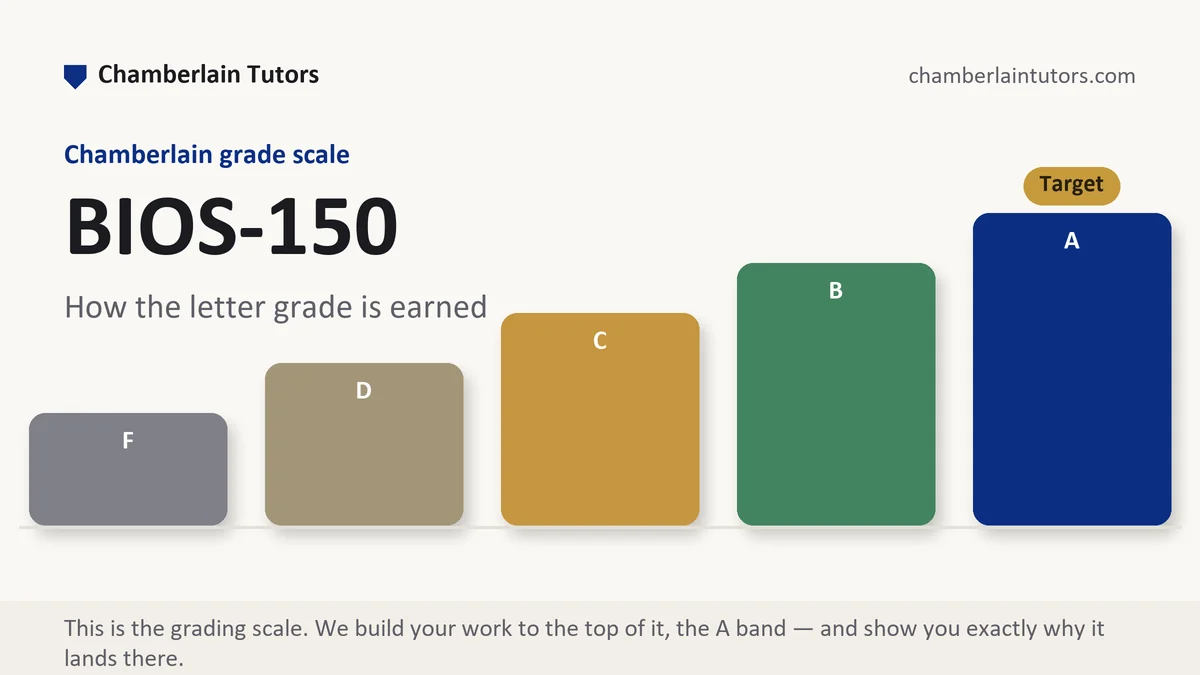
Service terms are the same everywhere on this site: a premium original draft in 24 to 48 hours, targeted at the A band of your course's actual scale, through the eight-person pipeline with two QA passes and the floor check, revised free until it lands where you need it.
In BIOS-150 right now?
Send the week and the rubric from Canvas. First premium sample free, floor-checked, back in 24 to 48 hours.
Read the scoring rows before you read the prompt
In a science course the prompt tells you the topic and the scoring guide tells you the thinking. A prompt that says describe the respiratory system could be answered fifty ways, most of them wrong for the grade. The rows narrow it: one asks for structure, one for function, one for an applied connection, one for sources and format. Open your week's rubric first, copy the rows out one per line, and reduce each to its verb. Describe, explain, compare, interpret, apply. Those verbs become your headings in the order the guide prints them, so a grader reading down the rows keeps arriving at the section they were about to look for.
Then convert weight into words, because a percentage is a depth instruction in disguise. Say your week's case study is capped at 1,200 words and the guide carries four rows worth 30, 25, 25 and 20 percent. Multiply through: roughly 360 words for the first row, 300 for the second, 300 for the third, 240 for the last. Write those figures beside your headings and hold each section to its own.
That arithmetic exposes the same imbalance every session. The structure row is the one students overrun, because anatomy is comfortable and there is always another detail to add. The applied row, worth 300 words of the same budget, gets four sentences at midnight. Anatomy that runs long is not generosity; it is words stolen from the section that would have moved your score.
Two mechanical checks before you draft. Whether the data table, figure captions and reference list count toward the limit, because if they do not, you have been trimming explanation to make room for something nobody was charging you for. And whether the guide names a format, since plenty of introductory science work is submitted as headed sections rather than flowing prose, and an unbroken essay where the rows expect headings loses a presentation row it never had to.
The shape of a lab report built from a virtual exercise
A simulated lab is still a lab, and the report carries the same seven jobs it would at a bench. A grader can tell inside a sentence or two whether each one is there.
| Section | What it has to contain | How the thin version reads |
|---|---|---|
| Purpose | The question the exercise asked, phrased so it has a measurable answer, plus what you expected before running it. | The exercise title with the word investigate in front of it. |
| Background | Only the physiology needed to make the results readable, in three or four cited sentences. | A page of textbook summary the results never refer back to. |
| Procedure | What was done, in past tense, at a detail someone could repeat, including any setting you changed. | The manual's instruction list copied out in the imperative, step numbers and all. |
| Results | Observations and numbers only, in a labelled table with units, plus one sentence pointing at what it shows. | Raw values with no units, no headings and no sentence telling the reader where to look. |
| Analysis | Why the numbers came out that way, tied to the physiology in your background, including anything that contradicted your expectation. | The results restated in prose, which is how this section usually fails. |
| Sources of error | Real limits of this exercise, such as a variable the simulation held fixed, and which direction each would push the result. | Human error, listed alone, in a lab where no human touched anything. |
| Conclusion | A direct answer to the purpose question, in two or three sentences, evidence attached. | A summary that never answers the question it opened with. |
Evidence and citation in an introductory biology course
Citation habits in a science course differ from the ones an English class rewards. Five carry most of the marks.
The lab manual and the simulation are sources. If you followed a procedure someone wrote, it has an author and belongs in the reference list, named as the exercise you ran. Students who cite three journal articles and leave the exercise uncredited have skipped the one source a grader can verify instantly.
Textbooks for mechanism, published studies for numbers. A general account of how filtration works is what a textbook is for. An average value in a healthy adult should come from the source that measured it, or a health agency that publishes reference values, not a paraphrase of a paraphrase.
Keep observation and inference in separate sentences. The reading rose from one value to another is an observation. The rise happened because a vessel narrowed is an inference. Fusing them hides the step where you could have been wrong, and science graders look for exactly that seam.
Every measurement carries a unit and every count carries a total. A number without a unit is not data, and a proportion without its denominator is decoration. Six of the eight trials produced the expected result tells a reader something that 75 percent worked does not.
Use the library and check the year. A five year window is a safe default when your guide sets none, with older work kept only when the sentence says why it still stands. Crowd-edited encyclopedias and homework answer sites are recognizable to a grader at a glance.
What separates a passing report from a strong one
A passing BIOS-150 submission is correct and complete. The parts are present, the anatomy is accurate, and it reads like a competent summary of the week, which is where most of the class sits because summarizing is what the reading trains you to do. Taken as a prerequisite inside the BSN, this course sits under the same 76 percent floor Chamberlain applies to core coursework, so check the minimum your own program posts and treat a run of high seventies as a warning rather than a pass.
Strong work differs three ways. It explains a result instead of restating it, so the analysis holds sentences that appear nowhere in the results. It commits to one mechanism rather than hedging across two, which means picking the explanation your data supports and saying what would have shown you were wrong. And it connects the system back to a whole body, so a case study ends on what a person would actually notice or do differently. None of the three asks you to read more.
Six habits that quietly cost marks here
- Writing the analysis as a second results section. If a sentence in your analysis could be moved into results without anyone noticing, it is not analysis. Analysis says why, results say what.
- Copying the procedure in the imperative. Pipette the sample is an instruction. A report says what was done, so the tense and the voice both change when the manual becomes a method section.
- Listing human error as the only limitation. In a virtual exercise it is close to meaningless. Name a real constraint of the simulation and say which way it would have moved your result.
- Describing structure and forgetting function. The rows almost always pay for both, and a beautifully detailed anatomical description with no functional consequence leaves half the marks on the table.
- Treating a board post as scratch paper. Chamberlain discussions do not reopen after they publish. Draft the post in a document, check the mechanism once, then paste.
- Leaving units off the table. A column of bare numbers costs presentation marks in every science course, and it is the easiest thing on this list to fix.